Osmo’s New Push to Master AR Edutainment
▼ Summary
– Osmo was an innovative edutainment system launched in 2014 that used a simple mirror and computer vision to blend physical play pieces with digital iPad apps.
– It was highly successful, leading to a $120 million acquisition in 2019, but shut down in 2024 after its parent company, Byju’s, collapsed.
– A small team of former employees, including Felix Hu and Ariel Zekelman, bought Osmo’s assets out of bankruptcy and are now reviving the brand.
– The founders aim to use modern AI to expand Osmo’s capabilities beyond its original, limited computer vision, allowing for more open-ended physical-digital interaction.
– They plan to pursue sustainable growth, avoiding addictive design and the hyper-growth pressures that often challenge kids’ hardware companies.
The unique magic of Osmo’s educational play system, which cleverly blends physical objects with digital feedback, is poised for a comeback. A small team of former employees has acquired the company’s intellectual property and is working to revive its beloved apps and hardware. Their mission extends beyond nostalgia; they aim to address the growing concern over children’s screen time by fostering healthier, more responsible interactions with technology through tangible play.
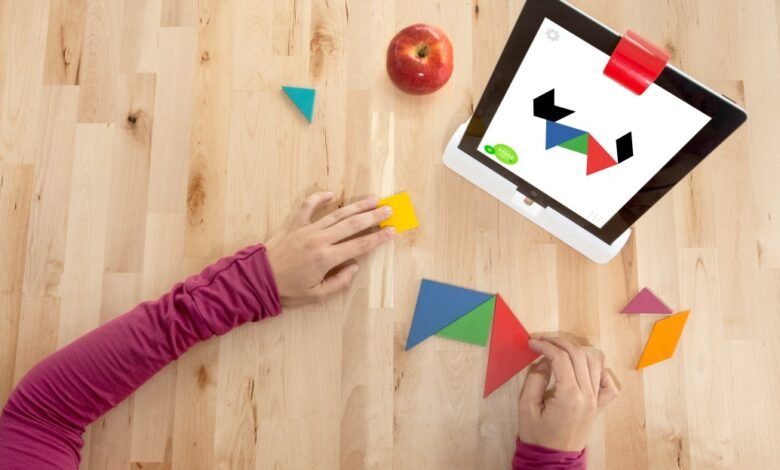
The experience of using Osmo for the first time was genuinely captivating. An iPad, positioned vertically on its stand, displayed a digital tangram puzzle. The challenge was to recreate that shape using real wooden pieces on the table. Success was met with a cheerful animation and sound from the app, unlocking the next puzzle. This seamless fusion of the digital and physical felt almost like wizardry, especially given its simplicity. The system required little more than the iPad, a custom stand, and a small mirror attachment that allowed the tablet’s camera to see the tabletop. It used basic computer vision to recognize classic playthings like wooden puzzle pieces, letter tiles, and numbers.
This innovative approach won Osmo a massive global following and led to its acquisition by the Indian edtech company Byju’s for a staggering $120 million. However, when Byju’s later collapsed amid serious fraud allegations, Osmo was dragged down with it, ceasing operations in 2024. Now, a dedicated group has purchased Osmo’s assets out of bankruptcy for just $825,000 and is quietly working to restore its legacy while planning its future.
Leading this effort are Felix Hu and Ariel Zekelman, a married couple who originally met while developing Osmo’s coding application. Becoming parents themselves has deepened their commitment to the brand’s philosophy. “Having kids just made us realize how special Osmo is and how there is nothing quite like it on the market,” Hu explains. They poured immense passion into these products and remain determined to see them succeed.
As parents, they are acutely aware that the issue Osmo initially tackled, children becoming disconnected from the physical world by screens, has only intensified. “I really want to create healthy relationships with the digital space,” Zekelman states. Her goal isn’t to keep technology away from children, but to introduce it in a more thoughtful and responsible manner. She also notes that children today interact with media very differently than they did a decade ago, necessitating a fresh approach.
While the team is currently focused on rebuilding trust with existing customers, including thousands of schools, they hint at a significant role for modern AI in Osmo’s evolution. Early technology limited the system to recognizing a small set of specific physical objects, requiring new hardware for each app. “We were limited by the technologies that were available at the time,” Hu admits. Now, with advancements like large language models, the potential is far greater. They envision a system where children can place virtually anything in front of the camera and have the software interact with it in meaningful and educational ways.
This powerful combination of digital prompts and physical manipulation is a challenging space that has attracted other companies. Amazon’s now-discontinued Glow projector shared clear inspiration with Osmo, as does the Nex Playground’s camera-based system for living rooms. Even phenomena like Pokémon Go, which uses the real world as a game board, operate on a similar principle. However, creating these hybrid experiences is far more complex than developing standard screen-bound apps, as evidenced by the short lifespan of products like Amazon’s Glow.
The revived Osmo will face its own hurdles, particularly in distribution. The original company benefited from major retail partnerships with stores like Target and Apple, arrangements that require substantial capital to secure. Hu declined to detail future distribution plans, but Zekelman emphasized a philosophy of deliberate, sustainable growth over the rapid scaling often demanded by venture capital. For products designed for children, she argues, that relentless growth model is inappropriate. “You don’t want to create these problematic play patterns,” she insists. “You don’t want to create addictive garbage.”
The founders acknowledge the road ahead will be difficult, from rebuilding brand awareness to resisting the pressures of hyper-growth. Their vision is clear: to responsibly leverage new technologies like AI not to trap children in digital worlds, but to creatively engage them with the physical one. “We have an idea of what we’re getting into,” Zekelman says. “We can’t be stupid. I think that’s it. We can’t sell out.”
(Source: The Verge)