Elephant Whiskers Have Built-In Sensing Intelligence
▼ Summary
– An elephant’s trunk is highly sensitive and dexterous, largely due to the unique structure of the whiskers lining it, which provide a form of innate “material intelligence.”
– Research into mammalian whiskers, which share similar anatomies across many species, aims to develop artificial tactile sensors for robotics and improve understanding of human touch.
– Rat whiskers are part of a complex scanning system that allows them to perform tasks like texture analysis, path finding, and object location simply by moving their whiskers.
– The sensitivity of whiskers comes from their connection to follicles containing thousands of neurons, forming a topographic map that relays detailed environmental information to the brain.
– Rats use whiskers of varying lengths to create a “frequency map” of their surroundings, as the whiskers resonate at different frequencies when they explore.
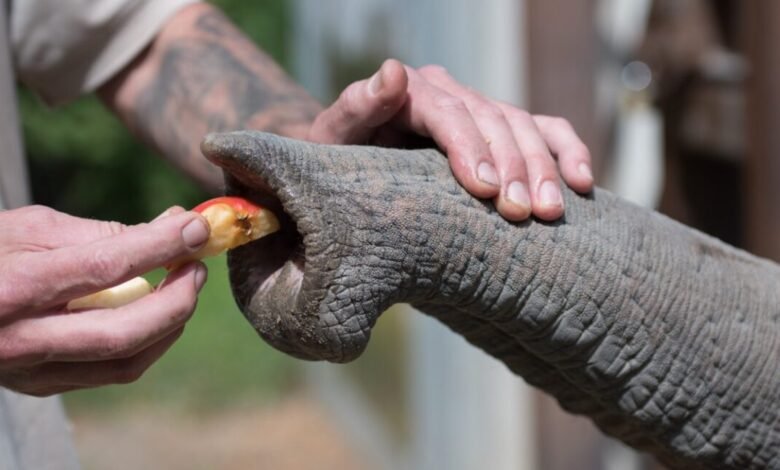
The remarkable dexterity of an elephant’s trunk, capable of both powerful lifting and delicate handling, stems from a sophisticated sensory system. Recent research reveals that the whiskers embedded within the trunk are not simple hairs but highly specialized structures, granting the animal a form of built-in “material intelligence.” This innate design allows for exceptional tactile sensitivity, enabling elephants to perform complex tasks like foraging and manipulating objects with surprising finesse.
The study of mammalian whiskers, or vibrissae, has a rich scientific history. Many animals, from common rats and cats to marine mammals like seals and manatees, possess these specialized hairs. While the basic anatomy is often similar across species, the functional applications are profound. Understanding these biological sensors could one day inform the development of advanced tactile systems for robotics and deepen our knowledge of the sense of touch itself.
Far from being simple strands, whiskers are integral components of a complex sensory network. Consider the common rat. It employs roughly thirty large whiskers alongside dozens of smaller ones as part of an active scanning system. This system allows the animal to analyze textures, navigate paths, recognize patterns, and locate objects simply by moving its whiskers across a surface. This capability transforms simple hairs into a primary tool for environmental interaction.
Structurally, the whisker hair is composed of dead keratin cells. The true source of its sensitivity lies in the follicle it grows from. Each rat whisker is anchored in a follicle connected to a neural structure called a “barrel,” which can contain up to four thousand densely packed neurons. These barrels form a detailed topographic map, sending precise information to the brain about nearby objects and their movements. Furthermore, these neural units are interconnected, creating a network that provides the rat with rich, multidimensional environmental data. Adding another layer of sophistication, rat whiskers naturally resonate at specific frequencies. The arrangement, shorter whiskers near the nose and longer ones further back, enables the animal to generate a kind of frequency map as it explores, offering yet another stream of sensory input.
(Source: Ars Technica)