Ex-Stripe Exec Lachy Groom’s Startup Builds AI Robot Brains
▼ Summary
– Physical Intelligence is a robotics company developing general-purpose robotic foundation models, described as “ChatGPT for robots,” by training AI with data collected from real-world tasks.
– The company uses inexpensive, off-the-shelf hardware (robotic arms costing around $3,500) and focuses on advanced software intelligence to perform tasks like folding clothes and peeling vegetables.
– It has raised over $1 billion at a $5.6 billion valuation from major investors without providing a clear commercialization timeline, betting that pure research will yield superior general intelligence.
– A key strategy involves “cross-embodiment learning,” aiming to transfer learned skills cheaply to any new robot platform, and it is testing systems with early partners in logistics and manufacturing.
– The company faces competition, notably from Skild AI, which pursues a different philosophy by deploying commercial models early to create a data flywheel, highlighting a major industry divide on the path to general robotic intelligence.
The quest to build a general-purpose artificial intelligence for robots is accelerating, with significant capital flowing into startups aiming to create the foundational “brains” that could power machines in homes, warehouses, and beyond. Physical Intelligence, a San Francisco-based startup co-founded by former Stripe executive Lachy Groom and researchers from UC Berkeley and Google DeepMind, is betting that a pure research focus, free from near-term commercial pressures, is the path to superior robotic cognition. Their approach centers on training versatile AI models that can learn from diverse data and transfer skills across different robotic hardware, a concept they liken to “ChatGPT, but for robots.”
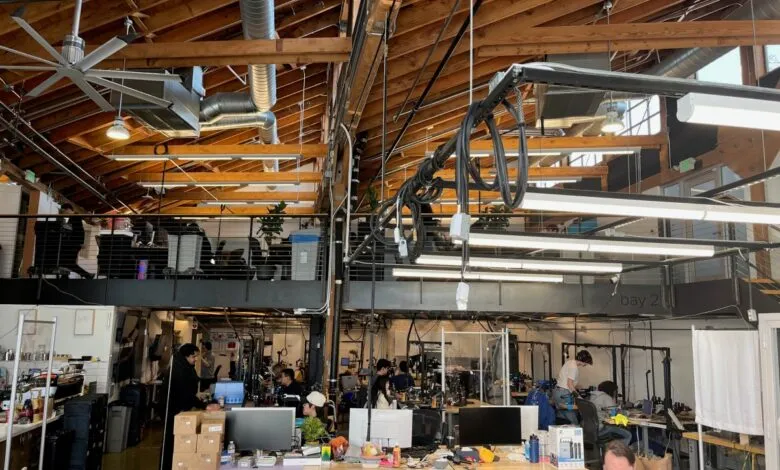
Finding the company’s headquarters requires a keen eye for a subtly colored pi symbol on a door. Inside, the space is a sprawling concrete box softened by long wooden tables. Some are cluttered with lunch remnants, Girl Scout cookies, a jar of Vegemite, while others host a mechanical ballet. Robotic arms in various states of assembly attempt mundane tasks: one struggles to fold black pants, another diligently works to turn a shirt inside out, and a third seems proficient, swiftly peeling a zucchini.
Sergey Levine, an associate professor at UC Berkeley and a co-founder, explains the scene. Each robot is part of a continuous testing loop. Data collected from these stations and from field deployments in warehouses and homes trains their general-purpose foundation models. Newly trained models return here for evaluation. The struggling pants-folder represents an experiment; the zucchini-peeler might be testing if the model can generalize its peeling skill to unfamiliar vegetables like apples or potatoes.
The environment is deliberately varied to challenge the AI. A sophisticated espresso machine sits nearby, not for employee caffeine fixes but as a training tool for robots. Any lattes produced are merely data points for the dozens of engineers focused on their screens or experiments. The hardware itself is intentionally inexpensive, off-the-shelf arms costing a few thousand dollars. The core philosophy is that advanced software intelligence can compensate for basic, affordable hardware, a notion that would have seemed improbable just a few years ago.
Lachy Groom, moving with focused energy, embodies the startup’s driven culture. His background is a blend of early entrepreneurial success in Australia and a stint as an early Stripe employee, followed by several years as a prolific angel investor in companies like Figma and Notion. He spent five years searching for the right venture before connecting with Levine, Stanford professor Chelsea Finn, and Google DeepMind researcher Karol Hausman. The alignment was immediate. “It was just one of those meetings where you walk out and it’s like, This is it,” Groom recalls.
Now two years old, Physical Intelligence has raised over $1 billion from investors including Khosla Ventures, Sequoia Capital, and Thrive Capital, reaching a valuation of $5.6 billion. Groom is quick to note the company’s burn rate isn’t exorbitant, with most capital directed toward computing power. He openly states there is “no limit to how much money we can really put to work” on compute, and under the right terms, he would raise more. Unusually, he does not provide investors with a concrete timeline for commercialization. “I don’t give investors answers on commercialization,” he says, acknowledging it’s a peculiar arrangement that backers currently tolerate.
The strategy, explains co-founder Quan Vuong, is rooted in cross-embodiment learning. The goal is to create AI models so versatile that deploying them on a new, unfamiliar robot platform requires minimal additional data collection. “The marginal cost of onboarding autonomy to a new robot platform, whatever that platform might be, it’s just a lot lower,” Vuong states. The company is already testing its systems with partners in logistics, grocery, and manufacturing, claiming some are already effective for real-world automation.
This vision is highly contested. A major competitor, Pittsburgh-based Skild AI, recently raised $1.4 billion and is pursuing a different path. It has commercially deployed its “Skild Brain” system, reporting $30 million in revenue, and argues that many so-called robotics models lack “true physical common sense” because they rely too much on internet data rather than physics-based simulation. The philosophical divide is sharp: Skild bets that commercial deployment creates a vital data flywheel, while Physical Intelligence bets that resisting near-term commercialization will yield a superior, more general intelligence.
For now, Groom describes his company’s culture with “unusual clarity.” It is researcher-driven, focused on collecting data or building hardware to support scientific needs rather than external commercial demands. The team had a 5-to-10-year research roadmap but blew through it in just 18 months. With about 80 employees, the plan is to grow slowly. The biggest challenge, Groom admits, is hardware. “Everything we do is so much harder than a software company,” he says, citing breakages, shipping delays, and complex safety protocols.
As the visit ends, the robots continue their practice, the pants still imperfect, the shirt uncooperative, the zucchini pile growing. Questions linger about the real-world desire for kitchen robots, safety, and whether this massive investment addresses problems of sufficient scale. Outsiders debate the viability of a general intelligence approach versus specific applications.
Groom exhibits no visible doubt. He is working alongside researchers who have dedicated decades to this problem and believe the moment for breakthrough has finally arrived. That conviction is enough for him. This pattern of backing visionary founders with ample capital and patience, even absent clear commercial roadmaps, is a longstanding Silicon Valley tradition. It doesn’t always succeed. But when it does, the payoff has a way of justifying all the attempts that fell short.
(Source: TechCrunch)