OpenAI’s New Tool Simplifies Coding for Science

▼ Summary
– OpenAI’s Kevin Weil predicts 2026 will be a major inflection point for AI in science, similar to AI’s impact on software engineering in 2025.
– The company states that over 1.3 million scientists worldwide now use ChatGPT for advanced topics, indicating AI is moving from curiosity to a core scientific workflow.
– OpenAI’s new product, Prism, integrates the GPT-5.2 model into a LaTeX editor to help scientists with writing, summarizing, citations, and converting diagrams or proofs.
– Independent scientists report using models like GPT-5 for coding, literature review, polishing papers, and catching errors, noting a reduction in past issues like hallucinated references.
– Prism follows the industry trend of embedding AI chatbots into everyday software, similar to tools from OpenAI, Microsoft, and Google DeepMind.
The integration of artificial intelligence into scientific research is accelerating, with new tools emerging to streamline complex workflows. OpenAI’s latest offering, Prism, aims to become an indispensable assistant for researchers by embedding its advanced AI directly into the LaTeX document editor, a coding language ubiquitous in academia for publishing papers. This move signals a strategic effort to embed AI deeply into the core processes of discovery and publication.
Industry observers note a significant shift in how scientists are adopting these technologies. “I believe 2024 will mark a turning point for AI in scientific research, mirroring the transformation we saw in software engineering,” remarked Kevin Weil, who leads OpenAI’s science initiatives. He points to internal data suggesting a massive adoption rate, with millions of weekly queries from researchers on advanced topics, indicating AI is transitioning from an experimental novelty to a fundamental component of the daily grind.
For many scientists, AI has already become a trusted collaborator. Roland Dunbrack, a biology professor, notes his primary use is for writing and debugging code. “I sometimes ask it scientific questions, hoping it can sift through literature faster than I can,” he says. “Earlier issues with fabricated references seem to have diminished considerably.” Another researcher, statistician Nikita Zhivotovskiy, finds it invaluable for polishing manuscripts, catching subtle errors, and quickly summarizing dense articles to navigate the vast scientific literature more efficiently.
Prism represents a logical evolution in this space, following the pattern of tools like OpenAI’s own Atlas for browsers and AI-enhanced office suites from major tech firms. By combining a familiar chatbot interface with specialized document software, it creates a unified workspace. The tool leverages GPT-5.2, OpenAI’s most capable model for tackling mathematical and scientific challenges, within the LaTeX environment.
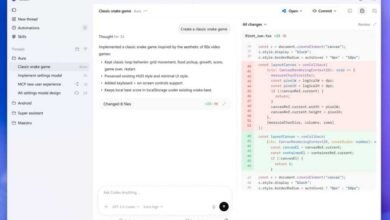
The user interface is designed for seamless interaction. A ChatGPT panel resides at the bottom of the screen, beneath the main document view. From there, researchers can request assistance with virtually any task: drafting text passages, summarizing reference material, organizing citations, or even converting handwritten whiteboard notes into precise equations and diagrams. The AI can also act as a sounding board, helping researchers talk through complex hypotheses or deconstruct the steps of a mathematical proof, all without leaving their primary writing environment.
(Source: Technology Review)