Elon Musk’s Davos Predictions: What He Foresees

▼ Summary
– Elon Musk has a history of making ambitious predictions about technologies like self-driving cars and space exploration that often fail to meet his stated timelines.
– At the World Economic Forum, Musk predicted that Tesla’s humanoid robot, Optimus, will go on sale in 2027 and eventually create an unprecedented abundance of goods and services.
– He forecast that Tesla’s robotaxis will become “very widespread” in the U.S. by the end of 2027, despite the company’s past delays in deploying autonomous vehicles.
– Musk stated that SpaceX will achieve a fully reusable Starship rocket this year, a goal that has been repeatedly delayed, to drastically reduce space travel costs.
– He predicted artificial intelligence will become smarter than any single human in 2024 or 2025 and surpass the collective intelligence of all humanity by 2035.
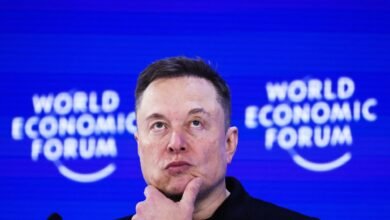
Elon Musk is a figure synonymous with immense wealth and bold technological ambition, though his record for accurate forecasting often sparks debate. While his financial success is undeniable, many of his public predictions regarding autonomous vehicles, space travel, and advanced robotics have yet to materialize as promised. During a recent, unexpected appearance at the World Economic Forum in Davos, the Tesla and SpaceX leader offered a philosophical defense of his approach, suggesting that for quality of life, it’s better to be an optimist and wrong than a pessimist and right. Given the vast influence of his ventures across automotive, aerospace, social media, and AI, even his casual remarks can send ripples through global markets. Here’s a breakdown of his latest set of prognostications.
Musk began his conversation with BlackRock CEO Larry Fink by touching on his core values and making light of extraterrestrial life. He pointed out that with thousands of satellites in orbit, not once have we had to maneuver around an alien spaceship. This led him to conclude that conscious life is likely extraordinarily rare, and humanity might very well be alone in the universe.
A central theme of his talk was the transformative potential of robotics. Musk reiterated his vision for Tesla’s Optimus humanoid robot, claiming that a future with ubiquitous, affordable AI and robotics would trigger an unprecedented economic explosion. He painted a picture of billions of AI-powered robots eventually outnumbering humans and saturating all material needs, leading to an overwhelming abundance of goods and services. However, he stated that Tesla must first begin selling the Optimus units, which he projected would start late next year.
On the topic of autonomous vehicles, Musk adjusted his timeline once more. After years of promises, Tesla launched a limited robotaxi service in Austin with safety drivers in 2025. Musk now asserts that robotaxis will be “very widespread” in the US by the end of this year. Industry observers remain skeptical, noting the company is likely focusing initial expansion on states with more lenient regulations, such as Arizona, Florida, and Nevada.
Musk also ventured into the realm of biotechnology, offering a characteristically confident take on aging. He admitted to not having studied the subject in depth but predicted that human aging is a “very solvable problem”, suggesting the underlying cause will seem obvious once discovered and challenging his Silicon Valley peers to tackle it.
Regarding SpaceX’s ambitious Starship program, Musk repeated a promise from the previous year: achieving a fully reusable rocket by year’s end. This milestone, he argued, would slash space travel costs by a factor of one hundred, eventually making space freight competitive with air freight. While SpaceX has conducted successful test flights, delivering a fully reusable vehicle within this timeframe remains a formidable challenge, given the history of missed deadlines for orbital tests and crewed Mars missions.
Finally, Musk shared his latest timeline for artificial intelligence. He reiterated his dual role as both a developer and a cautionary voice in AI, referencing his legal actions against OpenAI. At Davos, he predicted that AI will become smarter than any single human this year, or by next year at the latest. Looking further ahead, he forecast that by 2035, AI would surpass the collective intelligence of all humanity. As with many of his predictions, the accuracy hinges on definitions. Experts like Nvidia’s Jensen Huang have recently expressed doubt, suggesting that creating a generalized, god-like AI capable of everything remains a distant prospect, perhaps on a “biblical” or “galactic” timescale.
(Source: Wired)