Robot Swarm Blooms Like a Digital Garden
▼ Summary
– Princeton researchers have created a mini-robot swarm that blooms in response to light, with potential future use as dynamic, adaptive building facades.
– The design is inspired by “living architectures” like beehives and fire ant colonies, which exhibit collective behaviors as a single, adaptive unit.
– Previous research includes ant-like robots for digging tasks and studies of jackdaw flocks, showing how swarms can adapt rules for different goals.
– In contrast to adaptive natural systems, human architecture is largely static and cannot easily adjust to changing climate or occupant needs.
– Applying swarm intelligence from nature to design processes remains rare but could lead to more creative structures and better energy optimization.
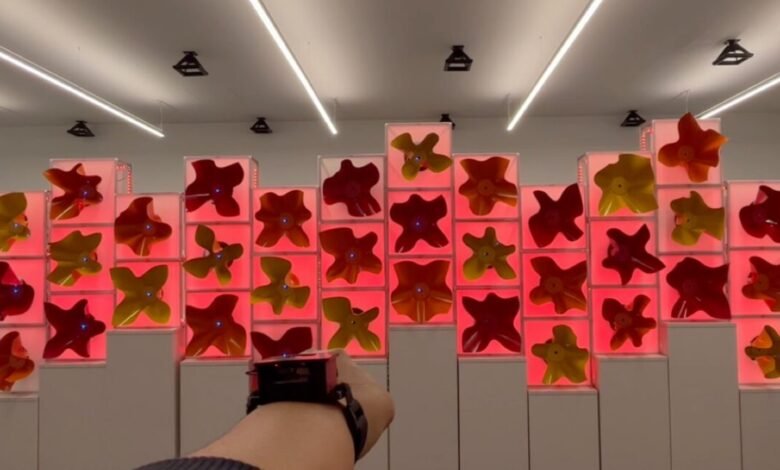
A team at Princeton University has developed a remarkable system of small, interconnected robots that can collectively open and close, much like flowers blooming, in reaction to shifting light within a room. This research, detailed in Science Robotics, points toward a future where building exteriors could become dynamic and responsive. Such adaptive facades, powered by robotic swarms, could allow structures to regulate their own climate, conserve energy, and interact with occupants in entirely new ways.
The project finds its roots in the study of “living architectures” found in nature. Consider the fire ant. When separated, these insects act independently. But when densely gathered, they behave as a cohesive material with surprising properties. Researchers have famously poured them like a fluid or watched them construct bridges and rafts. This collective intelligence allows them to manage complex tasks, like traffic flow, without ever causing a jam. Scientists are deeply interested in replicating these self-organizing systems for practical applications.
Previous efforts have explored this concept from various angles. At Georgia Tech, engineers created robot “ants” programmed to tunnel through simulated soil. A swarm capable of coordinated underground excavation could revolutionize fields like mining or search-and-rescue, where sending people is too dangerous. Another study focused on the behavior of jackdaw birds, which alter their flocking patterns based on whether they are heading home or mobbing a predator. This insight could lead to robotic teams that dynamically change their own rules to tackle different jobs as conditions demand.
The Princeton team observed that plants excel at adaptation. Individual cells communicate through mechanical and chemical signals, enabling the entire organism to grow toward sunlight or nutrients. Human-made architecture, by stark contrast, is predominantly static. Our buildings are composed of rigid, fixed components that cannot adjust to daily or seasonal environmental shifts. While there have been some attempts to use algorithms inspired by swarming insects or flocking birds in design, truly integrating this kind of distributed intelligence into physical structures remains a novel frontier. This latest work with light-responsive robot blooms is a significant step toward bridging that gap, suggesting a path to buildings that are as responsive and efficient as living things.
(Source: Ars Technica)


