Peter Drucker’s Warning: Embrace Positionless Marketing
▼ Summary
– Traditional marketing structures, designed for a slower world, create bottlenecks that prevent organizations from acting at the speed of customer behavior and real-time market shifts.
– Positionless Marketing removes these structural barriers by consolidating functions, empowering individual marketers with authority and tools to act from insight to action without handoffs.
– This transformation collapses execution cycles dramatically, as evidenced by examples where campaign launch times were reduced from weeks or days to hours or minutes.
– The approach shifts accountability from shared, task-based processes to single-owner, outcome-based execution, prioritizing effectiveness and moment-driven relevance.
– Technology, including AI and automation, serves to amplify human judgment and remove friction, enabling better and faster decisions rather than replacing strategic marketer input.
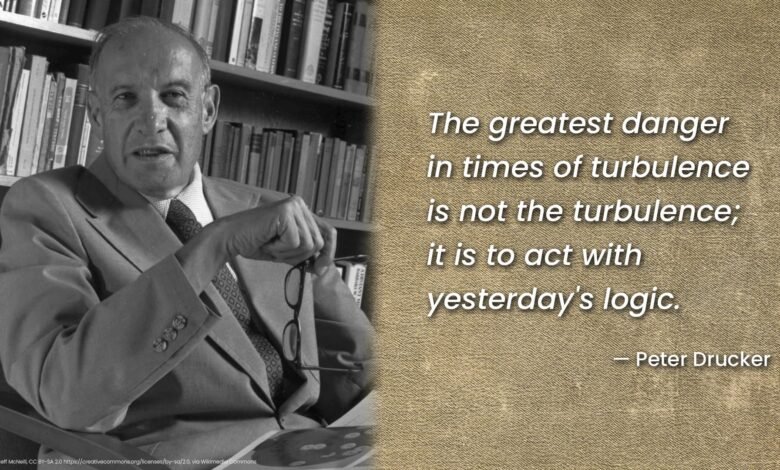
Imagine compressing a five-day workflow into just five minutes, or turning a six-week planning cycle into a single day. These aren’t just incremental gains; they represent a fundamental shift in how marketing operates. This transformation occurs when companies dismantle the rigid internal structures that prevent talented teams from moving as fast as their customers do. In today’s volatile landscape, where consumer behavior shifts in an instant, clinging to outdated organizational logic is the greatest risk a business can take. The greatest danger in times of turbulence is not the turbulence; it is to act with yesterday’s logic, a warning from management pioneer Peter Drucker that has never been more relevant for marketers.
Drucker’s core insight was that organizational structure matters more than individual capability. A brilliant team trapped in a convoluted system will inevitably underperform. Consider the experience of a major global gaming company. To launch one marketing campaign, they needed coordination across seven different teams, a process that dragged on for six weeks. The bottleneck wasn’t a lack of skill. The problem was structural: insights were siloed with analysts, creative work lived with designers, and activation depended on engineers. Every handoff between departments slowed decisions, diluted context, and caused valuable opportunities to vanish. Drucker argued that knowledge workers require both a clear purpose and the freedom to act. Positionless Marketing is the direct answer, removing those very barriers to create that essential freedom.
This philosophy moves marketing from slow, knowledge-based work to rapid, moment-based execution. A leading U.S. iGaming operator faced a critical delay, their campaign execution took five full days. In an industry where player engagement and disengagement happen in real-time, a five-day lag is an eternity. By consolidating customer data, orchestration, and execution tools into a unified system, they eliminated the handoffs that killed momentum. The result was staggering: campaign execution time plummeted from five days to five minutes, a 99% reduction. This embodies Drucker’s advocacy for decisions made close to the action, by the people with the most context. Marketers can now move directly from insight to action, bypassing approvals and cross-functional delays.
The impact extends far beyond raw speed. The shift enables a focus on outcomes rather than mere task completion. Drucker championed “management by objectives,” but many marketing departments had drifted toward simply checking boxes: build the campaign, launch the asset, measure later. For the gaming operator, adopting a Positionless approach brought this philosophy full circle. Campaign timelines collapsed from six weeks to hours. More importantly, accountability transformed. Where shared responsibility once meant no real responsibility, a single marketer now owns a campaign from conception to analysis. They build, launch, and learn from it directly. The goal is no longer just to send a message, but to drive a measurable response and create immediate value.
This pattern is repeating across sectors. Companies embracing Positionless Marketing principles are witnessing dramatic changes: multi-day cycles become near-instantaneous, large teams are streamlined to single owners, and planning shrinks from weeks to hours. Crucially, the work improves, becoming more personalized and effective. This isn’t merely a technology upgrade; it’s a structural revolution. These organizations have moved from a fragmented, assembly-line model to a system of empowered execution. They stopped organizing around internal functions like data or creative and started organizing around customer outcomes. They equipped individual marketers with the authority and integrated tools to act without waiting.
In this model, technology acts as an amplifier of human judgment, not a replacement for it. Drucker emphasized that tools should enhance wisdom, not substitute for it. Successful Positionless Marketing teams live this idea. Artificial intelligence offers predictions and automation removes friction, but the strategic judgment, the what, when, and why to engage, remains firmly with the marketer. With unified access to data and orchestration tools, marketers no longer need to wait for engineers to build segments or creative teams to deliver assets. Technology enables better decisions to be executed immediately, finally making the marketing knowledge worker truly productive.
Drucker anticipated flatter organizations and faster decisions, but even he might not have foreseen our always-on, hyper-connected world. In this environment, an insight without immediate execution is worthless, and rigid specialization creates fatal bottlenecks. Positionless Marketing is the natural evolution of his philosophy, providing marketers with what knowledge workers were always meant to have: immediate information, clear authority, and accountability for results, not just tasks. What once required a seven-team assembly line can now be owned end-to-end by one empowered professional.
The transition from theory to practice is clear. It means replacing waiting with action, turning week-long workflows into minute-long responses. It replaces cumbersome handoffs with clear ownership and swaps process-driven routines for moment-driven relevance. The pressing question for marketing leaders is no longer if they need to change, but when they will change before their competitors do. The informed knowledge worker Drucker envisioned is now, in marketing, an empowered and decisive actor. They are unconstrained by outdated structural limits. They are, fundamentally, positionless.
(Source: MarTech)