Anthropic’s Claude AI Aims to Be Your Coworking Partner
▼ Summary
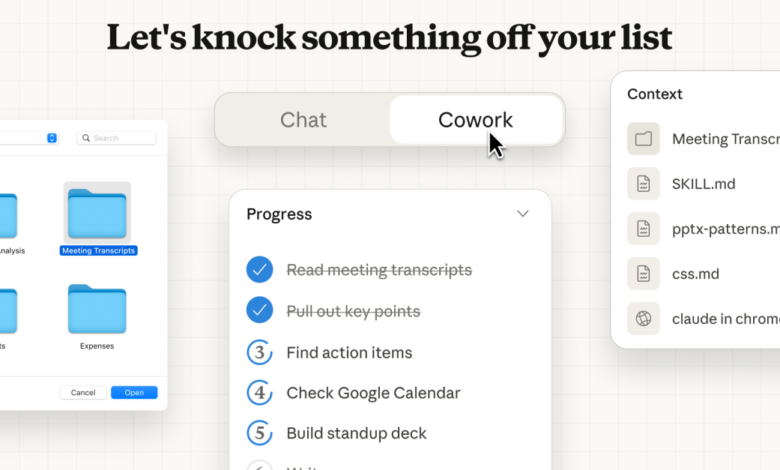
– Anthropic has launched “Claude Cowork,” a new AI agent feature that allows Claude to autonomously read, edit, and create files within a user’s designated computer folder.
– The feature is currently in a research preview, available only to Claude Max subscribers via the macOS app, costing between $100 and $200 per month.
– Claude Cowork can connect to external tools like Asana and Notion, and it allows users to queue tasks for parallel processing, reducing manual back-and-forth.
– This release is part of a broader industry push to develop practical AI agents, building on earlier capabilities like “Skills for Claude” which personalized the AI for specific tasks.
– Anthropic warns of potential safety risks, including the AI’s ability to delete files and vulnerability to prompt injection attacks that could bypass its safeguards.
Anthropic has introduced a new feature called Claude Cowork, designed to transform its AI assistant into a proactive digital partner that handles complex, multi-step tasks directly on a user’s computer. This move aims to capitalize on the popularity of Claude Code while making advanced automation accessible for everyday, non-coding activities. Currently available as a research preview, the tool is exclusive to Claude Max subscribers using the macOS app, with pricing ranging from $100 to $200 monthly based on usage levels.
The core functionality revolves around granting Claude access to a designated folder on a user’s machine. Once connected, the AI can read, edit, and generate files autonomously. Practical applications include reorganizing a cluttered downloads folder by sorting and renaming files, compiling expense data from various screenshots into a new spreadsheet, or synthesizing scattered notes into a coherent first draft of a report. Claude provides regular progress updates, allowing users to queue multiple tasks for parallel processing rather than engaging in a slow, sequential conversation.
This development represents a significant step in the race to build genuinely useful AI agents. The vision is to create an experience that feels less like issuing commands to a chatbot and more like delegating work to a colleague. Users can integrate Claude Cowork with external platforms like Asana, Notion, and PayPal through existing connectors, and link it to the Claude Chrome extension for web-based tasks. The system is designed to maintain context continuously, eliminating the need for users to repeatedly provide background information or manually reformat outputs.
The feature builds upon the foundation of “Skills for Claude,” a capability launched last October that allowed the AI to load specialized instructions and resources from folders to excel at specific job functions, such as manipulating Excel files or adhering to brand guidelines. Cowork expands this concept into a more generalized and autonomous workflow assistant.
However, Anthropic accompanies this release with a clear warning about the inherent risks of powerful AI agents. The company notes that with the ability to delete local files and execute other actions, unclear instructions could lead to potentially destructive outcomes. A significant concern is the threat of prompt injection attacks, where malicious code hidden on a webpage could hijack the model’s behavior, potentially bypassing its safety protocols to extract sensitive data or cause harm. Anthropic acknowledges that securing an AI’s real-world actions remains a major, unsolved challenge for the entire industry.
For now, Claude Max subscribers on macOS can access Claude Cowork directly through a sidebar option in the app. Users on other plans or platforms can join a waitlist for future access as Anthropic gathers feedback and continues its development.
(Source: The Verge)