Razer Unveils AMD-Backed External AI Accelerator
▼ Summary
– Razer has launched a new AI-focused hardware line, including the Forge AI Dev Workstation and a Tenstorrent external AI accelerator, expanding beyond its gaming roots.
– The Razer Forge AI Dev Workstation is a high-performance, on-premises system for developers to train and run AI models locally, avoiding cloud reliance and subscription fees.
– The workstation supports up to four professional GPUs and high-end CPUs, features extensive memory and storage, and is designed for sustained, heavy computational loads.
– The portable Tenstorrent AI accelerator connects via Thunderbolt to laptops, adding local AI compute and allowing multiple units to be daisy-chained for more power.
– This collaboration aims to make advanced AI development more accessible and portable for developers, though pricing and availability for the accelerator are not yet announced.
Razer is stepping decisively into the professional AI development space with the introduction of a powerful new workstation and a unique external accelerator. This move signals a strategic expansion beyond the company’s gaming roots, targeting developers who require serious local computational power for training and running advanced AI models without depending on cloud infrastructure.
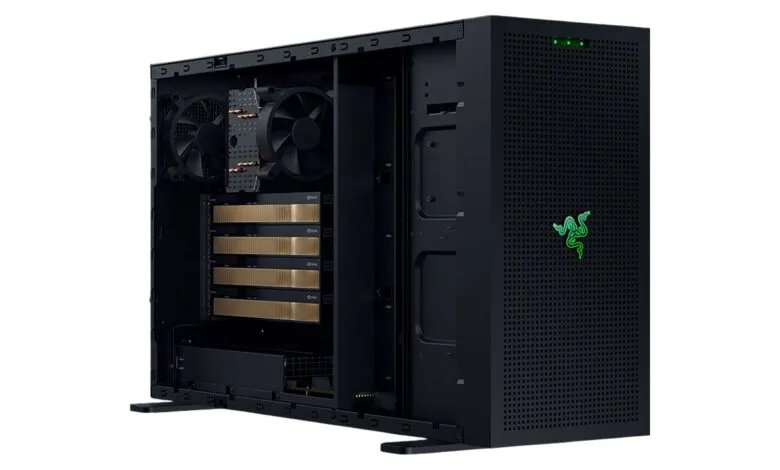
The centerpiece of this new direction is the Razer Forge AI Dev Workstation, unveiled at CES 2026. This high-performance system is engineered for demanding tasks like model training, inference, and simulation, all processed on-premises. This approach gives developers complete control over their datasets and experiments while sidestepping recurring cloud subscription costs. The workstation is built for flexibility, capable of operating as a standalone tower or integrating into rack-mounted server environments for clustered deployments.
Under the hood, the Forge workstation is designed for maximum configurability and sustained performance. It supports up to four professional-grade graphics cards from either Nvidia or AMD, enabling large pooled VRAM configurations ideal for multi-GPU workloads. For processing, users can choose between AMD Ryzen Threadripper PRO and Intel Xeon W chipsets. The system boasts eight DDR5 RDIMM slots for substantial memory capacity, dual 10Gb Ethernet ports for high-speed networking, and extensive storage options including four PCIe Gen5 NVMe drives and eight SATA bays. A robust cooling solution with multiple high-pressure fans ensures stable operation under continuous heavy loads.
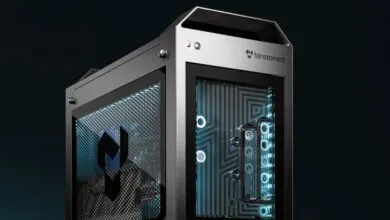
Complementing the workstation is a collaborative project with Tenstorrent, a company led by renowned chip architect Jim Keller. Together, they have created a compact external AI accelerator designed for portable development. This device connects to laptops and other compatible systems via Thunderbolt 4 or Thunderbolt 5, instantly adding dedicated local AI compute power. Based on Tenstorrent’s Wormhole architecture, it runs on the company’s open-source software stack, supporting large language models, image generation, and other AI tasks.
A key feature of this accelerator is its ability to be daisy-chained. Developers can link up to four units together, creating a small, portable cluster to handle larger or more complex models that would typically require a stationary workstation. This design philosophy emphasizes accessibility and mobility for AI development.
Christine Blizzard, Tenstorrent’s Chief Experience Officer, highlighted the partnership’s goal, stating that a plug-and-play device can unlock potential for a new generation of developers building on an open platform. Travis Furst, Head of Razer’s Notebook and Accessories Division, emphasized that the collaboration merges Tenstorrent’s acceleration technology with Razer’s expertise in high-performance engineering, delivering the power, flexibility, and mobility that edge AI developers demand.
While specific pricing and release dates for the external AI accelerator are still pending, Razer’s clear commitment is to provide developers with powerful, portable tools that bring uncompromising compute directly to their workflow.
(Source: techradar)