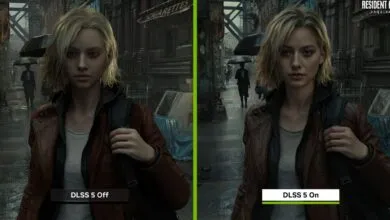
Nvidia’s DLSS 4.5 Debuts at CES: Can It Win Over Skeptics?
▼ Summary
– Nvidia announced DLSS 4.5 at CES 2026, an iterative upgrade featuring a second-generation transformer model and improvements to ghosting and temporal stability.
– A key enhancement is to the Multi Frame Generation (MFG) feature, which increases the maximum frame generation from 4x to 6x and can intelligently target a monitor’s refresh rate.
– Nvidia unveiled improvements to its GeForce Now streaming service, including a new top tier with RTX 5080-level performance and new native clients for Linux and Fire TV.
– The company introduced new G-Sync Pulsar monitors, which offer improved sharpness and smoother gameplay, targeted at esports gamers.
– High-end RTX 5000 GPU availability is a major concern for PC gamers due to a RAM crisis and soaring prices driven by high demand for AI datacenter hardware.
Nvidia’s latest showcase at CES 2026 brought a series of significant updates, headlined by the introduction of DLSS 4.5, an enhanced version of its AI-powered upscaling technology. This iterative upgrade arrives as a free enhancement for owners of the current-generation RTX 5000 series graphics cards. While not the full leap to DLSS 5, this release focuses on refining image quality and boosting performance through an improved AI model. The core advancements target common visual artifacts, promising better handling of ghosting, more accurate pixel sampling, and greater temporal stability during motion.
A major point of interest is the upgraded Multi Frame Generation (MFG) capability. This feature now supports generating up to six new frames from a single original frame, a notable jump from the previous maximum of four. In practical terms, this could enable dramatically higher frame rates. Early experiences with the 4x mode on existing hardware have shown some inconsistency, leading many users to prefer the standard 2x setting for stability. The success of this new 6x mode will heavily depend on whether the updated AI transformer model can deliver a smooth, artifact-free experience. Nvidia also states the improved MFG will intelligently target a user’s specific monitor refresh rate for optimized performance.
Alongside the DLSS news, Nvidia revealed substantial upgrades to its GeForce Now cloud gaming service. A new premium tier is set to replace the existing top offering, maintaining the $19.99 monthly price while delivering performance equivalent to a desktop RTX 5080. This tier is advertised to support streaming at up to 5K resolution and 120 frames per second, or 1080p at a blistering 360 FPS. The platform is also expanding its accessibility with new native applications for Linux and Amazon Fire TV, the latter being a clear play for living room gamers without a dedicated PC. Enhanced controller support, starting with racing wheels and flight sticks, is also in the pipeline.
The company’s display technology received attention with the announcement of G-Sync Pulsar. This new standard promises sharper image clarity and smoother gameplay compared to existing G-Sync monitors. Set to debut in select models from partners like Acer, Asus, AOC, and MSI, the first wave of displays will target the competitive gaming market. These are 27-inch panels with a 1440p resolution and a 360Hz refresh rate. Nvidia makes a bold claim about these monitors offering “1000Hz+ Perceived Motion Clarity,” a metric designed to appeal to professional esports athletes for whom every millisecond of visual feedback counts.
However, these software and service advancements exist against a challenging hardware backdrop. The benefits of DLSS 4.5 remain inaccessible to a vast number of gamers who cannot secure an RTX 5000 series GPU. A ongoing crisis in memory supply is severely impacting graphics card pricing and availability, creating a market reminiscent of the cryptocurrency mining boom. High-end cards are becoming prohibitively expensive and exceedingly difficult to find.
Nvidia itself is a key driver of this shortage. Soaring demand for powerful AI data center hardware continues to prioritize component allocation away from consumer graphics. This focus was evident throughout the CES presentation, where a substantial portion was dedicated to the RTX 5000 series’ capabilities in AI content creation and large language model performance. This strategy ensures another tremendously profitable year for the chipmaker, but it raises concerns about the company’s commitment to its traditional PC gaming audience. With GeForce Now positioned as a compelling alternative for those priced out of the hardware market, Nvidia appears to have a winning strategy regardless of which path consumers choose.
(Source: techradar)