Nvidia’s Rubin Platform: The Future of AI Computing
▼ Summary
– Nvidia unveiled its new Rubin AI supercomputing platform at CES 2026, designed to reduce the cost of building and deploying advanced AI systems.
– The platform aims to cut inference token costs by up to 10x and requires four times fewer GPUs to train certain AI models compared to its predecessor, Blackwell.
– Rubin uses an integrated design with six chips, including a Vera CPU, Rubin GPU, and specialized networking and data processing units.
– The primary goal is to accelerate mainstream AI adoption by making large-scale model deployment more practical and affordable.
– The first Rubin platforms will be available to partners like Amazon, Google, and Microsoft in the second half of 2026.
The recent unveiling of Nvidia’s Rubin platform marks a significant push to make advanced artificial intelligence more accessible by tackling one of the industry’s biggest barriers: exorbitant cost. Announced at CES 2026, this new AI supercomputing architecture is engineered specifically to lower the financial and hardware burdens of developing and running massive AI systems. By promising substantial reductions in both inference expenses and the number of required graphics processing units, Rubin aims to accelerate the mainstream adoption of complex AI models, particularly for consumer-facing applications.
The core promise of the Rubin platform is a dramatic reduction in operational costs. Nvidia claims the system can achieve up to a tenfold decrease in inference token costs. Furthermore, it reportedly requires four times fewer GPUs to train sophisticated mixture-of-experts models compared to its predecessor, the Blackwell platform. This efficiency is designed to address a critical industry pain point; as AI models grow larger and more capable, the infrastructure needed to support them becomes prohibitively expensive for many organizations. By slashing these costs, Nvidia hopes to make large-scale AI deployment a practical reality for a broader range of companies.
This leap in efficiency stems from a holistic design philosophy. Nvidia employed what it calls an “extreme codesign” approach, integrating six specialized chips into a single, cohesive supercomputer. At the heart of the system is the new Nvidia Vera CPU, an energy-efficient processor built with 88 custom cores and Arm compatibility, intended for powering large AI data centers. Working in tandem is the Nvidia Rubin GPU, which acts as the primary computational engine. It features a third-generation Transform Engine capable of delivering immense processing power for AI workloads.
The architecture is rounded out by several key components that ensure seamless, high-speed operation. An Nvidia NVLink 6 Switch facilitates ultra-fast communication between GPUs, while ConnectX-9 SuperNICs manage high-speed networking. To optimize performance, a Bluefield-4 Data Processing Unit offloads tasks from the central CPU and GPU, allowing them to concentrate fully on AI model computations. A Spectrum-6 Ethernet switch provides the necessary networking backbone for modern AI data centers.
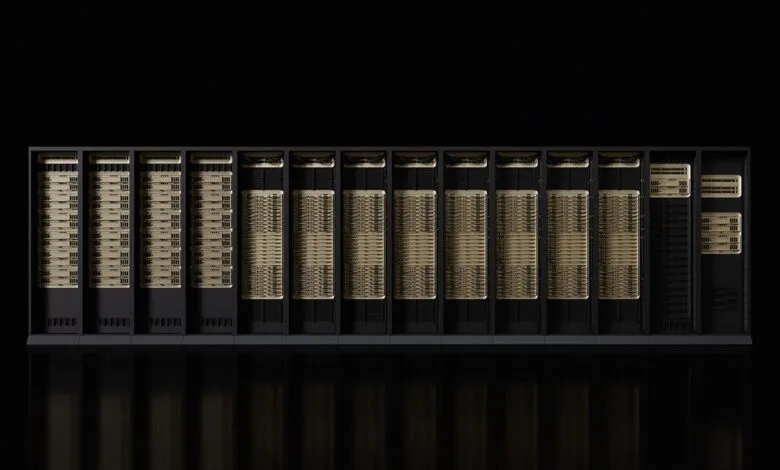
These components will be available in various configurations, such as the Nvidia Vera Rubin NVL72, which bundles 36 CPUs with 72 GPUs alongside the necessary switches and DPUs. It is important to note that these are not consumer products. The initial Rubin platforms are scheduled to reach partner companies in the second half of 2026, with cloud giants like Amazon Web Services, Google Cloud, and Microsoft expected to be among the first recipients. If successful, Nvidia’s Rubin could fundamentally change the economics of AI, enabling a new era where the scale of artificial intelligence is far more manageable and widespread.
(Source: ZDNET)