AMD Ryzen AI 400: Can These Laptops Keep AMD Ahead?
▼ Summary
– AMD is announcing its Ryzen AI 400 line of laptop chips at CES, which are the successors to the well-regarded Ryzen AI 300 series.
– The new AI 400 chips are not a major architectural leap, as they use the same core designs and core counts as their predecessors.
– The primary upgrades include slight boosts to CPU/GPU frequency, more memory bandwidth, and a faster NPU for AI tasks in the top models.
– These chips will soon compete directly with new laptop processors from Intel (Panther Lake) and Qualcomm (Snapdragon X2), all launching around the same time.
– AMD also announced two new lower-end Ryzen AI Max Plus chips, aiming to make its powerful integrated graphics more affordable.
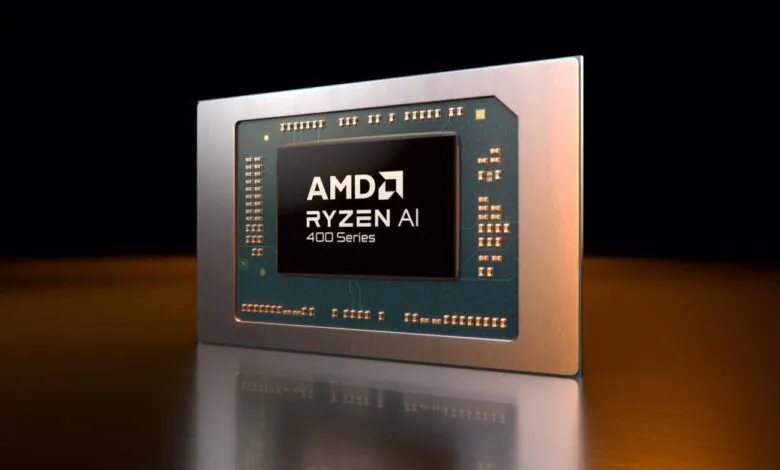
When AMD introduced its Ryzen AI 300 series processors, many were doubtful about their potential. Fast forward to today, and those chips now power some of the most impressive laptops available, striking an enviable balance between cost, raw power, and impressive battery longevity. At this year’s CES, AMD has unveiled the follow-up: the Ryzen AI 400 series, codenamed “Gorgon Point.” However, a closer look reveals this is more of a refined update than a revolutionary leap forward.
The new lineup is built on the same fundamental architecture as its predecessors. This means it utilizes identical Zen 5 and Zen 5c CPU cores and the same RDNA 3.5 graphics technology. Even the core counts remain unchanged across the board; for instance, a new 475 model still features 12 cores, 24 threads, and 16 graphics compute units, mirroring the older 375 chip.
So, what exactly is new? The upgrades are relatively modest. AMD has implemented slight increases to both CPU and GPU clock speeds, provided more memory bandwidth, and equipped the two top-tier models with a faster Neural Processing Unit (NPU) for artificial intelligence workloads. The flagship HX 475 now delivers 60 TOPS of AI performance, while the HX 470 offers 55 TOPS.
The similarities are so pronounced that AMD representatives were somewhat evasive when pressed for direct performance comparisons against the previous generation. Instead, they chose to benchmark the new chips against Intel’s current Lunar Lake processors, not the freshly announced Panther Lake lineup. Company executives did suggest that the AI 400 series is somewhat quicker, attributing gains to manufacturing refinements, firmware and software optimizations, and the aforementioned frequency and memory improvements.
Given the strong market position already established by the AI 300 chips, even incremental gains might be sufficient. The challenge will emerge later this quarter when these new AMD-powered laptops from major manufacturers like Acer, Asus, Dell, HP, and Lenovo begin shipping. They will enter a fiercely competitive landscape, going head-to-head with Intel’s new Panther Lake and Qualcomm’s latest Snapdragon X2 platforms, all slated for release in the same window.
Alongside the main Ryzen AI 400 announcement, AMD also revealed two new lower-tier chips: the Ryzen AI Max Plus series, based on the “Strix Halo” design. The goal here is to bring the company’s powerful integrated graphics to more budget-friendly devices. This could be particularly impactful for the handheld PC market, where attempts to incorporate the high-performance Strix Halo silicon have so far resulted in capable but expensive machines.
Pricing details remain scarce amid ongoing industry-wide memory supply constraints. AMD did note that systems featuring standard Ryzen AI chips can start around $499, while those with the more powerful Ryzen AI Max processors typically fall into the $1,000 to $1,500 range. As these new laptops hit shelves, the real-world performance and value they offer will determine if AMD can maintain its momentum in a rapidly evolving processor war.
(Source: The Verge)