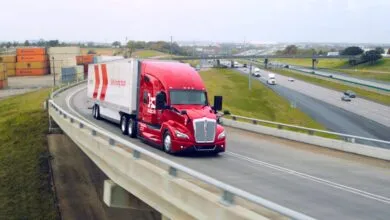
Kodiak Partners with Bosch to Scale Self-Driving Trucks
▼ Summary
– Kodiak AI is partnering with Bosch to develop a hardware and software system to equip standard semi-trucks with autonomous driving capabilities.
– Kodiak has already deployed driverless trucks commercially, making deliveries for Atlas Energy Solutions in the Permian Basin since January 2025.
– The collaboration aims to scale Kodiak’s technology by using Bosch’s production-grade hardware, which can be integrated during vehicle manufacturing or by a third-party upfitter.
– Bosch views the partnership as a growth opportunity to deepen its understanding of real-world autonomous vehicle requirements and enhance its offerings.
– No specific timeline has been provided for when the new systems developed through this partnership will go into production or become available.
The autonomous trucking company Kodiak has entered a strategic partnership with the global automotive supplier Bosch to create a scalable hardware and software package. This system is designed to equip conventional semi-trucks with self-driving capabilities, a move aimed at accelerating the broader adoption of autonomous freight technology. The announcement was made at the Consumer Electronics Show in Las Vegas, highlighting a significant step toward commercializing driverless trucking solutions.
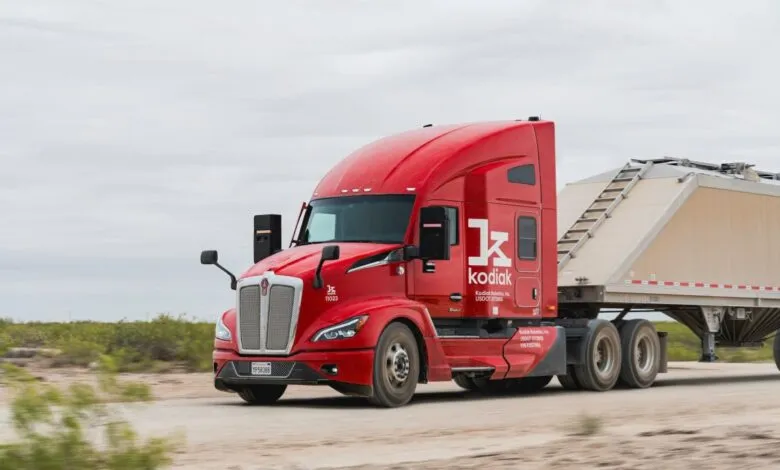
Kodiak has already proven its technology in real-world operations. The company, which focuses on autonomous systems for highway, industrial, and defense applications, has developed a comprehensive self-driving platform. This platform features redundant safety systems for critical functions like braking, steering, sensors, and computing. A major milestone was reached in early 2025 when Kodiak’s trucks began conducting completely driverless deliveries for Atlas Energy Solutions in the Permian Basin, a major oil-producing region spanning West Texas and eastern New Mexico.
As part of an initial order for one hundred trucks, Kodiak has already delivered at least eight autonomous vehicles to Atlas. These initial trucks were outfitted with the help of Roush Industries. Now, following its public listing via a merger in late 2025, Kodiak is shifting its focus toward mass scalability. The collaboration with Bosch is central to this new phase, aiming to develop redundant platforms that can transform semi-trucks from any manufacturer into autonomous vehicles.
Under the agreement, Bosch will supply a range of critical hardware components. These include various sensors and vehicle actuation technologies, such as advanced steering systems. A key advantage of this partnership is flexibility. According to Kodiak’s founder and CEO, Don Burnette, the systems can be integrated either directly on the vehicle factory production line or retrofitted later by a third-party upfitter. This modular approach is intended to meet diverse industry needs.
“We believe collaborating with Bosch will allow us to scale autonomous driving hardware with the modularity, serviceability, and system-level integration needed for commercial success,” Burnette stated. This sentiment underscores the partnership’s goal of creating a viable, widespread product rather than a limited prototype.
Bosch views the alliance as a significant opportunity within the growing autonomous mobility sector. Paul Thomas, President of Bosch in North America, emphasized the value of Kodiak’s existing commercial experience. “By supplying production-grade hardware, we are enabling the next generation of autonomous trucking alongside Kodiak,” Thomas said. He added that the cooperation provides a chance to deepen Bosch’s understanding of real-world autonomous vehicle requirements, which will help enhance its offerings for the entire ecosystem.
While both companies share a clear ambition for scaling the technology and expanding market share, a specific production timeline remains undisclosed. Neither Kodiak nor Bosch provided details on when these new integrated systems might become available for widespread use, leaving the industry to watch for further developments from this powerful partnership.
(Source: TechCrunch)