AI Content’s Future: Ensuring Trust & Provenance
▼ Summary
– AI tools act as summarizing shortcuts for knowledge, but they do not eliminate the need for primary sources and original research.
– The discussion emphasizes that provenance, or knowing the original source of information, will become essential for providing context and ensuring reliability in an AI-driven world.
– Content creators and publishers will shift from competing for audience attention to competing for trust by making their editorial standards and sourcing transparent.
– The conversation draws a parallel to photography, noting that just as photos can be manipulated, AI information has filters, and transparency about these filters builds credibility.
– The episode suggests that people have an inherent desire to delve deeper into topics, and content marketers can provide value by offering fascinating information that encourages further exploration.
The future of content creation is shifting from a battle for audience attention to a fundamental competition for trust. As artificial intelligence tools become ubiquitous summarizing devices, the value of primary sources and transparent editorial processes increases dramatically. A recent conversation between industry experts explores this pivotal change, examining how provenance and layered knowledge acquisition will define credibility in a digital landscape saturated with AI-generated material.
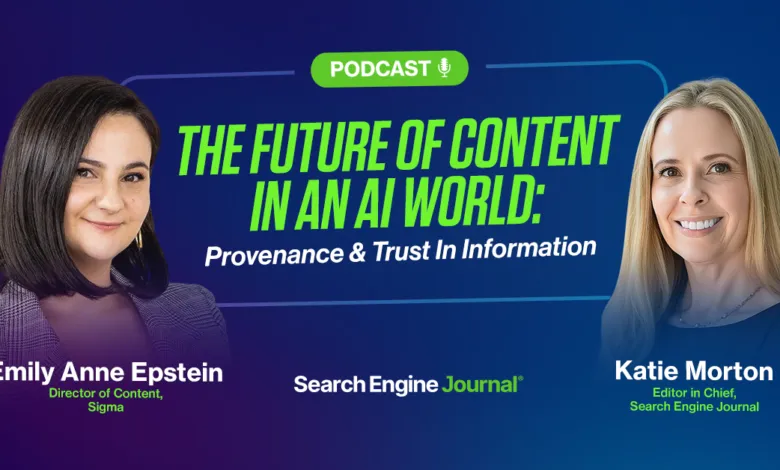
Katie Morton, Editor-in-Chief of Search Engine Journal, recently sat down with Emily Anne Epstein, Director of Content at Sigma, to discuss a thought-provoking LinkedIn post Emily authored. The central analogy of her post resonates deeply: people did not abandon books when encyclopedias arrived. This historical perspective offers a crucial lens for viewing today’s AI disruption. The emergence of tools that provide quick summaries does not eliminate our need for original, foundational sources. Instead, it creates a layered system for finding information.
Emily elaborated on this idea, noting that while many might start a search with an AI tool, they must finish elsewhere. The real value comes from platforms that organize primary sources, offer deeper analysis, and even highlight contradictions inherent in building knowledge. AI summaries often present a deceptively calm and impartial view, but all knowledge carries some bias because it cannot be all-encompassing. This reality makes understanding the origin of information, its provenance, more critical than ever.
The discussion naturally turned to how a standard of “showing the source material” can be established in an AI-assisted world. Emily emphasized that using these tools requires a societal reckoning with their reliability. She described knowledge acquisition as a form of triangulation, a practice familiar to journalists who balance various sources to arrive at a nuanced story. As AI delivers increasingly personalized responses, our individual realities fracture, making shared context difficult. Knowing where information originates provides the essential anchor for that context. Triangulation will become a vital skill for everyone, as poor information inputs lead to flawed decisions affecting work, finance, and personal life.
For content creators and publishers, this evolution signals a profound shift in strategy. The challenge is no longer just capturing eyeballs; it’s about earning confidence. When AI can repackage content as a commodity, the creator’s unique value lies in transparency. This means openly showing sources, methods, and editorial standards. Emily compared this moment to the history of photography, which transitioned from being seen as pure scientific fact to a recognized art form with its own filters and perspectives. Organizations that make their informational “filter” transparent will build lasting trust. They can position themselves as a verifiable ledger, much like a blockchain for content, where the trail of evidence is clear and auditable.
The risks of opaque AI systems are already apparent, from hallucinations where models generate false information to the rise of voice and video deepfakes. Acknowledging that we cannot broadly trust a tool unless it “shows its work” is the first step toward a healthier information ecosystem.
Encouraging audiences to seek deeper knowledge is another key component. The notion that people prefer only surface-level content is contradicted by the common experience of falling into a “Wikipedia hole,” following citation trails into ever-deeper understanding. Knowledge acquisition has an emotional component, offering dopamine hits of discovery. Content marketers and creators succeed by providing that value, making audiences feel smarter and more capable. The goal is for people to associate a brand with the genuine investment in their intellectual betterment.
Ultimately, the responsibility rests with both creators and consumers. Creators must champion transparency and depth, while consumers must adopt more critical, triangulating approaches to the information they encounter. The tools may provide shortcuts, but the enduring work of discerning truth, understanding context, and building trust remains irreplaceably human.
(Source: Search Engine Journal)