France’s ZML challenges Nvidia lock-in with free cross-chip AI software
▼ Summary
– A Paris startup, ZML, has released a free tool that runs open-source AI models efficiently across chips from Nvidia, AMD, Google, Apple, and Intel.
– The tool aims to loosen Nvidia’s dominance in AI hardware by providing a software-based alternative rather than a new chip.
– Nvidia still leads the AI hardware market, but its competitive advantages are gradually weakening.
A Paris startup is taking a different approach to challenging Nvidia’s dominance in artificial intelligence, focusing on software rather than hardware. ZML has launched a free, open-source inference server designed to run AI models efficiently across a wide range of chips, including those from Nvidia, AMD, Google, Apple, and Intel. While Nvidia remains the king of AI hardware, the barriers around its ecosystem are beginning to erode. Backed by AI-focused investors, ZML aims to give developers more freedom to choose their hardware without sacrificing performance.
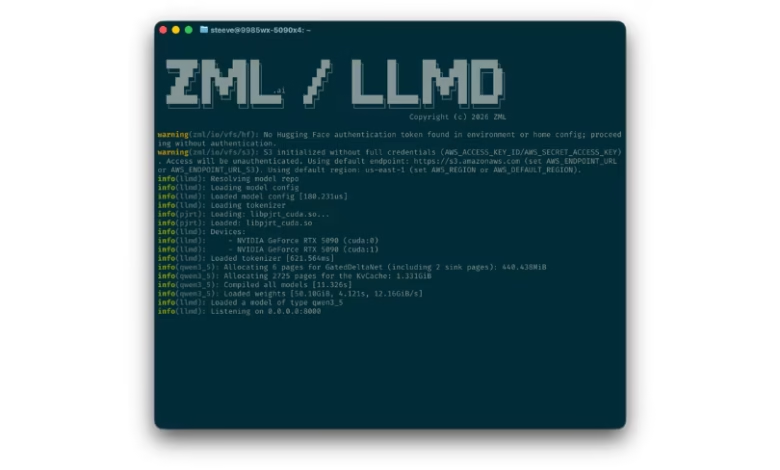
The newly released tool, called LLMD, is built to handle large language models with speed and flexibility. By enabling seamless switching between different processor architectures, it directly challenges the lock-in effect that has made Nvidia the default choice for AI workloads. ZML’s approach is notable because it does not require developers to rewrite their code for each chip; instead, it abstracts away the underlying hardware differences. This could be a game-changer for companies looking to cut costs or avoid dependency on a single supplier.
As AI adoption accelerates, the demand for cross-platform compatibility is growing. ZML’s software arrives at a time when regulators and industry leaders are increasingly concerned about Nvidia’s market power. The startup’s solution is not about beating Nvidia on raw performance, but about offering a more open and flexible alternative. By making its software free, ZML hopes to accelerate adoption and build a community around its technology.
The move reflects a broader trend in the AI industry: the push for hardware-agnostic software that allows companies to optimize for price, availability, or specific use cases. While Nvidia’s CUDA platform remains deeply entrenched, tools like ZML’s LLMD give developers a real reason to explore other options. For now, the startup is focused on proving that its software can deliver competitive speeds across different chips, and early results suggest it is on the right track.
(Source: The Next Web)