Vaughn Gittin Jr. Claims AI Wrote Negative Mustang Review
▼ Summary
– Car and Driver’s instrumented test found the RTR Spec 3 Mustang, despite having 810 horsepower, was slower in acceleration, had less grip, and required a longer stopping distance than a regular Mustang GT.
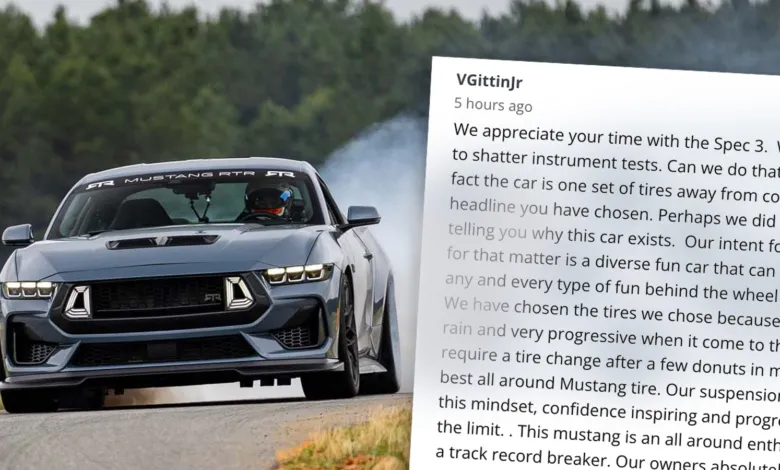
– Vaughn Gittin Jr. responded in the article’s comments, defending the car’s design for all-around driving enjoyment rather than track numbers and questioning if AI wrote the data-focused review.
– The article’s publisher, Hearst, confirmed the writer authored the piece herself, and an editor’s note strongly condemned the AI allegation as unfair and unfounded.
– The article argues that providing a car for a standard instrumented test and then criticizing the results for focusing on data is contradictory, as such tests are the publication’s norm.
– The author states that a company president accusing a journalist of using AI without evidence is an unusual and serious incident that merits reporting within the journalism community.
A recent instrumented road test of the RTR Spec 3 Mustang has sparked an unusual controversy. The review, published by Car And Driver, found that the heavily modified, 810-horsepower vehicle was outperformed in several key metrics by a standard Mustang GT, despite its nearly $110,000 price tag. The publication’s conclusion was blunt, framing the car as a champion in appearance but not in objective results. The story, however, escalated when the professional drifter and RTR founder Vaughn Gittin Jr. personally responded in the article’s comments, ultimately questioning whether artificial intelligence was responsible for the critical assessment.
Gittin Jr., posting under his own name, initially offered a reasoned defense of the Spec 3 Mustang’s philosophy. He explained that the car was engineered not for peak test-track numbers but for a versatile and confidence-inspiring driving experience, highlighting deliberate choices in suspension and tire selection for all-around enjoyment. The comment took a sharp turn in its second paragraph, where he expressed disappointment that the writer focused solely on instrumented data. “It makes me wonder if AI is doing the writing after data is output,” he wrote, casting a shadow over the article’s authorship without providing evidence.
This veiled accusation represents a serious allegation in automotive journalism. In response to inquiries, Hearst, the parent company of Car And Driver, firmly stated that the journalist, Elana Scherr, wrote the article entirely on her own. The publication’s editorial approach is famously data-centric, making a focus on performance figures standard practice, not an anomaly. A separate, more corporate response from an official RTR account later echoed Gittin Jr.’s core message about building a connected driving experience, but notably omitted any suggestion about AI.
The core of the review’s criticism was the performance figures for the money. The test data showed the supercharged RTR was slower to 60 mph and in the quarter-mile, required a longer stopping distance, and generated less skidpad grip than the less expensive stock GT. The article also noted potential durability concerns, like a clutch susceptible to failure during aggressive use. These observations fall squarely within the norms of objective automotive criticism.
Industry precedent suggests that manufacturers generally accept fair evaluations, understanding that a loan vehicle for testing is subject to professional assessment. The reaction from RTR’s principal is therefore seen as an outlier. While the review may not deter dedicated enthusiasts drawn to the car’s aesthetics and supercharged power from a roll, the decision by a company president to publicly question a journalist’s integrity without proof is a notable departure from standard practice. It underscores the tension between a builder’s subjective vision for driver engagement and a publication’s objective measurement of performance value.
(Source: Theautopian.com)