Why Most Original Data Goes Uncited
▼ Summary
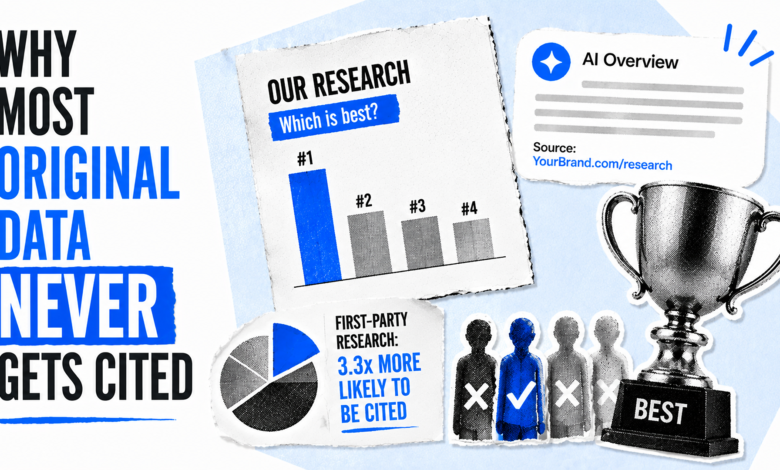
– Only 2.7% of cited pages in the dataset contained primary research, yet those pages earned 8.4% of all citations, making them 3.3 times more citation-dense than non-primary pages.
– AI strongly rewards first-party data when it is packaged as a benchmark that directly answers a commercial comparison question, such as “which is best” on measurable specs.
– The majority of primary-research citations came from cloud data warehouse benchmarks, with Fivetran’s benchmark alone accounting for 44 of 90 citations in this category.
– Content that wins citations features a stable URL, clear methodology, named comparisons, and results answering a buyer question directly, not just raw data buried in narrative.
– A citation-ready research page should lead with the comparison result, box the methodology, explicitly frame it as a comparison, and keep a stable, unmoved URL to ensure citations compound over time.
When it comes to earning citations from AI systems, publishing original data is only half the battle. A deeper look into citation patterns reveals that first-party research is rare but disproportionately rewarded. In an analysis of 301 cited URLs from Gauge’s dataset, only 8 pages qualified as primary research, yet those 8 pages accounted for 8.4% of all citations. That’s a 3.3x higher citation density compared to non-primary content. The key takeaway? AI doesn’t simply reward “original data” across the board. It rewards benchmark-driven comparisons that answer a specific buyer question: which option is best?
The data shows that 75 of the 90 primary-research citations came from a single cluster: cloud data warehouse benchmarks. Fivetran’s warehouse benchmark alone earned 44 citations, nearly half of all primary-research citations in the set. This pattern holds true in other verticals like crypto and Solana, where staking and MEV questions require first-hand ecosystem data. But in topics without a clear benchmark, such as B2B SaaS or Education, first-party research barely registers. The win isn’t “we published original data.” It’s “we published a benchmark that answers a buying comparison.”
What makes a page citable? Fivetran’s benchmark page from 2022 is a masterclass. It answers a measurable comparison head-on, naming major players like BigQuery, Redshift, Snowflake, and Databricks, ranked on speed and cost. It’s entity-rich, uses real first-party data from actual customer usage, and walks through the methodology step by step. The structure is designed to be lifted by AI, with descriptive headings like “Results” and “Why are our results different from previous benchmarks?” It links to raw data and sources, shows dated correction notes, and has a stable URL that never moved. This level of transparency and craft is what earns citations years later.
The opportunity is clear: publish a retrievable dataset for a buyer question where AI currently has no clean benchmark source. But the data alone isn’t enough. Many brands lose citations by burying numbers in narrative, gating them behind forms, moving the URL, or skipping methodology. A citation-ready research page must lead with the comparison result in the first 30% of the page, box the methodology clearly, frame it explicitly as a comparison with a table of named options, and keep the URL stable. Of 365 cited URLs in the dataset, 64 were dead or broken, taking 203 citations down with them.
This is the work behind a citable benchmark, and it’s more involved than it looks. As HockeyStack documented in their playbook, the process requires listing the data points you need, having a teammate pull them with SQL, defining and documenting the method so numbers hold up to scrutiny, and structuring the report around a real ICP question. Methodology is non-negotiable because without it, someone will always dispute your data.
With AI analysis, the data is the easy part now. Building the content into something that is citable, demonstrates E-E-A-T, and is still earning visibility four years out for commercial queries is where the hard work lies. Brands sitting on proprietary product, usage, or pricing data who package it into a comparison a buyer can act on will win. Those who bury original numbers in narrative or on unstable pages will lose. The open door exists, and in many verticals, nobody has walked through it with a real dataset.
(Source: Search Engine Land)