Turn SEO Reports into Actionable Insights
▼ Summary
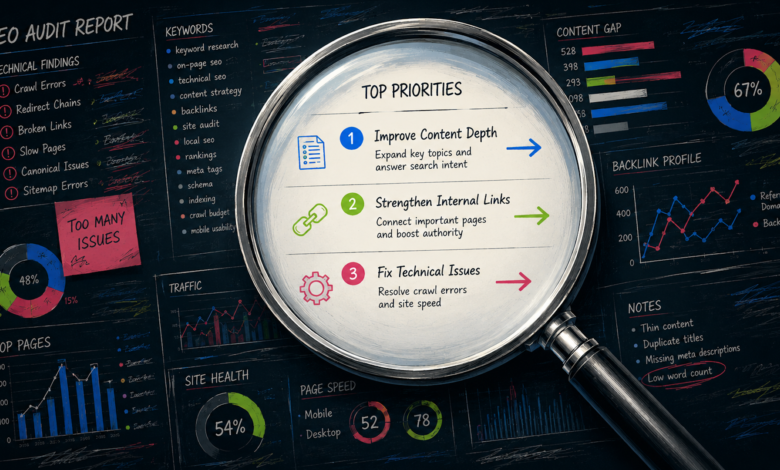
– SEO reports lose impact when findings are too generic, recommendations are not actionable, and priorities are unclear, leaving stakeholders without a clear next step.
– A strong report should focus on conclusions and priorities rather than raw data, explaining what matters now, why it matters to the business, and what should happen next.
– Common failures include broad takeaways that apply to any site, recommendations that lack execution details, and a list of priorities without sequencing by impact and effort.
– Reports must be tailored to each stakeholder (e.g., CEO, developer, content team), translating findings into their specific context for decisions and action.
– Every finding should answer three questions: what was found, why it matters, and what should happen next, with tool screenshots and generic advice cut if they don’t support decision-making.
SEO reports frequently contain solid research, including keyword data, technical findings, competitor insights, content gaps, and recommendations. The trouble begins when stakeholders finish reading and still have no clear idea what should happen next.
For instance, a report might state that internal linking needs improvement, but it fails to specify which pages should be linked, who should make the changes, when the work should occur, or what results to expect. It might also flag a crawl issue, yet never clarify whether fixing it is more urgent than addressing the content gaps or commercial page deficiencies already blocking growth.
This is the moment when many SEO reports lose their impact. The analysis might be accurate, but the decisions and action plan remain fuzzy.
A powerful SEO report should help readers grasp what matters right now, why it matters to the business, and what should happen next. It should minimize the need for another round of interpretation before work can begin.
Research is useful, but it is not the final output
Keyword research, SERP analysis, technical crawls, competitor reviews, and content audits are all essential SEO activities. They uncover gaps, risks, and opportunities that would otherwise remain hidden.
However, those inputs should not dominate the final report.
Stakeholders do not need to see every export, screenshot, or crawl detail. They need the conclusions that emerge from the research. They need to understand which findings matter, which improvements can wait, and which actions deserve priority.
For example, a crawl might identify 300 pages with missing meta descriptions. That finding is only useful if the report explains whether those pages are important. Missing descriptions on low-value archive pages may not warrant immediate attention. Missing descriptions on high-intent service pages with strong impressions, however, may be worth fixing quickly.
The same logic applies to keyword gaps. A list of 200 missed keywords is less valuable than identifying the five opportunities that align with commercial intent, existing authority, and realistic execution capacity.
A useful SEO report shows the work behind a recommendation only when it helps stakeholders understand why it deserves priority.
Where SEO reports lose stakeholders
Most SEO reports lose momentum when the findings are too generic, the recommendations are not actionable, or the priorities are unclear. The following are among the most common reasons reports fail to drive action.
The takeaway could apply to any website
Many SEO reports lose impact when the main takeaways are too broad.
Phrases like “improve content quality,” “strengthen internal linking,” and “target high-intent keywords” may be correct, but they do not tell the reader anything specific about their site compared to others. These recommendations are too broad because they could apply to almost any website.
A stronger takeaway explains what is different about the website, the market, or the opportunity.
For example:
Weak: “Create more bottom-funnel content.”
Strong: “Competitors are winning comparison and pricing-intent queries, while your site mostly ranks for educational searches. The next content priority should be three comparison pages that connect to existing high-traffic guides.”
The second version gives stakeholders a clearer reason to act. It explains the gap, the business relevance, and the first move.
The recommendation stops before the work begins
A recommendation can sound useful but still be difficult to execute.
“Improve internal linking to commercial pages” is a common example. It identifies the right area but leaves too many open questions:
Which pages should link?
Which commercial pages matter most?
Who updates the copy?
When should it be done?
How will impact be measured?
A more useful recommendation would look like this:
“Week 1: Map the top 10 informational pages by organic clicks to the three commercial pages with the highest lead value. Week 2: Add contextual links using descriptive anchor text. SEO owns the mapping and QA. Content owns the copy updates. Review impact after four to six weeks through crawl depth, impressions, and ranking movement.”
That level of detail helps work begin without another strategy meeting.
Priorities are listed, not sequenced
Many reports list 15 or 20 recommendations at the same level of importance. This creates confusion because stakeholders cannot tell what should happen now, what comes next, and what can wait.
Priority should account for impact, effort, dependency, and timing.
For example, while fixing broken links might be easy, it may not be the highest-impact task. Consolidating cannibalized pages may take longer, but it could create more commercial value if those pages are competing for the same high-intent queries.
A useful report explains the order of operations. It shows which actions create momentum first, which actions depend on other teams, and which improvements should be treated as later-stage work.
Tool outputs are mistaken for strategy
Automated audits can surface useful issues, but they lack business context.
A tool can flag missing schema, duplicate titles, slow pages, and broken links. However, it cannot reliably determine which issue matters most for a specific business at a specific moment.
For example, a tool may flag site speed as a critical issue. But if competitors in the niche are equally slow and the bigger gap is weak commercial content coverage, site speed may not deserve top priority.
Tools identify potential issues. SEO judgment determines which issues deserve action.
Tailor reports to the stakeholder
A common reason SEO reports fail to drive action is that they treat every stakeholder the same.
The same finding may need to be explained differently depending on who has to act on it. A CEO, a marketing lead, a developer, and a content manager do not need the same level of detail. They need the same truth translated into the context of their decisions.
For a CEO or founder, the report should focus on business opportunity, risk, resource needs, and expected impact.
Example: “The site is losing visibility in commercial comparison searches where competitors are capturing high-intent demand. The top priority is building three comparison pages and linking them from existing high-traffic informational content. The pages can be published within four to six weeks, with early visibility signals reviewed after indexing.”
For a marketing lead, the report should connect SEO work to demand generation, campaigns, and content direction.
Example: “The blog attracts early-stage visitors, but these pages do not support product discovery. The next step is adding commercial pathways from the top informational pages into product, demo, or comparison content.”
For a developer or product team, the report should remove ambiguity from the technical requirement.
Example: “Update canonical tags on these 12 filtered category URLs to point to the main category page. Acceptance check: The canonical target returns 200, is indexable, and appears consistently in rendered HTML.”
For a content team, the report should make page-level action clear.
Example: “Update this guide to include a comparison section, add two internal links to commercial pages, and answer the pricing-related query that competitors cover but the page currently misses.”
A strong SEO report presents the findings in a way that each stakeholder can act on.
What a decision-ready SEO report should show
A useful SEO report should clearly answer a small number of questions. These questions may vary by stakeholder, but the underlying purpose stays the same: helping people decide what to do next.
Start with the opportunity
Where can SEO create business value? This could be a topic cluster where competitors are weak, a set of underperforming commercial pages, or an existing content asset that attracts demand but does not support conversion.
Identify the main constraint
Is growth blocked by crawlability? Content depth? Competitor dominance? Something structural in how the site maps to buyer intent?
The answer shapes everything that follows.
For example, a B2B site may have strong informational rankings but weak visibility for comparison queries. In that case, the problem is not simply a content gap. It is a missing bridge between educational demand and commercial intent.
Define the first move
The report should explain which action deserves priority and why it should happen before other work. This is where impact, effort, dependency, and timing matter.
For example, instead of saying “create a buyer guide,” the report should specify which guide to create, which SERP pattern justifies it, which existing pages should link to it, who owns the draft, when it should go live, and what signals should be reviewed after launch.
Establish how progress will be measured
Early signals may include indexing, crawl depth, impressions, or ranking movement. Later signals may include qualified traffic, demo requests, assisted conversions, or pipeline influence.
Turn every finding into a clear next step
Every important finding in an SEO report should answer three simple questions:
What did we find?
Why does it matter?
What should happen next?
This helps prevent findings from sitting in the report as observations with no clear path forward.
Consider a report that identifies five high-traffic informational pages with no links to relevant commercial pages. That is a useful finding, but without interpretation, stakeholders only know what exists. They do not know why it matters or what action it should trigger. The site is already winning organic visibility, but the journey from education to action is weak.
The next step should be specific.
Example: “Add contextual links from those five informational pages to the two most relevant commercial destinations. Content owns the updates. SEO reviews the mapping and anchor text. Measure changes in crawl depth, impressions, clicks, and assisted conversions after four to six weeks.”
This turns a finding into work that can be assigned, implemented, and reviewed.
If a finding cannot be connected to a next step, it may belong in a supporting document rather than the main report.
What to cut from SEO reports
SEO reports often become clearer when they remove material that does not help the reader make a decision.
Tool screenshots are a common example. A screenshot can support a point when it shows a clear pattern, but adding screenshots for every issue usually makes the report harder to read.
The same applies to large keyword exports, crawl tables, and raw audit scores. These details are useful as supporting material, but they should not dominate the main report.
Generic best-practice advice should also be removed or rewritten. “Add schema,” “improve page speed,” and “optimize title tags” only help when the report explains why those actions matter for this site right now.
Long methodology sections can usually be shortened. Methodology matters when trust, reproducibility, or stakeholder education is needed. But most senior stakeholders do not need to see the entire research process. They need the conclusion that came from it.
Before adding something to the main report, ask whether it helps the reader understand the priority or take the next step. If it does not, it is likely better placed in an appendix or supporting document.
The best SEO reports make the next step obvious
SEO reporting should reduce uncertainty. After reading a report, stakeholders should understand what matters most and what work should move forward.
That does not mean every recommendation needs to come with a perfect forecast. SEO rarely works with that level of certainty. But each recommendation should explain the expected direction of impact and the signals that will be used to evaluate progress.
A useful report connects research to decisions. It shows the business context behind the finding, the rationale for prioritizing the recommendation, and the practical path to execution.
When reports stop at analysis, they create more work for the readers. When reports translate analysis into action, they help teams move faster.
The strongest SEO reports leave stakeholders with a clear priority, a practical next step, and a way to judge whether the work is moving in the right direction.
(Source: Search Engine Land)