How ‘It’s Just SEO’ Took Over the GEO Conversation
▼ Summary
– The search industry’s debate over whether Generative Engine Optimization (GEO) is “just SEO” is harming itself, as it constrains a major commercial opportunity and distracts from the real changes in search.
– The dominant meme “it’s just SEO” spread because it is short, repeatable, and protects existing hierarchies, while the “GEO grifter” meme further discouraged curiosity and experimentation.
– Marketers outside the SEO echo chamber already use generative AI daily and see the interface changing, but the industry’s internal debates risk causing clients to defer budgets to paid channels.
– The B2B Institute argues GEO is “the new wave of SEO,” emphasizing that brands need mental and physical availability across all buying environments, not just traditional search.
– A name like GEO is commercially necessary to create a legible category with its own budget, team, and targets; killing the name shrinks the market for organic search visibility.
Search has pulled off a strange paradox. Just as it should be gaining more strategic weight and budget relevance for clients, a sizable chunk of the industry has decided to argue its way into irrelevance. The real fight isn’t about tactics or technology. It’s about ownership.
Who gets to define what search becomes next? Who claims the budget? Who explains what happens when search stops being a list of blue links and turns into a machine that recommends answers, brands, and actions?
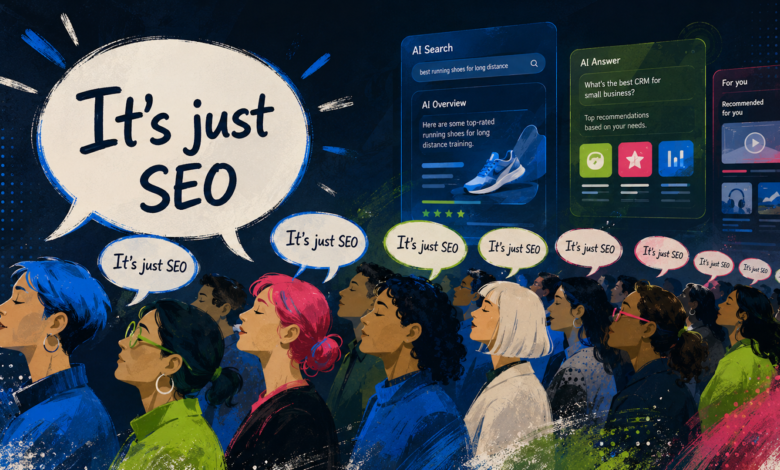
“It’s just SEO” has inflicted real damage. It sounds measured and experienced, the kind of thing a veteran would say to calm a panicked room. But it isn’t strategy. It’s a meme that is actively constraining one of the biggest commercial opportunities the search industry has seen in years.
Why Memes Matter to Search
Meme theory isn’t new. Richard Dawkins introduced the term in The Selfish Gene back in 1976, arguing that ideas spread through culture like genes through a population. They replicate, mutate, and compete. The winners aren’t the most accurate. They are the easiest to copy.
Susan Blackmore expanded this in The Meme Machine, suggesting humans are essentially meme machines built to imitate and transmit cultural information. The stickiest ideas win, not the truest ones. Think about “Happy Birthday to You.” The melody is instantly memorable. The lyrics require no skill. The social context gives everyone a reason to join in. No one actively preserves it. It just keeps winning the competition for space in our brains.
“Jingle Bells” works the same way. It has no guardian. It spreads because copying it costs nothing and signals belonging. Slogans, rumors, and professional clichés travel the same path. They survive not because they are correct, but because they are easy to repeat, socially useful, and emotionally charged. Accuracy is irrelevant to the selection process. SEO and GEO have a serious memetic problem.
How ‘It’s Just SEO’ Became the Dominant Meme
When GEO entered the conversation, the reaction was immediate. Some saw a fundamentally different interface: AI systems summarizing, recommending, and generating answers in ways that classic search results never did. They saw a need for new tools, workflows, and thinking.
Others saw a threat. For much of the SEO influencer community, the response was containment. “It’s just SEO” became the line, then the chant, then the weapon. The phrase was perfect meme material: short, repeatable, and certain without requiring investigation. It also protected status. If GEO is just SEO, the existing hierarchy stays intact. The same speakers keep the spotlight. The same agencies keep the same budgets.
Then came the uglier meme: “GEO grifter.” That one did even more damage. It didn’t just question the term. It framed anyone using it as suspect. It turned curiosity into suspicion and experimentation into opportunism. This is how professional consensus forms online: visible people repeat a simple framing, algorithms reward it, and repetition starts to look like agreement. And this is where the search industry started harming itself.
Clients Buy Certainty, Not Acronym Wars
Marketers outside the SEO echo chamber are already ahead of many specialists. They see the interface changing because they use generative systems every day. I’ve seen it firsthand. At BrightonSEO and other recent conferences, I asked a simple question: Who here is using AI to make decisions, solve problems, or get work done? The hands went up. Not a few. All of them. Hundreds of people gave the same answer without needing a 30-post LinkedIn argument about terminology.
When marketers are already changing how they search and work, the industry doesn’t get to insist nothing has changed. Clients don’t buy theological disputes. They buy certainty. SEO has never been an easy channel to sell. Many companies have been burned by vague retainers and vanity metrics. At the same time, good SEOs have built companies and created revenue. Both things are true, which is why this argument is so dangerous. If the industry can’t explain what changed, buyers will defer. They’ll move budget into paid search or whatever ad unit Google or OpenAI sells them next.
The B2B Institute Already Called This
LinkedIn’s B2B Institute and the Ehrenberg-Bass Institute make this clear in their report, “Easy to find: Being where B2B buying happens.” The argument isn’t about acronym point-scoring. It’s about mental and physical availability. B2B brands grow by being easy to think of, find, and buy. The report explicitly describes GEO as “the new wave of SEO” and states that generative engine optimization rewards foundational brand-building: authority, relevance, thought leadership, and earned mentions. The marketing scientists aren’t saying “write more keyword articles.” They’re saying discoverability is changing, but the fundamentals remain. Be easy to think of and easy to find. This isn’t a choice between SEO and GEO. It’s a physical availability problem in a new environment.
The 9 a.m. to 5 p.m. Test
“It’s just SEO” collapses too much into one bucket. SEO already means different things to different people: technical hygiene, content production, digital PR, ecommerce feeds, or local search. So when someone says GEO is “just SEO,” the obvious question is: Which SEO, exactly? What are you doing today to increase the likelihood that a generative system recommends your brand? What are you measuring? What sources are you influencing? What third-party evidence are you earning? If the answer is “helpful content,” we’re in trouble. Helpful content isn’t a strategy. It’s a phrase so vague it means everything and nothing. Brands need extractable, repeated, credible information about the problems they solve. That’s why GEO is closer to digital PR and brand strategy than many want to admit.
No Name, No Budget
Markets don’t fund things they can’t name. A name isn’t decoration. It’s a buying mechanism. It’s how a nervous CMO turns a vague threat into a line item. If GEO is “just SEO,” it gets dragged into the existing SEO budget, which is already fighting for oxygen. The industry’s grand plan is to take a new interface, new buyer behavior, and a new measurement problem, then hide it inside the same budget clients were reluctant to increase. That’s commercial self-sabotage. Call it GEO, AI search visibility, or SEO evolved. The exact label matters less than creating a commercially legible category. Once a category has a name, it can have a brief. Once it has a brief, it can have a budget, a team, and a target. Kill the name, and you don’t protect SEO. You shrink the market it should have owned.
A Better Way to Frame the Shift
There’s a simple way out of this mess. Call GEO “SEO evolved” if that helps. Call it “SEO rebranded for generative search” if that allows people to cross the bridge without losing face. But stop pretending nothing has changed. Search is becoming generative, and brands need to become easier for AI systems to retrieve, understand, and recommend. The goal is no longer just to rank. It’s to be recommended. To be present in the answer, visible in the journey, and credible as a source. That requires SEO skills. It also requires digital PR, brand strategy, and serious marketing thinking. GEO is SEO growing into the rest of marketing. The brands that adapt will earn visibility as search changes. The ones still stuck in a naming debate risk missing the commercial opportunity entirely.
(Source: Search Engine Land)