Easter Island Statues Built by Small Clans, 3D Model Reveals
▼ Summary
– Easter Island’s famous moai statues were carved from volcanic rock at the Rano Raraku quarry.
– A new high-resolution 3D model of the quarry suggests multiple independent groups, likely family clans, created the statues rather than a centralized system.
– Researchers used the 3D model to document and share views of the site that are impossible to see from the ground.
– Previous research confirmed the statues were transported upright, “walked” into place with ropes, a method requiring far fewer people than assumed.
– Field trials showed just 18 people could efficiently move a statue 100 meters in 40 minutes using pendulum dynamics and resonance principles.
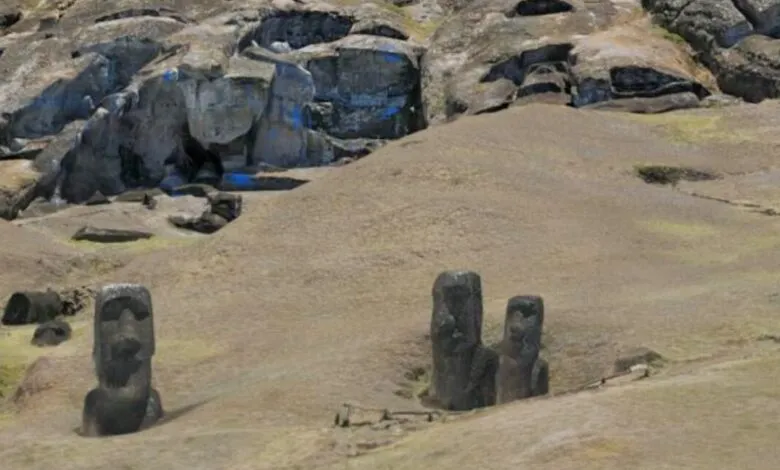
The iconic stone statues of Easter Island, known as moai, were likely crafted by numerous independent family groups rather than a single, unified society. This new perspective emerges from a detailed 3D model of the Rano Raraku quarry, the volcanic source of the statues. The high-resolution digital reconstruction allows researchers to analyze the site in unprecedented detail, revealing patterns that suggest decentralized, clan-based production of these massive figures around 800 years ago.
Archaeologists developed an interactive model of the quarry to document and study the carving processes. This technological approach provides a comprehensive view of the landscape, enabling experts to examine areas that are physically inaccessible. Co-author Carl Lipo of Binghamton University notes that the model allows anyone to virtually “fly around” and observe different carving styles and features, creating a permanent, shareable record of the site.
Lipo is a leading authority on the moai. His recent work has also transformed our understanding of how these multi-ton statues were moved. For years, the prevailing theory assumed a large population was necessary to transport the statues, implying the island once supported tens of thousands of people. However, Lipo’s experimental trials, informed by 3D physics modeling, demonstrated a far more efficient method.
His team confirmed that the statues could be “walked” upright to their platforms by a surprisingly small crew. Using ropes, just 18 people were able to maneuver a replica statue. With four people on each lateral rope and ten on a rear rope, they coordinated a side-to-side rocking motion that moved the figure 100 meters in about 40 minutes. This technique leverages basic pendulum dynamics, minimizing ground friction. It also utilizes a gradual build-up of amplitude, indicating the islanders possessed a sophisticated, practical grasp of resonance principles. This efficient method challenges the old narrative, showing that a smaller, organized community was fully capable of these monumental achievements.
(Source: Ars Technica)