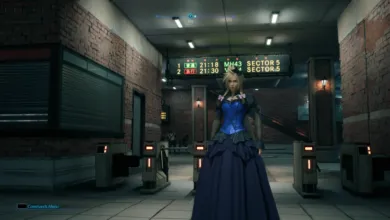
Final Fantasy 7 Rebirth Director Defends Yellow Paint Design

▼ Summary
– Social media users often criticize modern games for using bright yellow paint to mark interactive elements, sparking debates about game design quality.
– Final Fantasy VII Rebirth’s director acknowledged the controversy over yellow paint, recognizing it as a divisive element among players.
– He defended the use of such guidance systems as necessary to help players navigate and understand gameplay objectives effectively.
– The director noted that while methods vary, clear player guidance is essential to prevent frustration and enhance the gaming experience.
– The debate over immersion versus guidance in games continues, with future titles likely to explore different solutions for balancing these needs.
Navigating the sprawling environments of modern video games presents a unique challenge for developers, who must balance player guidance with immersive world-building. The use of yellow paint to mark interactive elements like climbing ledges in Final Fantasy VII Rebirth recently ignited discussions across gaming communities. While some players view these visual cues as disruptive to the game’s atmosphere, the development team stands by their design choices as essential for smooth gameplay.
Naoki Hamaguchi, the game’s director, addressed the ongoing conversation in a recent interview. He acknowledged the divided opinions, noting that while some players feel the yellow markings clash with the game’s aesthetic, others find them helpful. From a design standpoint, Hamaguchi emphasized that clear guidance is often necessary to prevent players from becoming stuck or frustrated. He explained that developers continuously experiment with different methods to indicate interactivity, striving to find approaches that feel natural within each game’s unique world.
Hamaguchi elaborated on the practical considerations behind these design decisions. He pointed out that guiding players through complex environments is a fundamental aspect of game design, ensuring that everyone can progress without unnecessary obstacles. The debate, in his view, centers less on whether guidance is needed and more on how it should be implemented. He recognizes that some players will always prefer minimal or invisible hints, but maintains that effective signposting remains a crucial tool for creating accessible and enjoyable experiences.
This issue extends beyond a single title, with many contemporary games employing similar techniques. Other major releases have used visual markers, sometimes humorously compared to “bird poop” or “liquid caution tape”, to highlight paths and interactive objects. The underlying principle is consistent: when players struggle to identify where to go next, their immersion can break more severely than it might from a brightly colored indicator. The temporary visual cue often prevents longer periods of confusion that could pull them entirely out of the experience.
The tension between realism and usability is particularly pronounced in detailed open-world games. Developers face the difficult task of creating believable worlds while also ensuring they are navigable. Non-diegetic elements like painted ledges offer one solution to this challenge, providing clarity without complex tutorial systems. Hamaguchi’s comments suggest that while player feedback is valuable, functional design requirements will continue to influence these choices. The gaming community will be watching to see whether future installments in the series adopt new guidance methods or continue using these established visual techniques.
(Source: Kotaku)