Unlock Air Freight’s SAF Potential with Book & Claim
▼ Summary
– Leaders emphasize the urgency for freight forwarders and shippers to reduce air freight emissions and explain the importance of using Sustainable Aviation Fuel (SAF).
– The webcast details what the book and claim model is and how companies can use it to support their emissions reduction strategies.
– Companies can learn how both freight forwarders and shippers can utilize and contribute to the benefits of SAF.
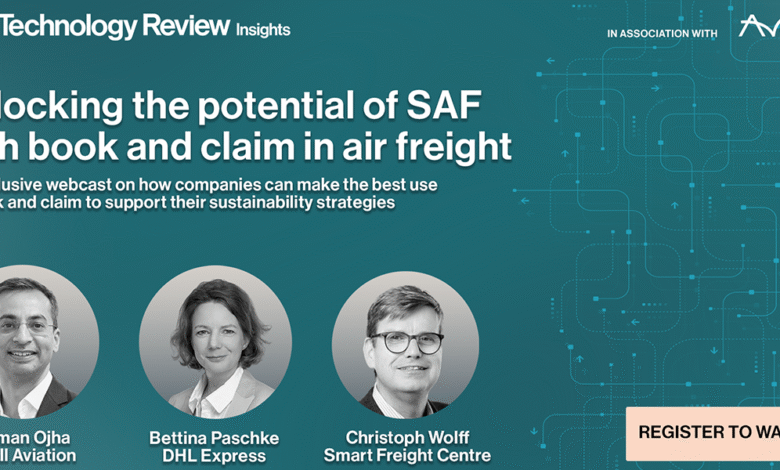
– Featured speakers include industry experts from Shell Aviation, DHL Express, and Smart Freight Centre, who share their experience in sustainability and SAF initiatives.
– The discussion is presented by MIT Technology Review Insights in association with Avelia, a Shell-owned solution developed with partners like Amex GBT and Accenture.
Exploring the critical role of Sustainable Aviation Fuel (SAF) in reducing air freight emissions is essential for forwarders and shippers aiming to meet sustainability targets. An upcoming webcast brings together industry leaders to discuss actionable strategies for integrating SAF into supply chains, focusing particularly on the innovative book and claim model that allows companies to support emissions reduction without physical fuel delivery.
Participants will gain insights directly from top executives about why adopting SAF is a priority and how the book and claim system functions. The session covers practical steps for freight forwarders and shippers to both utilize and contribute to the advantages of sustainable fuel, ensuring they can actively participate in lowering the carbon footprint of their logistics operations.
Featured speakers include Raman Ojha, President of Shell Aviation, who oversees Shell’s global aviation operations supplying fuels, lubricants, and lower-carbon solutions. With nearly two decades at Shell, Raman has held leadership roles across energy, lubricants, construction, and fertilizers, gaining extensive experience in mature markets like the Americas and Europe as well as emerging regions such as China, India, and Southeast Asia.
Bettina Paschke, Vice President of ESG Accounting, Reporting & Controlling at DHL Express, leads efforts in ESG, EU Taxonomy Reporting, and Carbon Accounting. Bringing over twenty years of finance experience, Bettina drives DHL Express’s Sustainable Aviation Fuel initiatives and engages in industry-wide collaborations to enable dependable book and claim mechanisms.
Christoph Wolff, Chief Executive Officer at Smart Freight Centre, heads programs dedicated to sustainability in freight transport. Previously, he served as Senior Advisor and Director at ACME Group, a global green energy leader. Christoph’s diverse background includes roles as Managing Director at the European Climate Foundation, Senior Board Advisor at Ferrostaal GmbH, and positions at Novatec, Solar Millennium AG, DB Schenker, and McKinsey & Company. He also worked as an Assistant Professor at Northwestern University’s Kellogg School of Management and holds multiple degrees from RWTH Aachen University and ETH Zürich, complemented by executive education at the University of Michigan.
Viewers are encouraged to watch the webcast for an in-depth exploration of these topics.
This discussion is presented by MIT Technology Review Insights in partnership with Avelia. Avelia, a Shell-owned solution and brand, was developed with support from Amex GBT, Accenture, and Energy Web Foundation. Opinions expressed by individuals not affiliated with Shell are their own and do not reflect the views of Shell PLC or its affiliates. Please note the cautionary statement on Shell’s global website.
This content was produced by Insights, the custom content division of MIT Technology Review. It was not authored by MIT Technology Review’s editorial team. Human writers, editors, analysts, and illustrators conducted the research, design, and writing. Any AI tools employed were restricted to secondary production processes that underwent comprehensive human review.
Availability of offerings varies by jurisdiction. Depending on local laws, Shell may provide the sale of Environmental Attributes, which buyers, after consulting their own advisors and considering applicable law, might use for emission reduction purposes, and/or Environmental Attribute Information, enabling buyers to help subsidize SAF use and reduce overall aviation emissions at specific airports without making emission reduction claims for their own operations. Different offerings come with distinct contracts, and no assumptions should be made about any offering without reviewing its specific contractual terms.
(Source: Technology Review)