Acer FA200 4TB SSD Review: Massive Storage, Familiar Performance
▼ Summary
– The Acer FA200 is a budget-friendly PCIe 4.0 SSD with good performance and efficiency, especially at capacities up to 4TB, but it may be hard to find at a reasonable price.
– It is a clone of the HP FX700, both made by Biwin, and uses YMTC QLC flash paired with a Maxio controller for surprisingly capable performance.
– The drive faces challenges due to market disarray and high demand for QLC flash, reducing its price advantage and making newer PCIe 5.0 drives more attractive over time.
– It is suitable for general storage, PS5 use, and laptops due to its single-sided design and graphene cooling, but it struggles with sustained writes and lacks DRAM.
– Competing drives like the Crucial P310 and Sandisk WD Blue SN5100 offer better value or features, though the FA200 remains a decent option if found on sale.
For those seeking a high-capacity storage solution, the Acer FA200 4TB SSD delivers solid all-around performance and impressive power efficiency, though finding it at a competitive price can sometimes be a challenge. This drive shares its core design with the HP FX700, as both are manufactured by Biwin and utilize YMTC QLC flash paired with a capable controller. The result is a budget-friendly, single-sided PCIe 4.0 NVMe SSD that handles games, media, and backups effectively.
The storage market has evolved considerably since the FA200’s initial release. Newer QLC drives like the Crucial P310 and Sandisk WD Blue SN5100 have pushed performance boundaries, while TLC options such as the Sandisk WD Black SN7100 offer similar capacity and cost benefits without typical QLC drawbacks. Additionally, the arrival of PCIe 5.0 drives with exceptional speed and efficiency makes the FA200 appear somewhat dated, though it remains a competent performer for its intended role.
A significant hurdle for the FA200 is the current state of the NAND flash market. High demand for QLC flash, driven partly by AI data needs, has reduced its availability for consumer SSDs. This erodes the usual price advantage for drives like the FA200, while vertically-integrated manufacturers can prioritize their own supply. Although the use of YMTC flash from China could help, geopolitical tensions complicate the situation, putting general pressure on PCIe 4.0 drives and making PCIe 5.0 alternatives more appealing over time.
This market shift isn’t entirely negative, as newer PCIe 5.0 drives are impressive, though they still need to become more affordable. For anyone specifically wanting a high-capacity PCIe 4.0 drive with QLC flash for storage purposes, acting sooner may be wise. Upcoming sales events provide opportunities, but identifying your preferred model in advance is recommended.
The FA200 fits well as a budget or secondary drive. It works reliably for general storage, is compatible with the PS5, and its graphene label aids in keeping temperatures manageable in laptops. If you can purchase this or a comparable drive on sale, especially in 2TB or higher capacities, it represents a reasonable choice. Just be aware that sustained write performance isn’t its strong suit. While it lacks TLC flash and DRAM, among DRAM-less QLC drives it holds its own. Alternatives like the P310 and Blue SN5100 may be superior, but a well-priced FA200 can deliver comparable everyday performance for typical uses.
Acer offers the FA200 in 500GB, 1TB, 2TB, and 4TB capacities. During our assessment, the 500GB model was unavailable, but it’s expected to be priced under $55. The other models are listed at $64.99, $117.99, and $219.99. These figures are somewhat high for the hardware, as competing models like the Orico e7400 and TeamGroup MP44Q are often cheaper. Ideally, the 1TB and 2TB versions should cost around $60 and $100, respectively. The 4TB model faces stiff competition from the WD Black SN7100, which uses TLC flash and is currently available for $209.99.
Peak performance is reached with the 1TB model, achieving sequential read/write speeds up to 7,200/6,200 MB/s and random read/write IOPS up to 1,000K/850K. The drive is backed by a standard five-year warranty and supports up to 500TB of writes per terabyte of capacity. Although this is below the typical 600TB for TLC drives, it’s actually quite good for a QLC-based SSD, which normally offers about half the write endurance. The stated endurance is not a significant weakness for the FA200.
Acer drives, similar to HP’s, are produced by Biwin. The accompanying software is Biwin Intelligence, a standard SSD toolbox application. It provides multiple functions including S.M.A.R.T. health monitoring, system information, performance testing, data migration and cloning, secure erasure, firmware updates, error scanning, TRIM optimization, and drive monitoring.
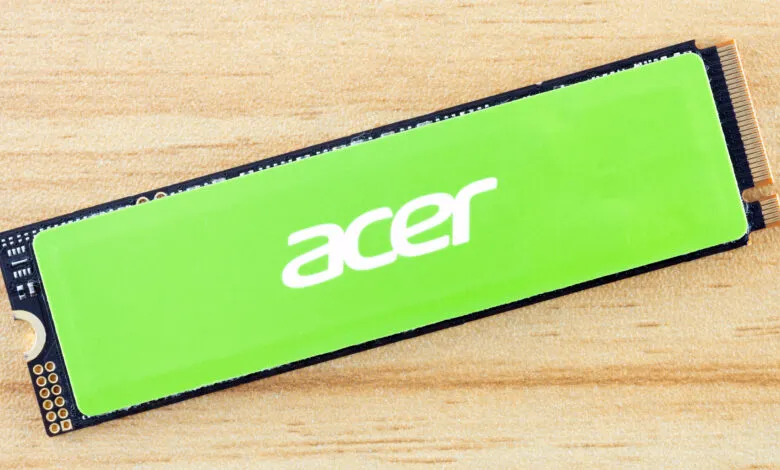
The FA200 is single-sided across all capacities, including the 4TB version, which eases installation and cooling. It features a graphene heatspreading label that proves genuinely effective, a design also seen on the HP FX700 since both are made by Biwin with identical hardware. The drive uses a DRAM-less controller alongside four NAND flash packages.
In our testing, the 4TB FA200 matched or exceeded the performance of the 2TB FX700, indicating firmware improvements, specifically, SN15536 on the FA200 versus SN14428 on the FX700, and optimization of the Maxio controller for 4TB of QLC flash. You don’t give up much in performance or power efficiency to reach 4TB, which isn’t always true for other four-channel, DRAM-less solutions.
!Internal view of the Acer FA200 SSD
These observations align with the controller used: the Maxio MAP1602-F3C is an updated version tailored for 4TB flash configurations. This controller can run quite hot, but a basic heatspreader manages the issue adequately. The flash memory is YMTC’s 232-Layer QLC, which has proven reliable in previous use. It is well-suited for gaming and general storage applications, even at the 4TB capacity, with no notable hardware peculiarities identified.
(Source: Tom’s Hardware)