5 Star Trek Gadgets That Are Now Real-World Tech
▼ Summary
– “Star Trek” has inspired the development of humanoid robots.
– The series inspired universal translation devices.
– Hypospray-like medical jet injectors were influenced by the show.
– Virtual environments are another technology inspired by “Star Trek”.
The starship Enterprise may still be light-years away, but the technology that made it legendary is closer than you think. From the bridge of a fictional spacecraft to your pocket, Star Trek-inspired gadgets have steadily transitioned from science fiction to science fact. Here are five once-imaginary devices that now exist in the real world.
The communicator worn by Captain Kirk and his crew was a handheld device used for ship-to-ship and away-team communication. Today, this concept lives on in every smartphone. While early flip phones were direct visual homages, modern devices like the iPhone and Samsung Galaxy have far surpassed the fictional original, offering video calls, global connectivity, and access to the sum of human knowledge.
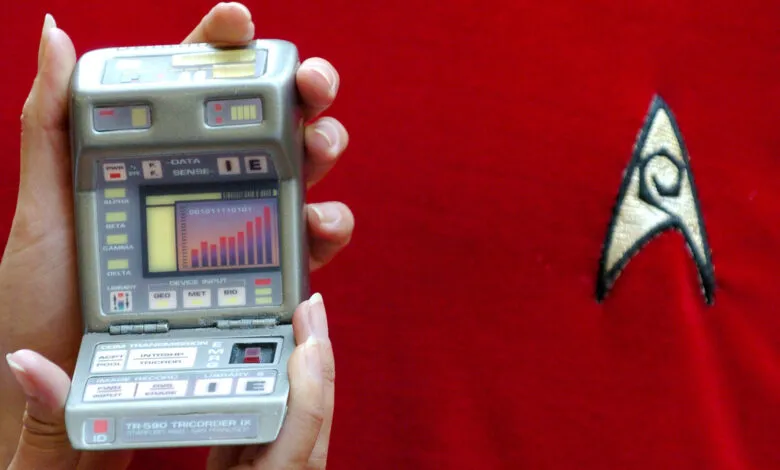
Medical tricorders were the go-to diagnostic tools for Dr. McCoy, scanning patients to instantly identify illnesses and injuries. In the real world, companies like Scanadu and DxtER have developed prototype medical tricorders that measure vital signs, detect irregular heartbeats, and even assess respiratory health. While not yet as omnipotent as the fictional version, these devices represent a major leap in portable health diagnostics.
The replicator from Star Trek: The Next Generation could instantly create any food or object on demand. Today, 3D printers and food printers are the closest real-world equivalents. Companies like Natural Machines have developed printers that can create intricate meals from fresh ingredients, while industrial 3D printers are used to manufacture everything from airplane parts to prosthetic limbs, effectively “replicating” objects layer by layer.
Universal translators allowed the crew to communicate with alien species across the galaxy. That capability is now available in your ear with real-time translation earbuds. Products like Google Pixel Buds and Timekettle earbuds can translate conversations between dozens of languages in near real-time, breaking down language barriers in a way that would make Lieutenant Uhura proud.
Finally, the holodeck offered immersive, interactive virtual environments for recreation and training. While we don’t have a room that can simulate a rainy Parisian street, virtual reality (VR) headsets like the Meta Quest 3 and HTC Vive provide incredibly detailed, interactive digital spaces. VR is now used for everything from surgical training simulations to architectural walkthroughs, fulfilling the holodeck’s promise of limitless virtual exploration.
These five gadgets prove that the future envisioned by Star Trek is not just a fantasy. It is a blueprint that engineers and scientists have been following for decades, turning what was once purely imaginative into tangible, everyday technology.
(Source: BGR)