Jupiter-Sized Planet Survives Its Star’s Death
▼ Summary
– WD 1856 b is the only confirmed planet that survived the death of a Sun-like star, now orbiting a white dwarf.
– The James Webb Space Telescope recently studied the planet, revealing it is a Jupiter-size gas giant in an unusual system.
– The planet’s transit causes only a 50% dip in the white dwarf’s brightness, likely due to a grazing transit from a very unlikely viewing angle.
– WD 1856 b orbits extremely close to its star at 0.02 AU, contradicting expectations that gas giants should migrate outward after the star loses mass.
– The planet was accidentally discovered in 2020 by the TESS observatory while searching for small objects transiting white dwarfs.
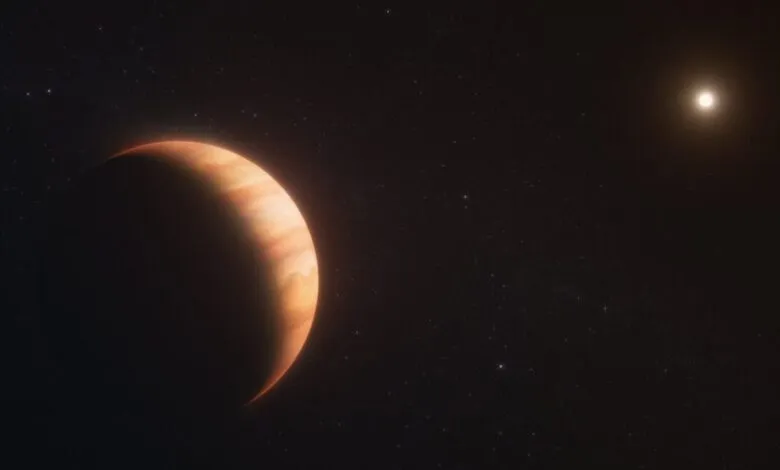
The James Webb Space Telescope has turned its gaze toward WD 1856 b, a Jupiter-sized planet that somehow survived the violent death of its Sun-like star. This world, which orbits a dense white dwarf (the collapsed core of a once-normal star), is the only confirmed example of a planet enduring such a cosmic catastrophe. But new observations have only deepened the mystery surrounding this strange system.
Astronomers first stumbled upon WD 1856 b by accident in 2020, when the TESS observatory was scanning roughly 2,000 white dwarfs. The original mission was to detect small objects like comets or asteroids passing in front of these dead stars. Instead, the team found a gas giant. “As soon as they looked at it, they said, okay, that’s weird,” recalled Christopher O’Connor, a theoretical astrophysicist at Cornell University and co-author of a recent study in Nature.
The white dwarf itself is about seven times smaller than the planet circling it. When WD 1856 b transits, the star’s brightness should drop to nearly zero. Instead, it dips by roughly half. O’Connor suggests the planet is making a grazing transit, where only the edge of its disk clips the star’s face. “That’s a very unlikely viewing angle,” he said, “but it’s the only way to explain what we actually see.”
Even more puzzling is the planet’s orbit. WD 1856 b sits just 0.02 AU from its white dwarf, a distance that defies current theories about how stars reshape their planetary systems as they die. “When the star expands to become a red giant, it consumes the inner planets,” O’Connor explained. Then, as the star sheds about half its mass and shrinks into a white dwarf, its gravitational pull weakens. “The outer planets, like gas giants, should migrate outward by about a factor of two,” he added.
Yet WD 1856 b remains stubbornly close, as if it never got the memo about stellar evolution. The James Webb Space Telescope’s new data haven’t solved the riddle, but they have confirmed just how unusual this system truly is. For now, WD 1856 b stands as a cosmic survivor, challenging our understanding of what happens to planets when their stars die.
(Source: Ars Technica)