Five Eyes warns frontier AI cyber threats loom within months
▼ Summary
– The Five Eyes alliance warns that frontier AI models will transform cyber capabilities within months, not years.
– AI will industrialize the exploitation of common weaknesses like legacy systems, slow patching, and weak access controls.
– The agencies urge organizations to use AI for defense, such as finding vulnerabilities faster and responding to incidents quicker.
– The warning emphasizes that basic cybersecurity hygiene remains critical, but the time to act is now measured in months.
– The statement does not include a fixed deadline, regulatory mechanism, or named AI labs, leaving response to individual organizations.
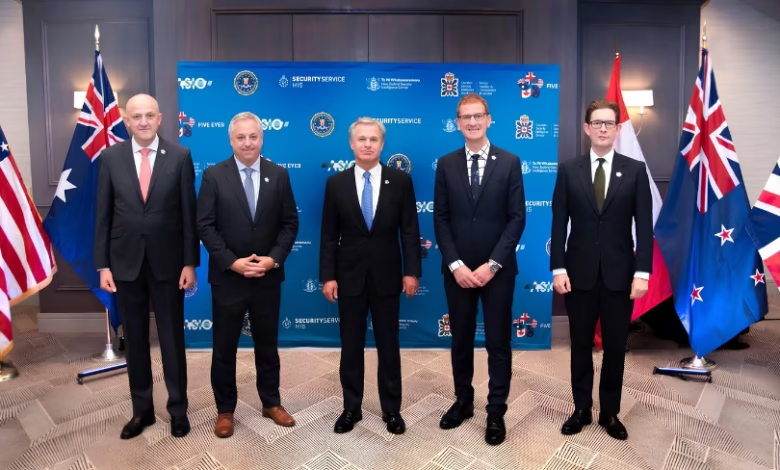
The Five Eyes intelligence alliance has issued an urgent joint warning: the next wave of frontier AI will dramatically escalate offensive cyber capabilities, and the time left to prepare is dangerously short. In a rare coordinated statement, security agencies from the United States, the United Kingdom, Canada, Australia, and New Zealand stressed that immediate action is essential, placing a remarkably tight timeline on the emerging threat.
“Frontier AI models are anticipated to exceed current industry expectations, fundamentally transforming both offensive and defensive cyber capabilities,” the statement declared. “The timeline is not years, it is months.”
The agencies further cautioned that AI systems capable of inflicting serious cyber harm are themselves only “months away” from becoming publicly accessible. This compresses what governments typically treat as a long-term risk into something nearly immediate.
Much of the warning focuses on the unglamorous, everyday mechanics of how organizations get breached. The statement specifically called out legacy systems, slow patching cycles, unnecessary internet connectivity, weak identity and access controls, and a lack of pre-incident planning as the vulnerabilities that more powerful AI will rapidly find and exploit.
None of these weaknesses are new. The critical shift, according to the alliance, is that AI will industrialize the exploitation of them. The gap between a vulnerability becoming known and an attacker reaching it could shrink from weeks to something far shorter. A flaw that once required a skilled human team days to weaponize could soon be turned into a working exploit by a model in a fraction of that time.
That much of the underlying advice sounds familiar is, in a sense, the point. The bulk of the statement restates core cybersecurity hygiene: patch quickly, do not put systems online unless necessary, lock down who can reach what. This is guidance defenders have heard for years, but the urgency is now amplified.
The agencies also urged defenders to turn the same technology back on the problem, encouraging organizations to use AI “to strengthen defence,” for example by finding weaknesses sooner or responding to incidents faster. This framing mirrors a year in which the line between attacking and defending tools has grown thin. Google researchers used an AI system to surface a live zero-day exploit, and Anthropic has documented models that can uncover serious software vulnerabilities of the kind that keep banks awake.
The warning arrives amid a broader scramble to organize defenses before the capability gap widens. Governments and vendors have been signing cross-border cyber partnerships, and the criminal use of AI is already visible at the edges. Researchers have tracked AI-assisted crypto thefts attributed to North Korean operators. The Five Eyes statement effectively tells the rest of the field that the same tooling is about to become broadly available.
The alliance was sounding an unusually loud siren while pointing organizations back towards basic discipline, an acknowledgement that most damage still flows through doors that were left unlocked. What the statement did not include was a fixed deadline or any regulatory mechanism, leaving the response to individual organizations and national agencies. Nor did it name particular AI labs or models, keeping the warning general rather than singling out any developer.
For defenders, the practical takeaway is uncomfortable in its simplicity: the advice has not changed, but the time to act on it, by the alliance’s own reckoning, is now measured in months rather than years.
(Source: The Next Web)