Pump.Fun Bounties Platform: A Black Hole of Grifting
▼ Summary
– Pump.Fun GO allows users to post crypto bounties for others to complete tasks, with rewards held in escrow until a deadline.
– The platform moderates bounty submissions and claims without clarifying its approval process, leading to concerns about fairness.
– Terms of service state users are responsible for their own actions and compliance with law, and rewards are not guaranteed.
– Many bounties involve AI-generated imagery as fake evidence, and actual task completers have no recourse if another submission is chosen.
– Bounties range from mundane tasks like getting a burger to exploitative ones, including degrading acts and requests for tattoos, often from users outside the US.
Would you storm into a packed lecture hall, blast a loud noise through a megaphone, and scream “fartcoin” at full volume? If you can film the stunt and capture the crowd’s reaction, you could earn a reward of roughly $1,000. That payout, however, comes in fartcoin, a meme cryptocurrency trading at just over 10 cents as of this writing, with a total market cap near $130 million.
That’s the premise behind Pump. Fun GO, a new feature on Pump. Fun, one of the fastest-growing crypto platforms in recent years. It claims to let users “pay anyone to do anything.” Individuals or pooled wallets deposit crypto bounties into escrow, held by Pump. Fun until a countdown expires. Completing a task is supposed to earn you the prize; creators get a refund if no one finishes the job.
Pump. Fun’s legal team did not respond to a request for comment. The company has stated, without detailing its process, that it moderates and approves bounty submissions and related claims. An initial wave of GO bounties included offers to parachute into a World Cup game wearing a memecoin-themed costume, and a request for a Black person to cover themselves in watermelon and repeat the phrase “I’m your friend, the watermelon man.”
The platform’s terms of service state that GO users are responsible for their own “actions, decisions, wallet security, submissions, communications, and compliance with law.” They also warn that Pump. Fun may remove content, suspend accounts, and cooperate with authorities in cases of “fraud, scams, market manipulation, infringement, hacking, scraping, abusive or illegal content, stolen property, unlawful financial activity, or other harmful or prohibited conduct.” Crypto transfers and rewards are “not guaranteed,” according to those terms.
The GO feature arrives as Pump. Fun faces a massive crash in user engagement, and it seems poised to invite further accusations of lawlessness and deception. Many bounties, such as one requesting footage of a memecoin-themed car exploding in a ball of flame, are flooded with AI-generated imagery presented as proof of completion. People who actually carry out a challenge have no clear recourse if someone else’s submission is selected as the winner by Pump. Fun, based on unspecified internal criteria.
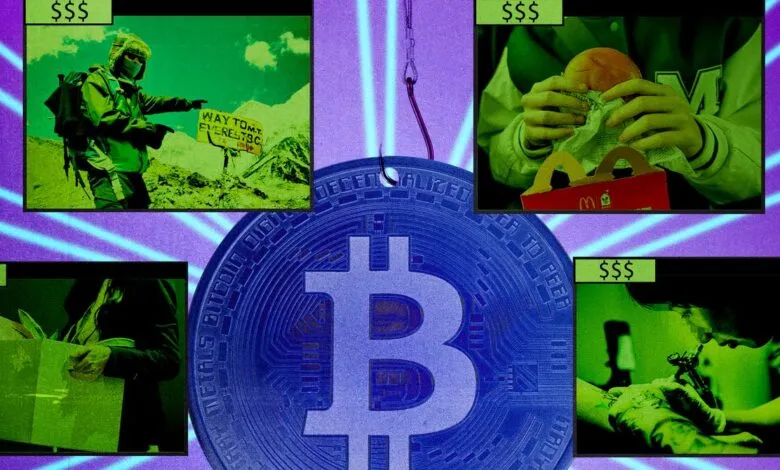
Fine print can also muddy the waters. A $215 bounty titled “Go to McDonalds and get a burger” specifies that the payout will be split among the first 20 valid entries, yielding just $10.75 in crypto each, less than what most paid for their meal.
While that bounty is relatively tame, others still open are strikingly dystopian, exploitative, or harmful. Multiple requests ask users to get the names of various cryptocurrencies tattooed on their bodies. A man in India has already had his forehead tattooed for the equivalent of $3,000. Video replies depicting people completing more degrading tasks frequently come from users outside the US. You can record yourself begging a gas station attendant for a pill to help with a flaccid penis for about $100, interview multiple homeless people and ask who they voted for ($700), or quit your job on camera ($3,000). “Bonus points for style, creativity, and chaos,” the last prompt reads. “This is your severance package.”
Andrew Ford Lyons, a technologist working on digital security and safety projects for human rights groups, tells WIRED that GO is incentivizing coercion, harassment, and significant physical and legal risks, “leveraging inequality” for online entertainment. “This is essentially what the digital economy is boiling down to,” he says.
(Source: Wired)