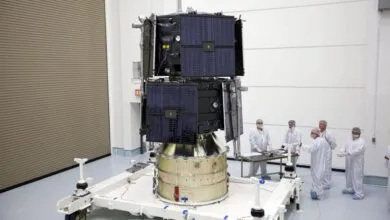
Satellite rescue mission assembled in record time faces uncertain outcome

▼ Summary
– NASA challenged companies to build and launch a satellite within a year to save a $500 million astronomy mission at risk of crashing.
– Katalyst Space Technologies won a $30 million contract in September to build a satellite that will boost Swift’s orbit back to a safe altitude.
– The Swift observatory, launched in 2004, studies gamma-ray bursts but lacks thrusters to maintain its orbit.
– Aerodynamic drag has caused Swift’s altitude to decay from 363 miles to 225 miles, with the decay rate accelerating.
– Swift will eventually burn up in the atmosphere unless Katalyst’s Link spacecraft successfully raises its orbit.
Just 10 months ago, NASA posed an unprecedented challenge to three companies: develop and launch a satellite capable of rescuing a $500 million astronomy mission teetering on the edge of destruction. The catch? Do it in under a year, on a limited budget, and with technology that has never been tested in space.
Among the contenders, Katalyst Space Technologies, a startup founded in 2020, delivered the most convincing proposal. “They came back with a response that was technically and programmatically plausible, and then we were like, ‘Yeah, let’s do it,’” recalled Shawn Domagal-Goldman, director of NASA’s astrophysics division.
The timeline was aggressive. In August of last year, the discussions began. By September, NASA had awarded Katalyst a $30 million contract to design, build, test, and launch a compact satellite. The mission’s objective: chase down the aging Swift observatory, latch onto it using three robotic arms, and boost its orbit back to a sustainable altitude. Only then can Swift resume its critical scientific work. The plan sounds straightforward. Executing it is anything but.
Swift’s predicament stems from a simple but fatal flaw. Launched in November 2004 to detect gamma-ray bursts , the most energetic explosions in the cosmos , the spacecraft lacks any onboard thrusters to maintain its orbit. Over two decades, atmospheric drag has gradually pulled it downward. Swift originally entered an orbit about 363 miles (585 km) above Earth. As of Thursday, it had fallen to just 225 miles (363 km). As it sinks deeper into denser air, the rate of decay accelerates. Eventually, without intervention, Swift will burn up during reentry.
Despite its age, Swift remains indispensable to astrophysicists. Its multi-wavelength instruments allow scientists to identify and pinpoint gamma-ray bursts, enabling follow-up observations by other telescopes around the world. Losing Swift would mean losing a unique, real-time window into the most violent events in the universe.
Katalyst’s Link servicing spacecraft now carries the weight of that mission. Whether it can reach Swift in time, execute a complex docking maneuver, and successfully raise its orbit remains uncertain. But for a mission assembled in record time, the stakes could not be higher.
(Source: Ars Technica)