Rocapine raises $13m to build healthy app habits
▼ Summary
– Rocapine, a Paris venture studio creating wellness apps, raised $13M in Series A funding led by Educapital, applying mobile gaming’s addictive design tactics to promote “time well spent” instead of screen time.
– Founded in late 2024 by Stanislas Marchand and others, the studio tests hundreds of app concepts yearly and scales the few that succeed, reaching $6M in annual recurring revenue within nine months.
– Its portfolio includes apps like Harmony, That Girl, and Unchaind, targeting women’s health, habit-building, and breaking compulsive behavior.
– The funding will support scaling early hits into category leaders, expanding testing to 400 apps this year, and building AI, data, and marketing infrastructure.
– In-app purchase revenue from non-gaming apps surpassed games in 2025, reaching $85.6B, with wellness as a fast-growing segment, and Rocapine aims to improve 40 million lives over five years.
A Paris-based venture studio focused on wellness applications has secured $13 million in Series A funding, with Educapital leading the round. The concept flips the standard mobile gaming playbook on its head: instead of using rapid iteration, AI-native development, and performance marketing to maximize screen time, Rocapine applies those same techniques to minimize it. The goal, as the studio puts it, is not more time on screen but time well spent.
The motivation behind this approach is stark. According to DataReportal, the average person spends roughly five hours and 16 minutes each day on a smartphone engineered to keep them engaged. Over a lifetime, that adds up to nearly 15 years. Rocapine’s apps aim to “hold instead of hook” by earning a place in daily routines through genuine usefulness rather than compulsive design.
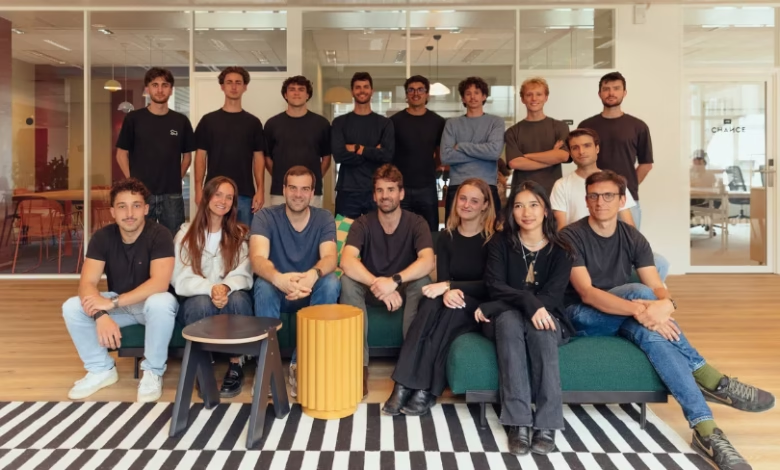
Founded in late 2024 by Stanislas Marchand, a former executive at the mobile-gaming unicorn Voodoo, along with Jean-Gabriel Boinot-Tramoni and Sammy Teillet, the studio operates as a high-velocity publisher. It tests hundreds of concepts annually, often collaborating with independent developers, then refines and scales only the most promising ones.
The numbers so far are impressive. Within nine months of launch, Rocapine hit $6 million in annual recurring revenue and surpassed 2.5 million downloads, with 70% of revenue coming from the United States. One app reportedly reached $1 million ARR just 16 days after release.
The current portfolio includes apps targeting women’s health, habit-building, and breaking compulsive behaviors, such as Harmony, That Girl, and Unchaind. The fresh capital will be used to transform early successes into category leaders, expand the testing engine to 400 apps this year, and strengthen the AI, data, and marketing infrastructure.
“Technology was supposed to make us smarter, healthier and more connected,” said Stanislas Marchand, co-founder and CEO. “Instead, too much of it has become addictive, extractive and exhausting.” He highlighted the cultural relevance of the issue, noting that Oxford named “brain rot” its 2024 Word of the Year.
The timing works in the studio’s favor. In 2025, in-app purchase revenue from non-gaming apps surpassed games for the first time, reaching approximately $85.6 billion, according to Sensor Tower. Wellness is one of the fastest-growing segments, with demand skewing younger. Rocapine aims to improve the lives of at least 40 million people over the next five years.
The investment round attracted a notable group of operators. It was led by Educapital, with participation from Daphni (which led the 2024 seed round), Ring Capital, and Centre Court Capital. Individual backers include Jean-Charles Samuelian-Werve of Alan and founders from consumer apps like Opal and Yubo.
“The best consumer products earn trust by improving people’s lives,” said Samuelian-Werve, an early supporter who praised the studio’s use of AI to personalize apps and scale them efficiently. Educapital, a Paris-based impact fund focused on edtech and the future of work, manages around $200 million and counts Preply and 360Learning among its portfolio companies. Investment director Alexandre Glaser described Rocapine as “one of the most compelling stories we have seen in European consumer tech.”
The studio operates across Paris, Nantes, and Barcelona, and its broader backer list includes founders from Mojo, Photoroom, Knowunity, and The Sandbox. The real challenge, which this funding does not resolve, is whether apps designed to reduce screen time can thrive on metrics that typically reward the opposite.
(Source: The Next Web)