China Launches First Underwater Data Center Powered by Wind
▼ Summary
– China launched the world’s first wind-powered underwater data center off Shanghai, using seawater for natural cooling to cut energy use for cooling to under 10%.
– The facility, a collaboration between HiCloud Technology and state-owned China Communications Construction, cost 1.6 billion yuan ($236 million) and has an initial capacity of 24 megawatts.
– The underwater data center is designed to achieve a power-usage effectiveness (PUE) of no more than 1.15, considered state-of-the-art, and uses over 95% green electricity.
– It reduces energy consumption by 22.8% and eliminates water and land use compared to traditional onshore data centers, supporting China’s AI development and energy self-sufficiency.
– China and the United States host about 90% of global AI data centers, but China pursues a strategy of reducing fossil fuel dependence through renewables, hydrogen, and market reforms to strengthen energy security.
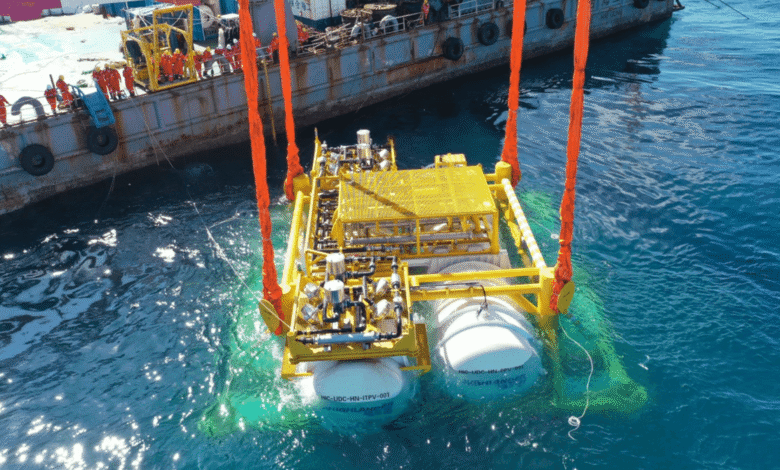
China has made history by launching the world’s first underwater data center (UDC) powered entirely by offshore wind energy, situated off the coast of Shanghai. This groundbreaking facility marks a major milestone in the nation’s strategy to secure energy supplies amid the explosive growth of artificial intelligence, reduce reliance on fossil fuels, and minimize the environmental footprint of its expanding tech infrastructure.
The project is a joint venture between private firm HiCloud Technology and state-owned China Communications Construction, backed by an investment of 1.6 billion yuan, roughly $236 million. With an initial capacity of 24 megawatts, the UDC sits submerged at a depth of 10 meters within the Lin-gang Special Zone, part of the China Pilot Free Trade Zone in Shanghai. Its underwater location allows seawater to serve as a natural cooling system, slashing the energy used for cooling to less than 10 percent of total consumption.
This design directly tackles one of the biggest energy drains in conventional data centers, where air conditioning typically consumes between 40 and 50 percent of total electricity. The facility’s thermal efficiency is measured by its power-usage effectiveness (PUE), an industry benchmark where 1.0 represents perfect efficiency. In its first phase, the Lin-gang complex aims for a PUE of no more than 1.15, a figure considered cutting-edge in the sector.
HiCloud previously launched the world’s first commercial underwater data center in Hainan, southern China, in 2023, but the Shanghai complex is the first to integrate offshore wind power into its operations. Construction wrapped up in mid-October of last year. According to Chinese government statements, the project is designed to use over 95 percent green electricity, cutting energy use by 22.8 percent, while eliminating water consumption entirely and reducing land use by more than 90 percent compared to traditional onshore facilities.
The debut of this UDC represents a critical step in China’s broader push to optimize energy supply through renewables while maintaining its leadership in AI-driven computing capacity. A recent UN report highlights that only 32 countries host AI-specialized data centers, with roughly 90 percent of that infrastructure concentrated in just two nations: China and the United States. Both powers are racing to secure the energy needed for AI development, but they are pursuing divergent paths. The U. S. has scaled back investments and proposals tied to the energy transition, while China is doubling down on reducing fossil fuel dependence to meet climate goals and decrease vulnerability to foreign suppliers.
Beijing’s energy self-sufficiency strategy is particularly aggressive. As the world’s largest energy consumer, China is exploring a wide range of technologies, from thorium and bismuth to rapid expansion of renewables and nuclear power. Last year, a new energy law took effect, prioritizing renewable sources and hydrogen to cut fossil fuel reliance and strengthen national energy security. The law mandates that authorities set minimum consumption targets for clean energy. Simultaneously, China launched a sweeping reform of its electricity market, requiring all solar and wind energy to be traded through market mechanisms or auctions starting June 2025, phasing out old feed-in tariffs. These changes, paired with financial incentives and the removal of legacy subsidies, aim to spur investment in clean tech and boost system efficiency.
China’s energy transition is not just about the environment. It is a long-term economic and geopolitical play designed to bolster technological and industrial independence. The launch of this underwater data center reinforces the country’s position in the global race to build the infrastructure that will power the next generation of AI and other advanced technologies, placing it firmly ahead in the contest with the United States and the rest of the world.
(Source: Wired)