Supermicro Seeks $7B to Fill $39B AI Server Orders
▼ Summary
– Supermicro plans to raise $7 billion through equity offerings to fund components for $39 billion in AI server orders from over 20 customers.
– The offering includes $5 billion in underwritten stock and depositary shares, plus a $2 billion at-the-market program starting in Q3 2026.
– The stock fell about 9% after hours due to dilution concerns, as the raise represents over a quarter of Supermicro’s $26.5 billion market value.
– Supermicro has a troubled history, including a 2018 Nasdaq delisting, a 2020 SEC charge for accounting violations, and a 2025 indictment of co-founder Yih-Shyan Liaw for alleged server smuggling to China.
– The $39 billion backlog exceeds Supermicro’s trailing twelve-month revenue of $28 billion, but investors must weigh this against the company’s corporate governance issues.
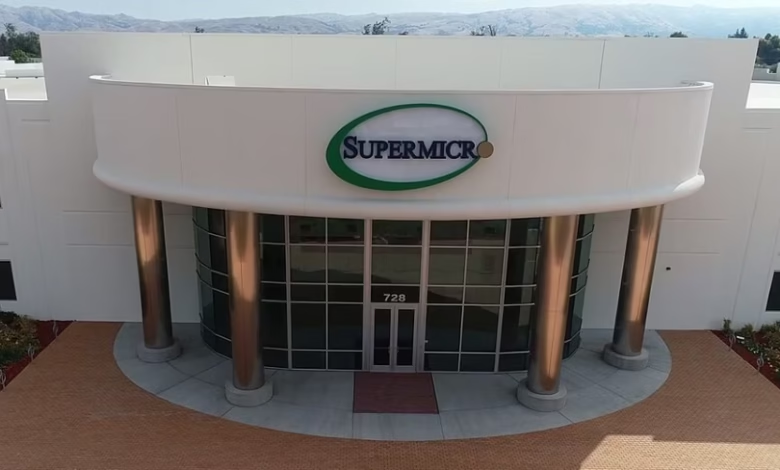
Super Micro Computer is making a bold financial move, announcing plans to raise $7 billion through a package of equity offerings to secure the components needed for its massive backlog of AI server orders. The company revealed on Tuesday that it has received approximately $39 billion in orders from more than 20 clients in recent weeks for its advanced AI servers, including its Data Center Building Block Solutions, and requires fresh capital to purchase the necessary parts for fulfillment.
The capital raise is structured in two parts. The first is a $5 billion underwritten offering of common stock and depositary shares, comprising roughly $1.25 billion in common stock and $3.75 billion in depositary shares. The second is a $2 billion at-the-market (ATM) program that will allow Supermicro to sell shares directly into the open market, with sales beginning no earlier than the third quarter of 2026.
The news weighed heavily on the stock, which fell approximately 9% in after-hours trading as investors digested the dilution. With a market capitalization of roughly $26.5 billion and about 601 million shares outstanding before the announcement, the $7 billion raise represents more than a quarter of the company’s entire market value.
The sheer scale of the order backlog is striking. At $39 billion from more than 20 customers, it exceeds Supermicro’s trailing twelve-month revenue of roughly $28 billion. The company reported $10.2 billion in revenue for its fiscal third quarter ending March 2026 and has guided fourth-quarter revenue between $11 billion and $12.5 billion. This backlog is larger than a full year of sales, underscoring the explosive demand for AI infrastructure.
Supermicro assembles and sells server systems built around Nvidia’s AI chips, positioning it as a primary beneficiary of the AI spending wave. Last week, Alphabet raised a record $85 billion in equity for AI capital expenditure, and hyperscalers’ combined capex is projected to exceed $690 billion in 2026. That spending flows downstream to server assemblers like Supermicro, Dell, and Hewlett Packard Enterprise.
However, the raise comes with significant baggage. Supermicro narrowly avoided being delisted from Nasdaq in early 2025 after its auditor Ernst & Young resigned in October 2024, citing unwillingness to be associated with management’s financial representations. Short seller Hindenburg Research had published a report two months earlier alleging accounting manipulation and sanctions evasion. The company filed its overdue financial statements in February 2025, and Nasdaq accepted its compliance plan, but questions about internal controls have not fully dissipated.
This is not the first time Supermicro has faced such scrutiny. It was delisted from Nasdaq in 2018 for failing to file financial statements and was charged by the SEC in 2020 for widespread accounting violations involving more than $200 million in improperly recognized revenue. More recently, in March 2026, co-founder Yih-Shyan Liaw was indicted for allegedly conspiring to divert $2.5 billion in Nvidia AI servers to China, causing the stock to fall 33% on the day the charges were unsealed. Supermicro has said it was not involved in and had no knowledge of the alleged smuggling scheme and does not expect any restatements of previously filed financial statements related to the 2024 accounting crisis.
Investors weighing the $7 billion offering must decide whether $39 billion in orders is enough to offset a corporate history that includes two delistings, an SEC enforcement action, and an indicted co-founder. The company may also use a portion of the proceeds for general corporate purposes, including debt repayment, working capital, and capital expenditure. No timeline has been given for when the underwritten offerings will price.
(Source: The Next Web)