Vinted CEO calls US an ‘enormous opportunity’ as $9B marketplace eyes Atlantic crossing
▼ Summary
– Vinted’s marketplace CEO Adam Jay sees an “enormous opportunity” in the US resale market but warns building it could take years.
– Revenue rose 38% in 2025 to €1.1 billion, while net profit fell 19% to €62 million due to heavy investment in logistics, payments, and expansion.
– A secondary share sale in April valued Vinted at €8 billion, a 60% premium over its October 2024 valuation, with no new primary capital raised.
– High shipping costs are the biggest challenge in the US, where competitors include Poshmark, ThredUp, Mercari, and eBay’s Depop acquisition.
– Vinted expanded beyond fashion to categories like electronics and books, and coined “Vinted math” for buyer behavior factoring resale value into purchases.
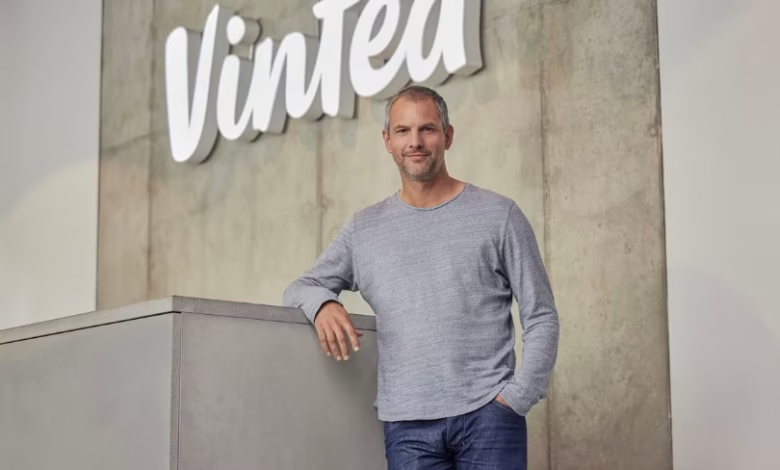
Vinted, the Lithuanian secondhand marketplace valued at roughly $9 billion, sees the United States as an “enormous opportunity” as it intensifies efforts to crack the American resale market. Marketplace CEO Adam Jay made the remarks Sunday at London Tech Week, telling CNBC that the shift toward secondhand consumption represents “a fundamental change” that is “very much here to stay.” The company began active marketing in the US earlier this year after maintaining a dormant presence there since 2013. Still, Jay cautioned that building a foothold in the American market could take “weeks, months, and maybe years.”
The push into the US comes as Vinted reveals financial results that highlight both its momentum and the costs of aggressive expansion. Revenue jumped 38% in 2025 to €1.1 billion, while gross merchandise value climbed 47% to €10.8 billion. Net profit, however, slipped 19% to €62 million as the company poured resources into its logistics arm Vinted Go, its payments infrastructure Vinted Pay, and geographic expansion into new markets including the US, Latvia, Estonia, and Slovenia.
A secondary share sale in April, led by EQT Growth with Schroders Capital and Teachers’ Venture Growth as new investors, valued Vinted at a 60% premium over the €5 billion valuation it achieved in October 2024. The deal provided liquidity to early investors and employees but raised no new primary capital. Vinted has described itself as “IPO-ready” but has set no timetable, and Jay declined to comment on the timing or location of a potential listing.
The company’s financial discipline is a key strength. Vinted is cash-positive, generated €137 million in free cash flow in 2025 (up 36% year-on-year), and has shown it can raise nearly a billion euros in private capital without diluting existing shareholders. That independence means the company faces no pressure to list, giving it the flexibility to time an IPO on its own terms rather than to meet investor liquidity demands.
The US market marks Vinted’s first expansion outside Europe and its toughest competitive test. High shipping costs are the biggest challenge, Jay said, in a market where established players like Poshmark, ThredUp, and Mercari already compete for secondhand buyers. eBay, which reported $79.6 billion in GMV in 2025, is also strengthening its fashion position through a pending $1.2 billion acquisition of Depop, the Gen Z-focused resale platform that has been investing heavily in AI-powered listing tools.
Vinted’s expansion strategy goes beyond geography. The company spent years as a fashion-only marketplace before cautiously adding electronics, books, toys, and household items. Jay said the team “was nervous” about category expansion because users valued the platform’s simplicity, but ultimately had enough signals to proceed, including users who had already been creatively listing non-fashion items before the categories officially opened. Vinted Ventures, the company’s corporate investment arm, is also backing adjacent commerce startups, most recently leading into live-commerce platform Tilt’s $26 million round as a defensive move against Whatnot’s European expansion.
The company has coined the term “Vinted math” to describe a consumer behaviour pattern where buyers factor resale value into new purchases and check Vinted before buying at retail. According to Vinted’s 2025 Impact Report, users saved €21.6 billion on fashion purchases compared to retail prices, paying on average 72% less. Those figures come from the company’s own reporting and should be understood as a marketing construct rather than independently audited savings data, but the underlying behavioural shift they describe is consistent with broader industry trends.
The global secondhand apparel market is growing roughly twice as fast as the overall apparel market, according to GlobalData research, and is expected to reach $393 billion by 2030. That tailwind benefits Vinted, but the company’s success in the US will depend on whether it can solve the shipping-cost problem that Jay identified as the biggest barrier, while competing against platforms that already have American infrastructure and brand recognition.
Vinted now operates in 26 countries, with France and the UK as its largest markets. The platform was founded in 2008 in Vilnius by Milda Mitkutė and Justas Janauskas, became Lithuania’s first tech unicorn in 2019, and turned its first annual profit in 2023 under group CEO Thomas Plantenga. Whether the company can replicate its European dominance in the US, where the competitive landscape is denser, shipping economics are harder, and consumer habits around secondhand differ from those in France and the UK, will determine whether Vinted’s IPO, whenever it comes, prices as a European champion or a global platform.
(Source: The Next Web)