Early Universe’s “Little Red Dot” Reveals Naked Supermassive Black Hole
▼ Summary
– The James Webb Space Telescope discovered “little red dots,” which are early versions of supermassive black holes from the Universe’s earliest periods.
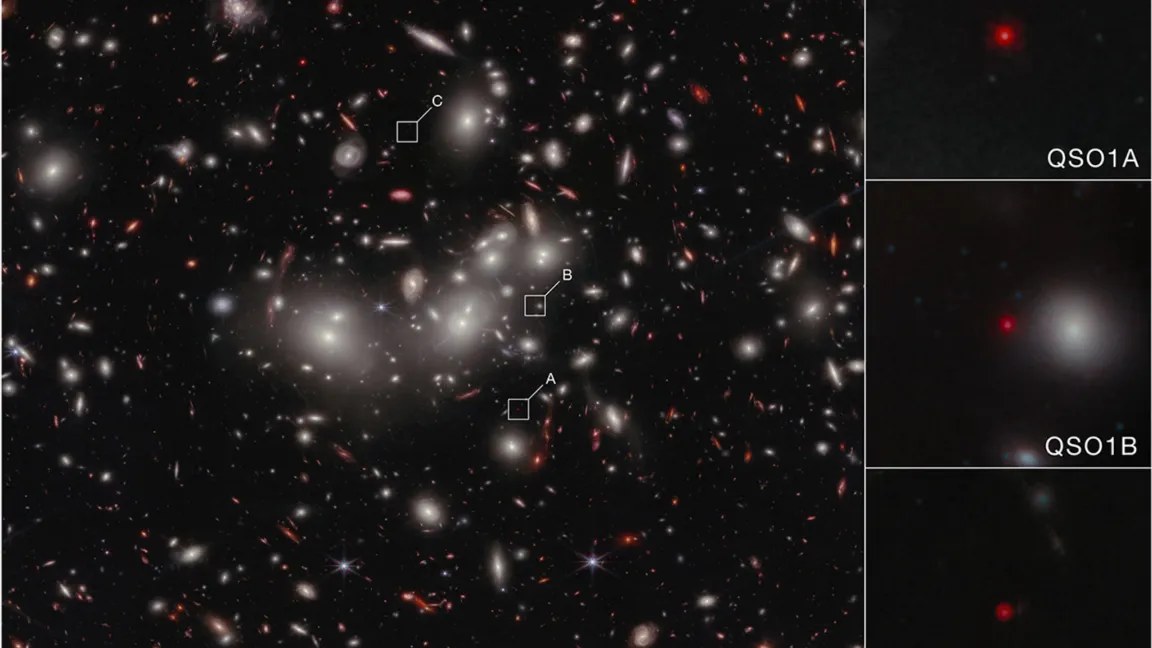
– Gravitational lensing confirmed that one little red dot, Abell 2744−QSO1, is a supermassive black hole with little surrounding galaxy.
– Abell 2744−QSO1 appears three times due to gravitational lensing, and its light dates to 700 million years after the Big Bang.
– The three lensed images of QSO1 show different details, indicating variations in its emissions consistent with a black hole feeding on varying amounts of material.
– Based on its luminosity, the black hole in QSO1 is estimated to be over 10 million times the mass of the Sun, unusually large for that early era.
The James Webb Space Telescope was engineered to peer into the Universe’s earliest epochs, a formative era when the first stars emitted enough radiation to ionize the hydrogen that then comprised nearly all normal matter. Scientists had many predictions about what would be found, but the cosmos has a way of defying expectations.
One of the earliest and most puzzling discoveries was a class of objects quickly dubbed “little red dots” , and they are precisely what the name implies. After initial debate, researchers concluded these were primordial versions of the supermassive black holes now found at the core of nearly every large galaxy. Now, thanks to gravitational lensing, astronomers have confirmed that one such dot is essentially a supermassive black hole with very little galaxy surrounding it.
The object in question, named Abell 2744−QSO1, has been magnified and appears as three separate images near the galaxy cluster responsible for the lensing effect. Analysis of its spectrum reveals we are observing it as it existed just 700 million years after the Big Bang.
QSO1 has been known for roughly two years and has undergone intense scrutiny. One study noted that its three lensed images display subtle differences. Because each image’s light traveled a distinct path to Earth, arriving at slightly different times, this indicates that QSO1’s emissions have varied over time , consistent with a black hole consuming fluctuating amounts of material as it feeds. Based on the object’s brightness, researchers had already estimated the black hole’s mass at over 10 million times that of the Sun, an impressive size for such an early point in cosmic history.
(Source: Ars Technica)