JWST Maps Extreme Weather on Hot Gas Giant 700 Light-Years Away
▼ Summary
– WASP-94A b is a hot, tidally locked gas giant in a binary system 690 light-years away, studied using the James Webb Space Telescope.
– The planet has cloudy mornings and clear evenings, challenging previous assumptions about exoplanet atmospheres.
– Despite having less than half Jupiter’s mass, its diameter is over 70% wider, giving it low density and a more observable atmosphere.
– Standard transmission spectroscopy averages light across the planet’s silhouette, oversimplifying tidally locked worlds with varied day and night sides.
– Temperature differences and the Coriolis effect likely cause equatorial super-rotation on WASP-94A b, with winds blowing eastward faster than the planet rotates.
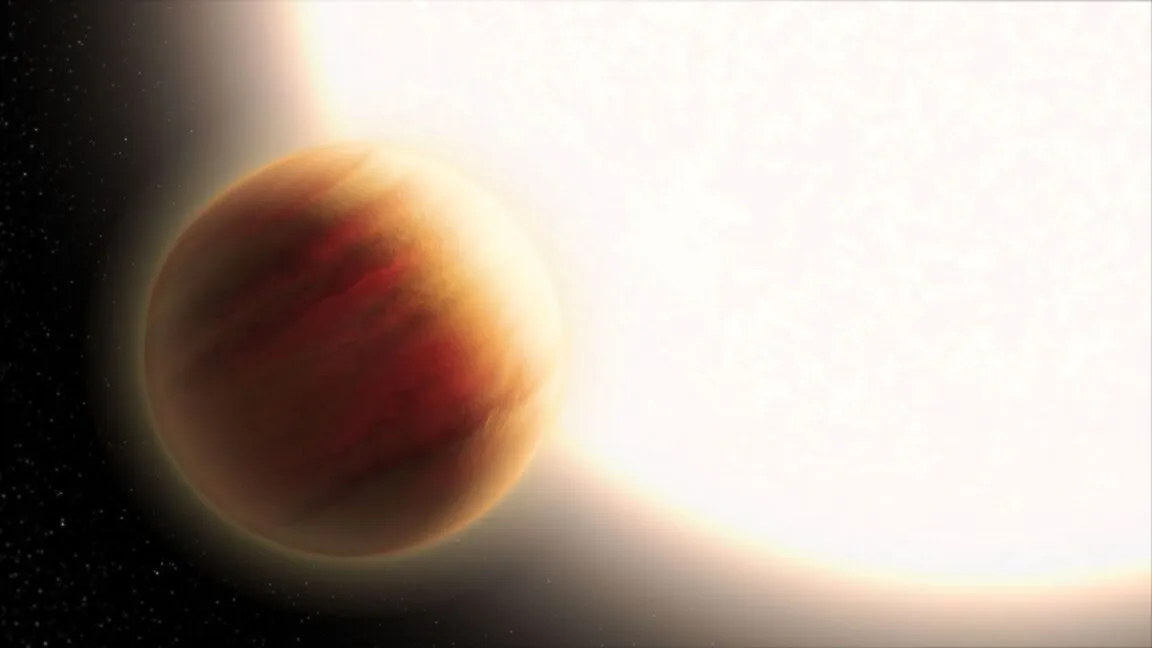
The James Webb Space Telescope has delivered a breakthrough in exoplanet weather forecasting by mapping the atmospheric conditions on a distant gas giant. The planet in question, WASP-94A b, orbits one star in a binary system located roughly 690 light-years from Earth. It is a hot, tidally locked world, meaning one hemisphere permanently faces its star while the other remains in endless darkness. A team led by Sagnick Mukherjee, an astrophysicist at Johns Hopkins University, published their findings in Science, revealing a surprisingly dynamic climate.
Tidal locking eliminates the familiar cycle of day and night temperature shifts across the planet’s surface. “We wanted to understand the atmospheres of such planets,” Mukherjee says. “Are they static or dynamic? Do they have winds? Do they have clouds?” The answers came back with clear patterns: WASP-94A b experiences cloudy mornings and clear evenings. This discovery carries a deeper implication. If scientists did not know this basic weather pattern, it suggests they may have fundamentally misunderstood the chemistry of this and many other exoplanets.
The planet itself is a peculiar specimen. Though its mass is less than half that of Jupiter, its diameter is more than 70 percent larger. “This means the planet has low density, and its atmosphere extends further out into space, which makes it easier to observe,” Mukherjee explains. Astronomers typically study such atmospheres using transmission spectroscopy, which analyzes starlight filtered through the planet’s atmosphere as it transits its host star. This technique reveals the chemical makeup of the gases present.
The catch is that this method averages the light passing through the entire circumference of the planet’s silhouette. It treats the atmosphere as one uniform, homogenous sphere. For a tidally locked planet, this is a massive oversimplification.
On these worlds, extreme temperature differences between the permanent day side and the permanent night side create variations in atmospheric density. Those density differences, combined with the Coriolis effect from the planet’s slow rotation, drive a phenomenon called equatorial super-rotation. In this process, winds along the equator blow eastward faster than the planet itself spins. Circulation models had predicted this exact behavior for WASP-94A b, and the JWST observations have now confirmed it.
(Source: Ars Technica)