Why the Apple Studio Display fell short of its potential
▼ Summary
– Apple’s Studio Display still uses an old 60Hz, edge-lit 5K panel from 2014, only adding a better webcam and Thunderbolt 5 ports in its 2026 update.
– Competitors like BenQ, Asus, and KTC now offer 27-inch 5K monitors for $550 to $1,100, with better stands, ports, and multi-computer support.
– The BenQ MA270S ($1,000) is highlighted as a top alternative, offering a glossy screen, deep blacks, and a KVM switch for Mac and Windows.
– Apple’s $1,600 Studio Display lacks a height-adjustable stand in its base model, requiring an extra $400 for one, while competitors include flexible, removable stands.
– The article concludes that the Studio Display is no longer the best 5K option, recommending cheaper competitors unless Apple’s design is the top priority.
For the better part of a dozen years, Apple held a virtual monopoly on the 27-inch 5K monitor market. Aside from LG’s functional but uninspired UltraFine, the only real option was to buy a 2014 iMac just for its display. That changed in 2022 when Apple released the $1,599 Studio Display, effectively offering the iMac’s screen as a standalone monitor with a webcam and speakers, and promptly delisted the LG from its store.
It wasn’t until late 2024 that rivals like BenQ and Asus finally launched their own 27-inch 5K panels. While the Studio Display boasted superior build quality with its sleek aluminum chassis, these competitors brought features Apple didn’t offer: more adjustable stands, better port selection, and multi-computer connectivity. They also work with Windows and cost significantly less, with prices ranging from $1,100 down to just $550. This put Apple in a position where a counterpunch seemed inevitable.
This year, Apple did release a Studio Display with a genuine panel upgrade. It features a mini-LED backlight instead of edge lighting, a quantum-dot optical stack for up to 2,000 nits of brightness, a 120Hz refresh rate, 14 reference modes, and two modes using Apple’s new CMF (color matching function) for cross-technology color consistency. That monitor, however, is the $3,300 Studio Display XDR.
For the standard Studio Display, Apple simply added a better webcam and faster ports to the same 12-year-old IPS panel and kept the $1,600 price tag. The problem is, it’s no longer 2022, and competition is fierce. I spent weeks testing the new Studio Display against the BenQ PD2730S ($1,100) and MA270S ($1,000), the Asus ProArt PA27JCV ($700), and the KTC H27P3 ($550). Most of these monitors outperform the Studio Display in at least one area, and all are hundreds of dollars cheaper.
To be fair, the 2026 Studio Display is an improvement over its predecessor. The camera is much better, and the port setup has been upgraded from one Thunderbolt 3 and three USB-C ports to two Thunderbolt 5 ports (one upstream, one downstream for daisy-chaining) and two USB-C. The speakers are better, and it now runs an A19 chip instead of the A13 Bionic. But it’s still built around the same old edge-lit 60Hz panel with just 600 nits of brightness.
Color accuracy remains a strength. The 2026 Studio Display is highly accurate, especially in sRGB mode. The BenQ PD2730S is visibly just as accurate and includes a calibration report. The BenQ MA270S and Asus ProArt aren’t quite as precise in measurements, but they’re still excellent for all but the most demanding color grading.
Where the Studio Display falls short is black levels. In a dark room, blacks appear more gray than black. Both BenQ monitors offer far deeper blacks, and even the Asus ProArt outperforms the Studio Display in this area. The standard glass on the Studio Display handles reflections decently, but the $300 nano-texture finish option is superior in bright rooms. BenQ’s PD2730S has a matte panel that cuts reflections almost as well as Apple’s nano-texture upgrade, though it slightly lifts black levels.
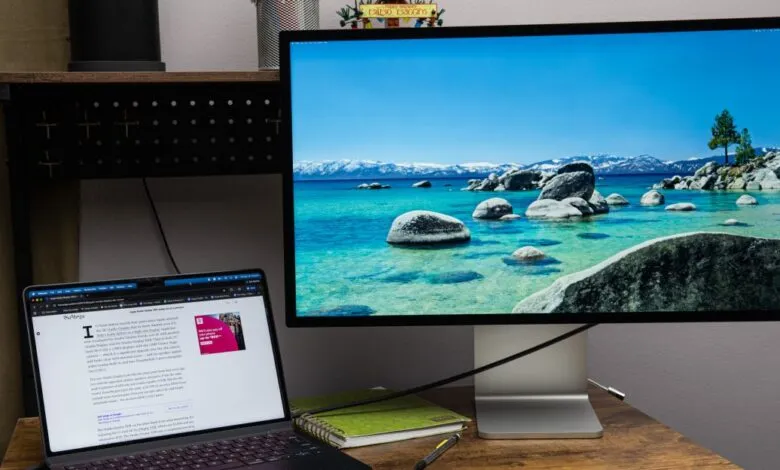
Build quality is excellent on the Studio Display, with its all-aluminum frame, but the base model’s stand options are frustrating. For $1,600, you get either a tilt-only stand or a VESA mount with no stand, and you must choose at checkout. A tilt- and height-adjustable stand costs an extra $400. It doesn’t rotate or pivot, and you can’t remove the stand or add a VESA mount yourself later.
Competitors offer far more flexibility. The BenQ MA270S, PD2730S, and Asus ProArt PA27JCV all have stands that pivot, rotate, tilt, and adjust in height. They are also removable for VESA mounting. While none are as robust or visually appealing as Apple’s, the extra flexibility is a clear advantage. The BenQ MA270S even has a rubber pad on the front for your phone or earbuds.
Port selection on the 2026 Studio Display is improved but still designed for Apple’s ecosystem. The Thunderbolt 5 upgrade is nice for daisy-chaining, but you can only connect one computer at a time. There’s no HDMI, DisplayPort, USB-A, audio out, KVM, or any physical controls. Everything is managed through the connected Mac’s settings, and there’s no power button. The BenQs, Asus, and KTC all offer more connectivity. While none have Thunderbolt 5, the BenQ monitors include Thunderbolt 4, and all have at least one HDMI port. The Asus and BenQ models also feature a KVM for using one set of peripherals with multiple computers.
During my testing, the BenQ MA270S became my favorite. It delivers a great picture, fits my desk better than the Studio Display, and lets me connect both my M4 MacBook Air and Windows PC simultaneously, switching between them quickly. It has a power button, and I can adjust brightness and color modes from my computers. At $1,000, it’s half the price of the Studio Display with the height-adjustable stand. Its glossy screen isn’t for everyone, but the matte BenQ PD2730S and Asus ProArt are excellent alternatives for those needing more reflection handling.
Having a 5K panel alone isn’t enough to compete. The $550 KTC H27P3 offers a sharp image but has a wobbly tilt-only stand, limited ports, and color inaccuracies that make it unsuitable for professional work.
Apple missed a clear opportunity with the Studio Display. Instead of upgrading the backlight, offering a more flexible stand, or using a higher refresh rate panel, we only got Thunderbolt 5 ports and a better camera on a dated panel. At $1,600, it’s hard to justify when competitors cost hundreds less and offer similar color accuracy with superior ergonomics and features.
All the monitors I tested use panels similar to Apple’s 60Hz edge-lit IPS panel from 2014. But now that the Studio Display XDR exists, competitors have more options too. New monitors like the LG 27GM950B and Asus ROG Strix XG27JCG use mini-LED backlighting with high refresh rates for $1,200 or less, making the standard Studio Display feel increasingly out of touch. We’re also approaching the arrival of 120Hz 27-inch 5K OLED monitors, as both LG Display and Samsung Display have demonstrated the technology.
In 2022, the Studio Display was the best option for a 27-inch 5K monitor. That’s no longer true. The 2026 Studio Display isn’t the only game in town, and it’s not the best option either. Unless you prioritize Apple’s design above all else, you’re better off saving your money with something else.
(Source: The Verge)