DAIMON Robotics Aims to Give Robot Hands a Sense of Touch
▼ Summary
– DAIMON Robotics released Daimon-Infinity, the largest omni-modal robotic dataset for physical AI, with high-resolution tactile sensing data from tasks like folding laundry to factory assembly, supported by partners including Google DeepMind.
– The dataset initiative addresses a data scarcity bottleneck in robot learning, particularly the lack of physical interaction data, by leveraging DAIMON’s vision-based tactile sensor technology.
– DAIMON has open-sourced 10,000 hours of its dataset to accelerate embodied AI deployment, while building a distributed out-of-lab collection network to generate millions of hours of data annually.
– The company’s Vision-Tactile-Language-Action (VTLA) architecture elevates tactile sensing to a modality on par with vision, enhancing the standard VLA model for dexterous manipulation tasks.
– DAIMON’s business strategy, termed “3D” (Devices, Data, Deployment), focuses on tactile sensor hardware, real-world data collection, and deploying robots in specific domains like hotels and convenience stores.
This April, Hong Kong-based DAIMON Robotics unveiled Daimon-Infinity, a dataset it calls the largest omni-modal robotic collection for physical AI. It features high-resolution tactile sensing across a diverse spectrum of tasks, from folding laundry in a home environment to precision work on factory assembly lines. The initiative has drawn support from a global network of collaborators, including Google DeepMind, Northwestern University, and the National University of Singapore.
The release marks a pivotal strategic move for DAIMON, a company just two and a half years old that has already made a name for itself with advanced tactile sensor hardware. Its flagship product is a monochromatic, vision-based tactile sensor that packs over 110,000 effective sensing units into a module the size of a fingertip. By leveraging this high-resolution technology and a distributed, out-of-lab collection network capable of generating millions of hours of data annually, DAIMON is constructing large-scale robot manipulation datasets rich with tactile information. To help accelerate the real-world deployment of embodied AI, the company has also open-sourced 10,000 hours of this data.
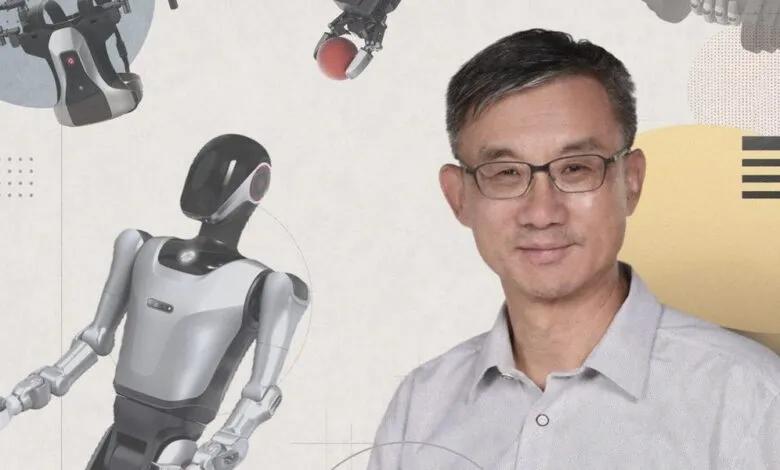
Behind this strategy is Prof. Michael Yu Wang, DAIMON’s co-founder and chief scientist. He earned his PhD at Carnegie Mellon, studying manipulation under the renowned Matt Mason, and later founded the Robotics Institute at the Hong Kong University of Science and Technology. An IEEE Fellow and former Editor-in-Chief of IEEE Transactions on Automation Science and Engineering, Wang has spent roughly four decades in the field. His core objective is to solve the problem of “insensitivity” in robot manipulation, a limitation of the dominant Vision-Language-Action (VLA) model. He and his team have pioneered the Vision-Tactile-Language-Action (VTLA) architecture, elevating tactile feedback to a modality on par with vision.
We spoke with Prof. Wang about how tactile feedback is set to change dexterous manipulation, how the dataset initiative will improve our understanding of robotic hands in natural environments, and where , from hotels to convenience stores in China , he expects touch-enabled robots to make their first real-world inroads.
The Dataset Initiative
This month, DAIMON Robotics released the largest and most comprehensive robotic manipulation dataset, developed with multiple leading academic institutions and enterprises. Why release the dataset now rather than continuing to focus solely on product development? What impact will this have on the embodied intelligence industry?
DAIMON Robotics has been around for almost two and a half years. We have been committed to developing high-resolution, multimodal tactile sensing devices to perceive the interaction between a robot’s hand , particularly its fingertips , and objects. Our devices have become quite robust. They are now accepted and used by a large segment of users, including academic and research institutes as well as leading humanoid robotics companies.
As embodied AI continues to advance, the critical role of data has become clearer. Data scarcity remains a primary bottleneck in robot learning, particularly the lack of physical interaction data, which is essential for robots to operate effectively in the real world. Consequently, data quality, reliability, and cost have become major concerns in both research and commercial development.
This is exactly where DAIMON excels. Our vision-based tactile technology captures high-quality, multimodal tactile data. Beyond basic contact forces, it records deformation, slip and friction, material properties, and surface textures , enabling a comprehensive reconstruction of physical interactions. Building on our expertise in multimodal fusion, we have developed a robust data processing pipeline that seamlessly integrates tactile feedback with vision, motion trajectories, and natural language, transforming raw inputs into training-ready datasets for machine learning models.
Recognizing the industry-wide data gap, we view large-scale data collection not only as our unique competitive advantage, but as a responsibility to the broader community. By building and open-sourcing the dataset, we aim to provide the high-quality “fuel” needed to power embodied AI, ultimately accelerating the real-world deployment of general-purpose robotic foundation models.
The robotics industry is highly competitive, and many teams have chosen to focus on data. DAIMON is releasing a large, highly comprehensive, cross-embodiment, vision-based tactile multimodal robotic manipulation dataset. How were you able to achieve this?
We have a dedicated in-house team focused on expanding our capabilities, including building hardware devices and developing our own large-scale model. Although we are a relatively small company, our core tactile sensing technology and innovative data collection paradigm enable us to build a large-scale dataset.
Our approach is to broaden our offering. We have built the world’s largest distributed out-of-lab data collection network. Rather than relying on centralized data factories, this lightweight and scalable system allows data to be gathered across diverse real-world environments, enabling us to generate millions of hours of data per year.
“To drive the advancement of the entire embodied AI field, we have open-sourced 10,000 hours of the dataset for the broader community.” ,Prof. Michael Yu Wang, DAIMON Robotics
This dataset is being jointly developed with several institutions worldwide. What roles did they play in its development, and how will the dataset benefit their research and products?
Besides China-based teams, our partners include leading research groups from universities, such as Northwestern University and the National University of Singapore, as well as top global enterprises like Google DeepMind and China Mobile. Their decision to partner with DAIMON is a strong testament to the value of our tactile-rich dataset.
Among the companies involved, some have already built their own models but are now incorporating tactile information. By deploying our data collection devices across research, manufacturing, and other real-world scenarios, they help us gather highly practical, application-driven data. In turn, our partners leverage the data to train models tailored to their specific use cases. Furthermore, to drive the advancement of the entire embodied AI field, we have open-sourced 10,000 hours of the dataset for the broader community.
From VLA to VTLA: Why Tactile Sensing Changes the Equation
The mainstream paradigm in robotics is currently the Vision-Language-Action (VLA) model, but your team has proposed a Vision-Tactile-Language-Action (VTLA) model. Why is it necessary to incorporate tactile sensing? What does it enable robots to achieve, and which tasks are likely to fail without tactile feedback?
Over these years of working to make generalist robots capable of performing manipulation tasks , especially dexterous manipulation, not just power grasping or holding an object, but manipulating objects and using tools to impart forces and motion onto parts , we see these robots being used in household as well as industrial assembly settings.
It is well established that tactile information is essential for providing feedback about contact states so that robots can guide their hands and fingers to perform reliable manipulation. Without tactile sensing, robots are severely limited. They struggle to locate objects in dark environments, and without slip detection, they can easily drop fragile items like glass. Furthermore, the inability to precisely control force often leads to failed manipulation tasks or, in severe cases, physical damage. Naturally, the VLA approach needs to be enhanced to incorporate tactile information. We expanded the VLA framework to incorporate tactile data, creating the VTLA model.
An additional benefit of our tactile sensor is that it is vision-based: We capture visual images of the deformation on the fingertip surface. We capture multiple images in a time sequence that encodes contact information, from which we can infer forces and other contact states. This aligns well with the visual framework that VLA is based upon. Having tactile information in a visual image format makes it naturally suitable for integration into the VLA framework, transforming it into a VTLA system. That is the key advantage: Vision-based tactile sensors provide very high resolution at the pixel level, and this data can be incorporated into the framework, whether it is an end-to-end model or another type of architecture.
The Technology: Monochromatic Vision-based Tactile Sensing
You and your team have spent many years deeply engaged in vision-based tactile sensing and have developed the world’s first monochromatic vision-based tactile sensing technology. Why did you choose this technical path?
Once we started investigating tactile sensors, we understood our needs. We wanted sensors that closely mimic what we have under our fingertip skin. Physiological studies have well documented the capabilities humans have at their fingertips , knowing what we touch, what kind of material it is, how forces are distributed, and whether it is moving into the right position as our brain controls our hands. We knew that replicating these capabilities on a robot hand’s fingertips would help considerably.
When we surveyed existing technologies, we found many types, including vision-based tactile sensors with tri-color optics and other simpler designs. We decided to integrate the best of these into an engineering-robust solution that works well without being overly complicated, keeping cost, reliability, and sensitivity within a satisfactory range, thus ultimately developing a monochromatic vision-based tactile sensing technique. This is fundamentally an engineering approach rather than a purely scientific one, since a great deal of foundational research already existed. With the growing realization of the necessity of tactile data, all of this will advance hand in hand.
Last year, DAIMON launched a multi-dimensional, high-resolution, high-frequency vision-based tactile sensor. Compared with traditional tactile sensors, where does its core advantage lie? Which industries could it potentially transform?
The key features of our sensors are the density of distributed force measurement and the deformation we can capture over the area of a fingertip. I believe we have the highest density in terms of sensing units. That is one very important metric. The other is dynamics: the frequency and bandwidth , how quickly we can detect force changes, transmit signals, and process them in real time. Other important aspects are largely engineering-related, such as reliability, drift, durability of the soft surface, and resistance to interference from magnetic, optical, or environmental factors.
A growing number of researchers and companies are recognizing the importance of tactile sensing and adopting our technology. I believe the advances in tactile sensing will elevate the entire community and industry to a higher level. One of our potential customers is deploying humanoid robots in a small convenience store, with densely packed shelves where shelf space is at a premium. The robot needs to reach into very tight spaces , tighter than books on a shelf , to pick out an object. Current two-jaw parallel grippers cannot fit into most of these spaces. Observing how humans pick up objects, you clearly need at least three slim fingers to touch and roll the object toward you and secure it. Thus, we are starting to see very specific needs where tactile sensing capabilities are essential.
From Academia to Startup
After 40 years in academia , founding the HKUST Robotics Institute, earning prestigious honors including IEEE Fellow, and serving as Editor-in-Chief of IEEE TASE , what motivated you to found DAIMON Robotics?
I have come a long way. I started learning robotics during my PhD at Carnegie Mellon, where there were truly remarkable groups working on locomotion under Marc Raibert, who founded Boston Dynamics, and on manipulation under my advisor, Matt Mason, a leader in the field. We have been working on dexterous manipulation, not only at Carnegie Mellon, but globally for many years.
However, progress has been limited for a long time, especially in building dexterous hands and making them work. Only recently have locomotion robots truly taken off, and only in the last few years have we begun to see major advancements in robot hands. There is clearly room for advancing manipulation capabilities, which would enable robots to do work like humans. While at Hong Kong University of Science and Technology, I saw increasingly more people entering this area in the form of students and postdoctoral researchers. We wanted to jumpstart our effort by leveraging the available capital and talent resources.
Fortunately, one of my postdocs, Dr. Duan Jianghua, has a strong sense for commercial opportunities. Recognizing the rapid growth of the robotics market and the unique value that our vision-based tactile sensing technology could bring, together we started DAIMON Robotics, and it has progressed well. The community has grown tremendously in China, Japan, Korea, the U. S., and Europe.
Business Model and Commercial Strategy
What is DAIMON’s current business model and strategic focus? What role does the dataset release play in your commercial strategy?
We started as a device company focused on making highly capable tactile sensors, especially for robot hands. But as technology and business developed, everyone realized it is not just about one component, but rather the entire technology chain: devices, data of adequate quality and quantity, and finally the right framework to build, train, and deploy models on robots in real application environments.
Our business strategy is best described as “3D”: Devices, Data, and Deployment. We build devices for data collection, our own ecosystem, and for deploying them in our partners’ potential application domains. This enables the collection of real-world tactile-rich data and complete closed-loop validation. This will become an integral part of the 3D business model. Most startups in this space are following a similar path until eventually some may become more specialized or more tightly integrated with other companies. For now, it is mostly vertical integration.
Embodied Skills and the Convergence Moment
You’ve introduced the concept of “embodied skills” as essential for humanoid robots to move beyond having just an advanced AI “brain.” What prompted this insight? What new capabilities could embodied skills enable? After the rapid evolution of models and hardware over the past two years, has your definition or roadmap for embodied skills evolved?
We have come a long way and now see a convergence point where electrical, electronic, and mechatronic hardware technologies have advanced tremendously in the last two decades. Robots are now fully electric and do not require hydraulics, because hardware has evolved rapidly. Modern electronics provide tremendous bandwidth with high torques. If we can build intelligence into these systems, we can create truly humanoid robots with the ability to operate in unstructured environments, make decisions, and take actions autonomously.
“Our vision is for robots to achieve robust manipulation capabilities and evolve into reliable partners for humans.” ,Prof. Michael Yu Wang, DAIMON Robotics
AI has arrived at exactly the right time. Enormous resources have been invested in AI development, especially large language models, which are now being generalized into world models that enable physical AI capabilities. We would like to see these manifested in real-world systems.
While both AI and core hardware technologies continue to evolve, the focus is much clearer now. For example, human-sized robots are preferred in a home environment. This is an exciting domain with a promise of great societal benefit if we can eventually achieve safe, reliable, and cost-effective robots.
The Road to Real-World Deployment
Today, many robots can deliver impressive demos, yet there remains a gap before they truly enter real-world applications. What could be a potential trigger for real-world deployment? Which scenarios are most likely to achieve large-scale deployment first?
I think the road toward large-scale deployment of generalist robots is still long, but we are starting to see signs of feasibility within specific domains. It is very similar to autonomous vehicles, where we are yet to see full deployment of robo-taxis, while we have already started to find mobile robots and smaller vehicles widely deployed in the hospitality industry. Virtually every major hotel in China now has a delivery robot , no arms, just a vehicle that picks up items from the hotel lobby (e.g., food deliveries). The delivery person just loads the food and selects the room number. It is up to the robot thereafter to navigate and reach the guest’s room, which includes using the elevator, to deliver the food. This is already nearly 100 percent deployed in major Chinese hotels.
Hotel and restaurant robots are viewed as a model for deploying humanoid robots in specific domains like overnight drugstores and convenience stores. I expect complete deployment in such settings within a short timeframe, followed by other applications. Overall, we can expect autonomous robots, including humanoids, to progressively penetrate specific sectors, delivering value in each and expanding into others.
Ultimately, our vision is for robots to achieve robust manipulation capabilities and evolve into reliable partners for humans. By seamlessly integrating into our homes and daily lives, they will genuinely benefit and serve humanity.
This interview has been edited for length and clarity.
(Source: Ieee.org)