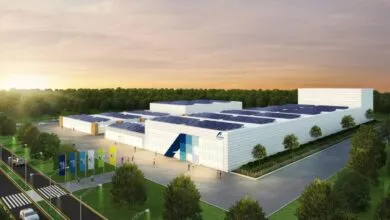
Blue Energy raises $380M for shipyard-built nuclear reactors

▼ Summary
– Tech companies and utilities are reconsidering nuclear power to meet rising electricity demands from AI and electrification, but recent U.S. reactor projects have been plagued by delays and cost overruns.
– Startup Blue Energy proposes building nuclear reactors in shipyards, inspired by the historical construction of naval reactors, to prefabricate components for easier transport and assembly.
– The company has raised $380 million to begin construction on a 1.5-gigawatt power plant in Texas later this year, using a mix of equity and debt financing.
– Blue Energy’s strategy focuses on changing construction methods, not reactor design, by centralizing work in controlled shipyard environments to reduce on-site labor and enable future automation.
– This approach aims to make nuclear projects more predictable and financeable by significantly cutting construction costs and timelines, which has attracted interest from major infrastructure funds and banks.
The growing demand for electricity from artificial intelligence data centers and broader electrification is pushing the power grid to its limits, creating a renewed search for reliable, large-scale solutions. While recent U.S. nuclear projects have been plagued by major delays and cost overruns, a new company is looking to the industry’s origins for a solution. Blue Energy has secured $380 million in financing to pursue a novel strategy: constructing full-scale nuclear reactors in shipyards.
The company’s co-founder and CEO, Jake Jurewicz, points out that the most common reactor technology, the light water reactor, was first developed for nuclear submarines. This maritime heritage suggests a path forward. By shifting complex fabrication to a controlled shipyard environment, Blue Energy aims to streamline construction, cut costs, and improve scheduling predictability before shipping completed components by barge to the final site.
Unlike many ventures designing entirely new reactors, Blue Energy is focused on innovating the build process itself. Jurewicz found inspiration in the methods used by liquefied natural gas companies like Venture Global, which have dramatically accelerated project timelines through modular, off-site construction. Applying a similar modular manufacturing approach to nuclear components could be similarly disruptive, he believes.
The company’s first project is a 1.5 gigawatt power plant in Texas, with construction planned to begin later this year. The recent funding round, led by VXI Capital with participation from At One Ventures, Engine Ventures, and Tamarack Global, will support this initial development. Jurewicz argues that centralizing work in a shipyard minimizes on-site labor, opens the door to greater automation, and fundamentally changes the project’s financial risk profile.
A key advantage of the maritime strategy is logistics. While it limits site selection to areas accessible by water, major rivers provide a pathway to serve large populations across the U. S., Europe, Africa, and Asia. “The majority of our population and the majority of our load growth is happening around waterways,” Jurewicz noted.
This approach is reportedly gaining traction with project financiers. The company has engaged with large infrastructure funds and banks, with three major project financing institutions responding to its request for proposal. Jurewicz states this is a strong signal that the industry views their model as financially viable. For him, controlling construction costs and schedules is the central challenge for nuclear power’s future.
“The crux of the issue with nuclear is not the technology,” Jurewicz explained. “It is how we get the construction costs and the construction schedule down to a place where it’s predictable.” By returning to a shipyard-built model, Blue Energy is betting that the industry’s past holds the blueprint for its future scalability.
(Source: TechCrunch)