Meet Bruce: The Parrot That Jousts With Its Beak
▼ Summary
– Bruce, a kea parrot missing his upper beak, became the dominant male in his group at a wildlife reserve.
– He developed a unique preening method using small pebbles as tools, a behavior he invented independently.
– Researchers concluded this tool use demonstrates the species’ high problem-solving abilities.
– Bruce won all his observed male-male conflicts, challenging the theory that better-armed opponents always win.
– His alpha status granted him low stress hormones, priority feeding access, and unique grooming from another bird.
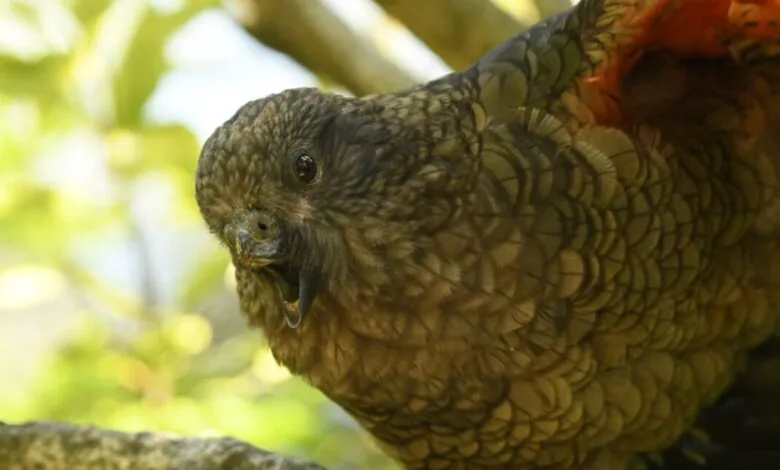
The remarkable story of a disabled parrot achieving dominance in his social group is challenging long-held scientific beliefs about animal conflict. Bruce the kea, an alpine parrot from New Zealand, lost his upper beak as a juvenile. Despite this significant physical disadvantage, he has risen to become the undisputed alpha male within his group, or “circus,” at the Willowbank Wildlife Reserve. A new study reveals his secret, a unique jousting fighting style that leverages his remaining lower beak to defeat rivals.
Bruce was already known for his exceptional ingenuity. In 2021, researchers documented his innovative preening behavior. Unable to preen normally, he independently discovered how to use small pebbles as tools, wedging them between his tongue and lower jaw to groom his feathers. While other keas played with larger stones, none used them for this practical purpose. This demonstrated not just high problem-solving abilities but potentially deliberate tool use, a trait the species is known for. His successful adaptation is precisely why caretakers have opted against fitting him with a prosthetic beak, avoiding unnecessary stress and the disruption of his hard-won skills.
His latest achievement directly contests a core principle of contest theory. This framework in behavioral ecology typically predicts that the larger or better-armed individual will win a fight. Bruce’s circus, with nine males and three females, provided a perfect test case. Over four weeks, scientists recorded 162 male-male interactions. Bruce participated in 36 of these conflicts and won every single one, solidifying his top position. His dominance was reflected in other ways, he showed the lowest levels of stress hormones, received priority at feeding stations, and was even groomed by a non-mate, a privilege extended to no other bird in the group.
Bruce’s success stems from his unconventional combat strategy. He uses his strong neck muscles to drive his sharp lower beak upward in a rapid, forceful motion, essentially jousting with opponents. This technique allows him to target vulnerable areas like the legs and underbelly of rivals, who are accustomed to facing off against opponents with two beaks used for grappling. His method is so effective that other keas often yield immediately upon seeing his distinctive approach, a clear sign of his established social status. This case shows that resourcefulness and novel tactics can outweigh pure physical weaponry in the complex social hierarchies of the animal kingdom.
(Source: Ars Technica)