Nvidia RTX 5060 Ti 8GB Review: Palit Dual Performance
▼ Summary
– The RTX 5060 Ti 8GB is a capable GPU for 1080p and 1440p gaming, generally outperforming its direct competitor, the AMD Radeon RX 9060 XT 8GB.
– Its primary limitation is the 8GB of VRAM, which can cause significantly lower performance than 16GB variants in certain games at high settings or resolutions.
– The card is often around $100 cheaper than the RTX 5060 Ti 16GB model, making it a more attractive proposition for its price point.
– In testing, it runs reasonably cool and quiet, though it operates at higher temperatures than comparable AMD cards.
– Real-world gaming performance can differ from synthetic benchmarks, with the 8GB constraint becoming more apparent in VRAM-heavy titles.
For gamers seeking strong performance at 1080p and 1440p without breaking the bank, the GeForce RTX 5060 Ti 8 GB presents a compelling case. In a market where rising memory costs have inflated prices, this more affordable variant of the 5060 Ti lineup stands out as a budget-friendly graphics card for mainstream builds. After extensive testing with a Palit Dual model, it’s clear this GPU delivers impressive speed for its class, though its 8 GB VRAM capacity introduces some clear limitations that buyers must consider.
The card’s core mission is straightforward: offer performance close to its 16 GB sibling for significantly less money at common gaming resolutions. For the most part, it succeeds. In synthetic benchmarks at 1080p and 1440p, the average frame rates between the 8 GB and 16 GB models are often surprisingly close. The Palit Dual cooler also manages thermals adequately, and the GPU consistently outperforms its direct rival, the AMD Radeon RX 9060 XT 8 GB, in most gaming tests. However, benchmark tools don’t capture the full picture. In real-world gameplay, especially in titles with high texture demands or at elevated settings, the VRAM constraint can cause noticeable performance dips compared to cards with more memory.
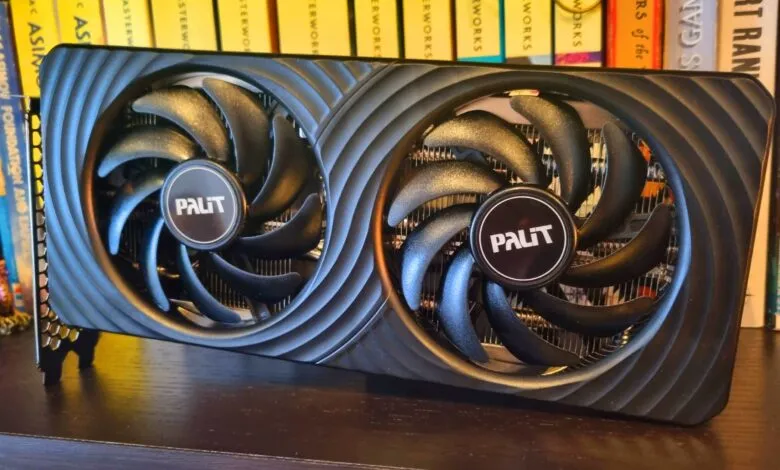
Under the hood, this model uses the same GB206 graphics chip and 128-bit memory bus as the 16 GB version, paired with speedy GDDR7 memory for a 448 GB/s bandwidth. The core specifications include 4608 CUDA cores, a boost clock of 2572 MHz, and a 180W typical power draw. The Palit Dual is a compact, dual-fan design that stays remarkably quiet under load, a significant plus for noise-conscious builders. Connectivity includes three DisplayPort 2.1b ports and one HDMI 2.1b.
Gaming performance reveals the card’s strengths and weaknesses. At 1080p, it delivers very playable frame rates. In Black Myth Wukong at High settings, it averaged 74 fps, nearly matching the 16 GB card. The story changes with more demanding titles. In Cyberpunk 2077 at RT Ultra settings, while the average fps was similar, the 1% low frame rates were significantly worse on the 8 GB model, indicating more frequent stutters. When settings are adjusted to a more realistic Medium RT with upscaling, the RTX 5060 Ti 8 GB solidly beats the 8 GB AMD competitor, though it still trails the 16 GB cards in smoothness.
The pattern continues at 1440p. Average frame rates remain competitive, but the performance consistency offered by cards with more VRAM becomes more apparent. In specific games like The Last of Us Part I, a known VRAM-heavy title, real-world testing showed the 8 GB cards falling far behind their 16 GB counterparts in both average fps and 1% lows, even with upscaling enabled. This highlights a crucial caveat: while benchmarks can show parity, actual gameplay in modern, demanding titles often tells a different story. 4K gaming is not a recommended use case for this card, as performance drops off sharply and the VRAM limitation becomes a severe bottleneck.
Thermally, the Palit Dual runs warmer than some competitors, hitting a peak of 68°C under load, but it remains within safe limits. Its acoustic performance is excellent, making it one of the quieter options in its category. The software experience is hassle-free, utilizing the standard Nvidia App for driver updates and feature management.
Value is the final and most complex assessment. While the official MSRP is $380, current market prices are higher. At around $400, the RTX 5060 Ti 8 GB faces a tricky landscape. It generally outperforms the similarly priced RX 9060 XT 8 GB, making it the better 8 GB option. However, for roughly $50 more, the RX 9060 XT 16 GB becomes available, and in VRAM-intensive scenarios, its extra memory allows it to pull decisively ahead. The RTX 5060 Ti 16 GB is also superior overall but commands a price premium of about $100.
Ultimately, this GPU is a capable 1080p and 1440p performer that makes sense for budget-conscious gamers who are willing to adjust settings for optimal performance. It is not for the “max settings or bust” crowd or for those who frequently play the latest, most demanding open-world games. If you can find it near its intended price and understand its limitations, the RTX 5060 Ti 8 GB offers a solid blend of speed and efficiency for mainstream gaming.
(Source: PC Gamer)