Build a Robot Snowman in 5 Steps
▼ Summary
– Nvidia’s GTC conference featured announcements like trillion-dollar sales projections, advanced graphics technology, and a demo of a Disney “Frozen”-themed Olaf robot.
– During a TechCrunch podcast recap, the hosts discussed CEO Jensen Huang’s keynote and debated the implications of his statement that every company needs an “OpenClaw” strategy.
– The podcast hosts highlighted a malfunction during the Olaf robot demo, where its microphone had to be cut off after it began rambling uncontrollably.
– A key criticism raised was that such robotics demos focus on engineering challenges while ignoring complex social and practical issues, like how the public might interact with or damage such robots.
– The discussion noted that Nvidia’s investment in open-source projects like NemoClaw is a strategic move to embed its technology in other enterprises and mitigate competitive risk.
Nvidia’s recent GTC conference showcased the company’s expansive vision, from its financial ambitions to new graphics tools and a strategic push for enterprise AI adoption. Amid the announcements, a memorable demonstration featured a robotic version of Disney’s Olaf, which sparked a broader conversation about the practical realities of deploying such technology. During a TechCrunch Equity podcast discussion, we analyzed CEO Jensen Huang’s keynote, debating not just Nvidia’s future but also the complex social implications often overshadowed by engineering feats.
Huang’s declaration that every enterprise needs an OpenClaw strategy was a bold, attention-grabbing statement. This comes at a pivotal time for the open-source project, whose founder has moved to OpenAI. Its future now hinges on community and corporate support. If heavyweights like Nvidia invest significantly, OpenClaw could thrive independently. The coming year will reveal whether Huang’s pronouncement was prescient or merely a passing remark.
For Nvidia, promoting its own open-source project, NemoClaw, built with OpenClaw’s creator, involves minimal risk. The underlying message, however, is strategic. By urging enterprises to adopt an OpenClaw plan, Nvidia is essentially ensuring it has a crucial pathway to embed its technology into countless other businesses. Inaction poses a greater threat than launching an initiative that may not fully succeed.
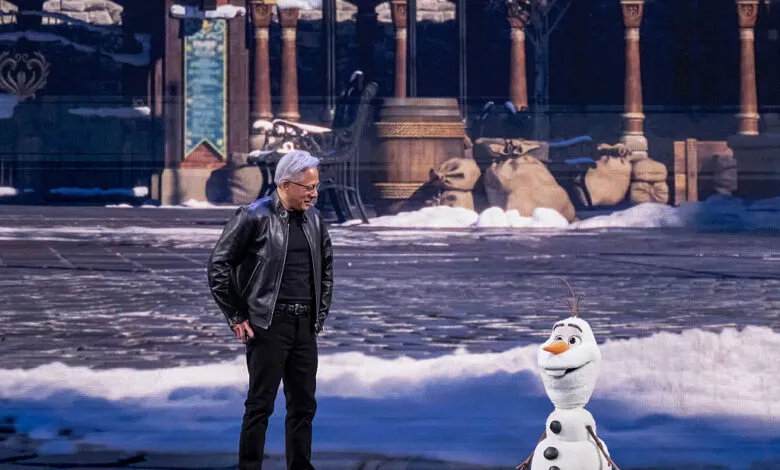
The conference’s most talked-about moment, however, was the Olaf robot. Huang enjoys these live demos, which are designed to showcase Nvidia’s robotics prowess. While it was unclear if Olaf was responding in real time or following a script, the demo took an amusing turn when the robot began rambling and its microphone was cut off. The image of a silently chattering Olaf being slowly lowered from the stage was both humorous and telling.
These demonstrations, while impressive on a technical level, frequently overlook the messy realities of real-world implementation. The Olaf robot was presented as a potential future for Disney parks, where guests could interact with animated characters. Yet, such presentations rarely address the significant social and logistical challenges. A key question arises: what happens when a child knocks Olaf over? A single malfunction could ruin the experience for many guests and damage the brand.
This highlights a common gap in the robotics discourse. While the engineering challenges of mobility, physics, and integration are fascinating and widely discussed, the conversation seldom extends to the gray areas of social integration. The focus remains on what is technically possible, not on how these technologies will coexist with humans in unpredictable environments. The hype around humanoid robots faces the same scrutiny; the difficult questions about public interaction and safety are often sidelined.
There is, however, a potential upside to this technological shift. Introducing advanced animatronics like Olaf into theme parks could become a significant job creator. Each robotic character would likely require a human attendant, perhaps dressed as a companion character like Elsa, to monitor interactions and ensure safety. In this light, the engineering experiment also presents an opportunity for new roles, blending advanced technology with essential human oversight.
(Source: TechCrunch)