DoorDash Expands Beyond Delivery with New Tasks Feature
▼ Summary
– DoorDash has launched a new “Tasks” platform that pays its gig workers to perform small, specific data-collection jobs, such as filming household chores or scanning retail shelves, to generate training data for AI and robotics companies.
– The platform leverages DoorDash’s existing network of over 8 million couriers as a ready-made, in-person workforce to efficiently collect valuable physical-world data that is difficult for other companies to replicate.
– A notable example is a partnership with Waymo, where Dashers are paid to drive to and close the open doors of autonomous vehicles, a task the self-driving cars cannot yet perform themselves.
– The launch raises significant unanswered questions regarding worker pay transparency, data privacy, consent, and the exclusion of regions with stricter gig worker regulations like California and New York City.
– This initiative represents the creation of an on-demand, task-paid “human sensing layer” over the physical world, a concept other delivery platforms like Uber and Instacart are also exploring.
Imagine a future where a delivery driver earns a few dollars not just for bringing you a meal, but for filming themselves washing dishes. This specific, reproducible footage is a goldmine for companies building the next generation of AI and robots. DoorDash is now formally entering this new data economy with its “Tasks” platform, leveraging its vast network of over eight million drivers to collect the physical-world information that tech firms desperately need.
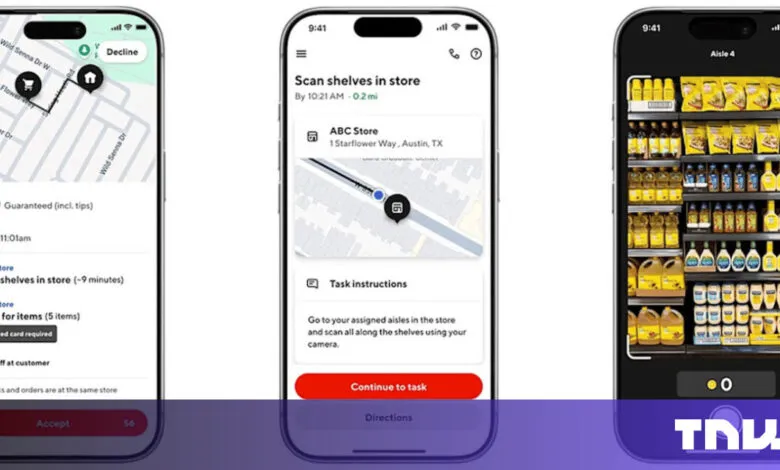
The initiative operates on two fronts. Within the main Dasher app, drivers can now accept jobs like photographing restaurant dishes for digital menus or scanning grocery store shelves for inventory checks. More notably, a separate Tasks app handles assignments with no delivery involved at all. These can range from recording household chores and casual conversations in different languages to, in a notable partnership, closing the doors of Waymo’s self-driving cars.
The Waymo door-closing program is a small task with major symbolic weight. When an autonomous vehicle’s door is left open—a safety issue that halts the car—a nearby Dasher can get an alert and earn roughly $11 to drive over and shut it. It presents a striking image: gig workers, often seen as the first to be replaced by automation, are being paid by a robotics company to solve a problem its own technology cannot yet handle.
For DoorDash, the move is a logical extension of its core business. The company has spent years perfecting a system to dispatch people to precise locations, verify their work, and process payments. This existing operational infrastructure is precisely what large-scale AI data collection requires, a capability not easily replicated by firms without a ready-made, nationwide human network.
“We have millions of Dashers who can reach almost anywhere and want flexible earning opportunities beyond delivery,” said Ethan Beatty, General Manager of DoorDash Tasks. “That’s a powerful capability for digitizing the physical world.” This scale positions DoorDash to compete directly with data-labeling firms, but with a key advantage: its workers operate in the real world, gathering the embodied, hands-on data that is becoming increasingly scarce and valuable.
Since early 2024, Dashers have already completed over two million tasks through earlier versions of this program. DoorDash is not alone in this pivot; rivals like Uber and Instacart have launched similar data-gathering services in the past year.
However, significant questions remain unanswered by the launch. DoorDash has not detailed its policies on user consent, data retention, or workers’ rights regarding footage filmed inside their own homes. The program’s notable absence in California, New York City, Seattle, and Colorado—regions with stronger gig worker and privacy laws—highlights potential regulatory hurdles.
Pay is set per task based on estimated effort, but the company has not published average rates or minimum pay guarantees. For a program that asks workers to bring cameras into their private spaces and record their voices, these are not trivial concerns.
DoorDash plans to expand Tasks into more categories and countries. For now, it has successfully launched a scalable version of a long-sought tech industry concept: a human-powered sensing layer over the physical world, available on-demand and paid by the task.
(Source: The Next Web)