Rubik’s WOWCube Reinvents the Classic Puzzle with New Complexity
▼ Summary
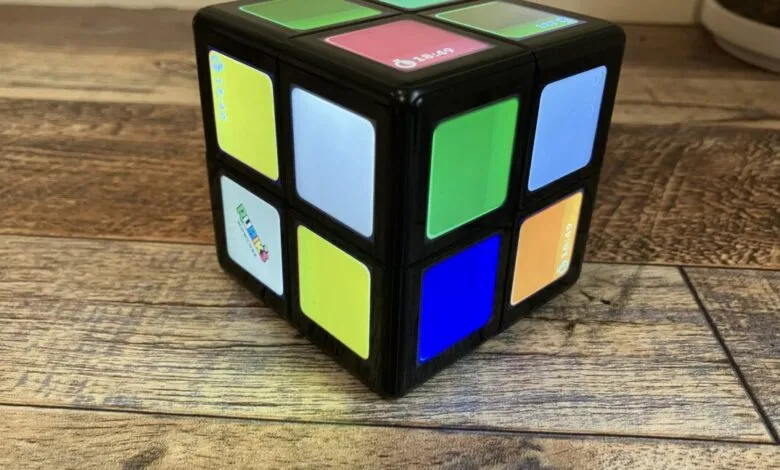
– The WOWCube is a modern, electronic version of the classic Rubik’s Cube, featuring a 2×2 grid of screens instead of a 3×3 grid of colored stickers.
– It is significantly more expensive at $399 compared to the original’s $10 price point and includes features like playing other games and displaying information.
– The device’s simpler 2×2 design makes solving its core puzzle significantly easier than the traditional 54-square Rubik’s Cube.
– While it successfully modernizes the puzzle, the article suggests its extensive technology can overshadow the original’s straightforward appeal.
– The product exemplifies the tension where adding advanced technology to a classic gadget risks compromising its fundamental charm.
The Rubik’s WOWCube represents a bold technological reimagining of the iconic puzzle, aiming to enhance its appeal through digital screens and interactive software. While it successfully introduces a new dimension of play, this innovation comes with a significant trade-off in both price and the core puzzling experience that made the original so enduring. This device must justify its existence not merely by adding features, but by fundamentally improving upon a classic that has thrived on elegant, mechanical simplicity for decades.
The original Rubik’s Cube, invented by Hungarian professor Ernő Rubik, was a marvel of structural design. Its genius lay in creating a solid object composed of smaller cubes that could rotate freely without the entire assembly falling apart. It became a global phenomenon, a staple of pop culture, and a benchmark for spatial puzzles, all without a single wire, sensor, or line of code. Its enduring popularity is underscored by its accessible price point, often around ten dollars.
The WOWCube takes a radically different path. Priced at $399, it transforms the familiar 3×3 grid into a 2×2 configuration. Each of the cube’s faces is composed of four small, full-color IPS screens, creating a total of 24 individual display panels. This digital canvas allows it to function as a traditional 2×2 puzzle, but also to run various games, display animations like screensavers, and even show basic information like the weather. It’s powered by a rechargeable battery, features multiple built-in speakers, and runs on a proprietary operating system called CubiOS.
However, this infusion of technology fundamentally alters the puzzle’s challenge. The smaller 2×2 grid offers a significantly reduced complexity compared to the traditional 54-colored squares of a standard cube. With only 24 panels to manage, solving the core puzzle is a much faster and less demanding task. Dedicated enthusiasts who relish the intricate, multi-layered problem-solving of the 3×3 cube may find this simplified version underwhelming. While speed solvers might appreciate a new platform for rapid execution, the depth of strategic thinking is inherently diminished.
The device’s technical specifications are impressive on paper, boasting high-resolution displays and a substantial total battery capacity. Yet, these features risk overshadowing the cube’s primary function. The original’s beauty was in its tactile, intuitive mechanics, a self-contained challenge requiring no instructions, charging cables, or software updates. The WOWCube’s reliance on electronics, its premium cost, and its simplified puzzle structure raise a compelling question: does adding digital layers genuinely enhance the experience, or does it inadvertently dilute the very essence of what made the Rubik’s Cube a timeless icon?
(Source: Ars Technica)