Trump’s Official Phone: What You Need to Know
▼ Summary
– The Trump T1 Phone is real in prototype form, with executives confirming its existence and showing it during an interview, though it has been significantly delayed and redesigned multiple times.
– The phone’s specifications have been upgraded, now featuring a Qualcomm Snapdragon 7 chipset, a 50MP selfie and main camera, 512GB storage, and a design that has changed from initial mockups, including a dropped T1 logo.
– The price will increase for new buyers to “less than $1,000,” while early depositors will still pay the original $499 introductory price, with the hike attributed to the improved specs.
– The launch is delayed, with executives stating the phone is awaiting T-Mobile certification expected in mid-March, but the author remains skeptical of the timeline given the history of missed deadlines.
– The phone is not “Made in the USA” but undergoes final assembly in Miami, with the bulk of assembly done in an unspecified “favored nation,” a clarification made after earlier misleading claims on the website.
The long-awaited Trump phone has finally been shown to the public, offering a glimpse into a device that has undergone significant changes since its initial announcement. After months of delays and speculation, executives from Trump Mobile provided an exclusive video demonstration of the T1 Phone, revealing new specifications, a revised design, and updated pricing details. While the launch timeline remains uncertain, the company promises a website relaunch with final images and specs within the coming weeks.
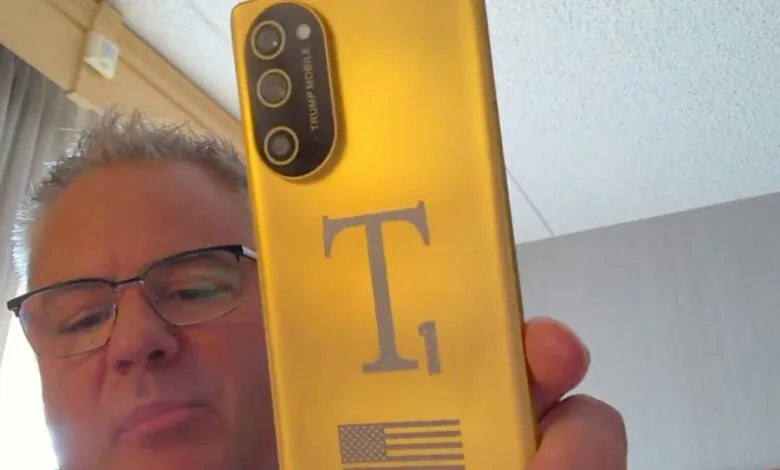
During an hour-long video call, executives Don Hendrickson and Eric Thomas displayed a near-final production model. The device shown is markedly different from the original mockups teased eight months ago. Gone is the iPhone-inspired camera triangle, replaced by three vertically arranged lenses housed in a black, oval-shaped module bearing the “Trump Mobile” name. Observant viewers will note the lenses are unevenly spaced. The phone also appears larger, featuring a curved “waterfall” display that seems closer to the originally promised 6.78-inch screen than the later-specified 6.25-inch version.
Under the hood, the T1 Phone is now slated to use a Qualcomm Snapdragon 7 series chipset, typically found in upper-midrange devices. It will include a substantial 5,000mAh battery, 512GB of internal storage, and support for microSD cards up to 1TB. Camera specifications have also been upgraded, with both the main rear sensor and the selfie camera reportedly using 50-megapixel components. The camera interface suggests the inclusion of an ultrawide lens and possibly a telephoto lens, features not previously listed.
Eric Thomas asserts the phone will compete with flagship models, claiming it will be “comparable to any phone that’s over $1,000.” This assertion invites scrutiny, as similar specifications can be found in other devices at significantly lower price points. The true value will depend on unconfirmed details like camera performance, waterproofing, and wireless charging capabilities.
To reflect these purported improvements, the price is increasing. Early customers who placed a $100 deposit will still pay the originally advertised total of $499, now termed an “introductory price.” Future buyers will pay more, with the executives confirming only that the cost will be “less than $1,000,” as the final price point is still being determined.
According to Hendrickson and Thomas, the extensive redesign is a direct response to the unexpected level of public interest. They decided to accelerate their long-term roadmap, skipping a planned entry-level model to deliver a more advanced device. This decision to re-spec the phone contributed to its six-month delay past the original launch window.
The executives state the phone has cleared FCC certification and is now awaiting final approval from T-Mobile, expected by mid-March. Following that, shipments to early buyers could begin, though no firm date was committed. Given the shifting timelines, from August/September 2025, to by year’s end, to the current vague “later this year”, any launch prediction should be viewed with healthy skepticism.
One key clarification involves manufacturing. The T1 Phone will not be “Made in the USA.” Instead, the handsets undergo what the company calls “final assembly” in Miami, a process described as more involved than simply applying a back cover, involving the assembly of approximately ten final components. The bulk of the phone is manufactured in an unspecified “favored nation,” a term seemingly chosen to indicate the work is not done in China. The executives acknowledge that early marketing materials erroneously claimed the phone was American-made, a claim they have since corrected. Achieving full US assembly remains a stated goal for future models, including a hinted-at “T1 Ultra.”
For now, the situation can be summarized as follows: the Trump phone exists in a tangible form, its specifications have been enhanced, and a launch appears to be on the horizon, albeit with several details still pending confirmation.
(Source: The Verge)