OpenAI’s New Mac App Supercharges AI Coding
▼ Summary
– AI is fundamentally changing software development by automating programming tasks through agentic systems where AI agents work independently.
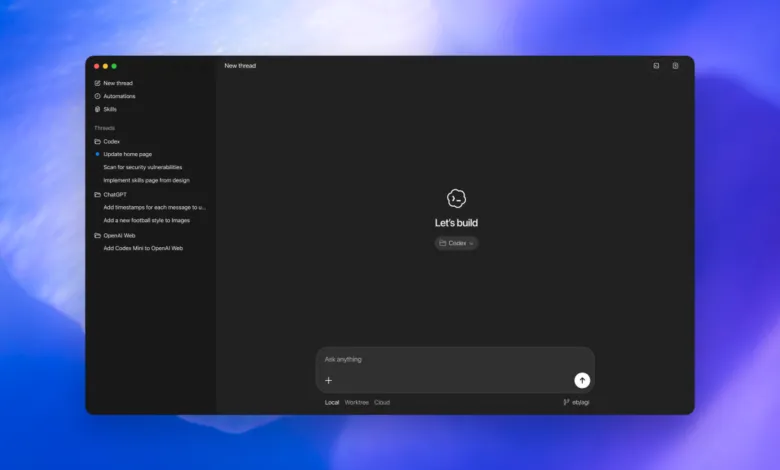
– OpenAI has launched a new MacOS app for its Codex tool, integrating popular agentic workflows to compete with rivals like Claude Code.
– The company’s new app leverages its GPT-5.2-Codex model, which it claims is the strongest for complex work, despite being previously harder to use.
– Benchmark results for coding AI models like GPT-5.2, Gemini 3, and Claude Opus are very close, showing no clear performance leader in practical tests.
– The Codex app introduces features like background automations and customizable agent personalities, with the core promise being a dramatic increase in development speed.
The landscape of software development is undergoing a profound transformation, driven by the integration of artificial intelligence into the coding workflow. OpenAI’s new MacOS application for its Codex platform represents a significant leap in this evolution, directly challenging competing agentic systems like Claude Code by bundling powerful AI capabilities into a streamlined desktop interface. This move aims to simplify access to the company’s most advanced coding model, GPT-5.2-Codex, within an environment designed for modern, multi-agent collaboration.
For developers, the shift toward agentic software, where AI can operate semi-independently on programming tasks, has been accelerating. OpenAI’s new app seeks to capture this trend by enabling parallel work across multiple AI agents, integrating specialized skills and sophisticated workflows directly into a Mac user’s environment. The launch follows closely on the heels of the GPT-5.2-Codex model, which the company positions as its most capable coding engine yet.
CEO Sam Altman emphasized the strategic importance of pairing raw model power with an intuitive interface. He noted that while GPT-5.2 stands out for complex, sophisticated work, its previous complexity posed a barrier. Embedding this high-level capability into a more flexible and user-friendly application could substantially lower that barrier, making advanced AI-assisted development accessible to a broader range of programmers.
However, the competitive picture is nuanced. Independent coding benchmarks present a mixed verdict. On TerminalBench, which evaluates performance on command-line programming tasks, GPT-5.2-Codex currently leads. Yet, agents powered by models like Gemini 3 and Claude Opus have posted scores that are statistically close. Similarly, results from SWE-bench, a test focused on fixing real-world software bugs, show no decisive leader. This highlights a key challenge: the user experience and effectiveness in practical, agentic scenarios can vary widely between models and are difficult to measure with standardized tests alone.
Beyond raw performance, the Codex app introduces practical features aimed at enhancing daily productivity. Users can configure automations to run on a scheduled basis in the background, with results queued for later review. A notable addition is the ability to select different agent personalities, allowing developers to tailor the AI’s interaction style, from strictly pragmatic to more empathetic, based on personal preference or the nature of the task at hand.
The ultimate promise, as framed by Altman, is a dramatic acceleration of the development process itself. The vision is one where a developer can start from nothing and, within hours, craft a sophisticated software application. The primary constraint shifts from technical execution to the speed of human creativity and ideation. This potential to radically compress development timelines sits at the heart of the value proposition for tools like the new Codex app, positioning AI not just as an assistant, but as a fundamental catalyst for software creation.
(Source: TechCrunch)