Witchfire’s Creative Director on Small Teams and Clair Obscur’s Brilliance
▼ Summary
– Adrian Chmielarz, co-founder of The Astronauts, began developing the dark fantasy RPG shooter Witchfire in 2017, and it is nearing its 1.0 release after selling over 500,000 copies in Early Access.
– The game’s success is attributed to its “Dark Souls with guns” concept, its striking photogrammetry-based visuals, and a small, talented, and egoless team that values open critique.
– Chmielarz believes a small team’s ideal size is not a specific number, but one where every member is recognized and mentally connected, which fosters efficient, passionate collaboration.
– He expresses fascination with how Clair Obscur: Expedition 33 achieved a AAA-like quality with a core team of about 30, half of whom were juniors, through smart design shortcuts like avoiding complex enemy animations.
– Witchfire incorporates extraction shooter elements, but Chmielarz is concerned the label is misleading, as the game is a hybrid of multiple genres and its extraction inspiration predates the genre’s popularity.
The journey of Witchfire, the dark fantasy RPG shooter from The Astronauts, began in 2017 and is now approaching its full release after a successful Early Access period. Creative director Adrian Chmielarz reflects on the game’s development, the philosophy behind small, passionate teams, and the surprising lessons learned from observing the creation of another standout title, Clair Obscur: Expedition 33. The discussion reveals a deep belief in talent-driven collaboration and the clever design choices that can make a game feel far larger than its team size might suggest.
Chmielarz traces the project’s origins to 2015, following the release of The Vanishing of Ethan Carter. The team initially explored a science-fiction survival simulator before their instincts pulled them toward a different vision. By mid-2017, a clear direction emerged. “We really like shooting demons in the head,” Chmielarz recalls. “Let’s do that, this is in our DNA.” This pivot set the stage for what would become a nine-year development cycle.
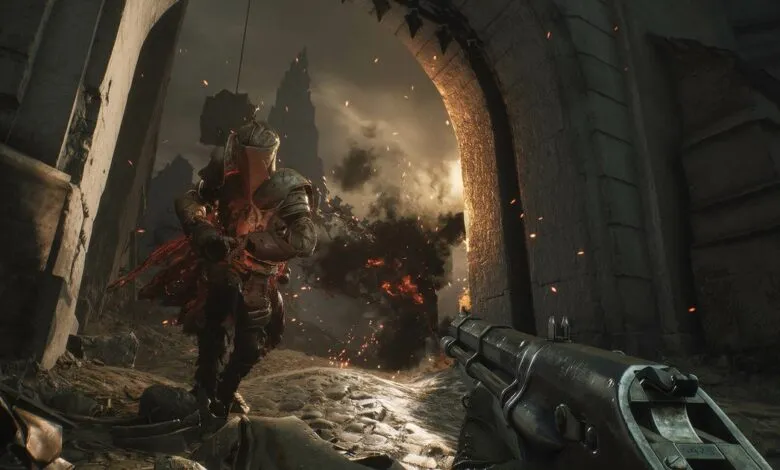
The game’s strong Early Access performance, with over 500,000 copies sold, stems from several factors. The compelling premise of a “Dark Souls with guns” concept resonated with a large audience. Visuals also played a crucial role, building on the studio’s expertise with photogrammetry, a technique they helped popularize. “Players come for the graphics, but stay for the gameplay,” Chmielarz notes, emphasizing that narrative elements will be further fleshed out for the 1.0 release.
Perhaps the most critical component, however, is the team itself. The Astronauts maintained a core group of around 12 people for most of Witchfire’s development, only expanding to about 26 in the last two years thanks to strong sales. Chmielarz champions the small-team dynamic, not for a specific headcount, but for the culture it fosters. “When you stop recognizing people, this is when you’ve grown too big,” he explains. This scale promotes an egoless environment where passionate, talented individuals can critique openly and iterate quickly, removing bureaucratic friction.
This philosophy was shaped by his earlier experiences on major titles like Bulletstorm and Gears of War: Judgment. “I only want to work with like-minded people: really passionate, really talented people,” he states. He references a Steve Jobs anecdote about building the original Macintosh team exclusively with “A” players, arguing that a small group of top-tier professionals can outperform a much larger group of amateurs. For Chmielarz, assembling a team of pure talent and passion is non-negotiable for effective, small-scale development.
However, the recent success of Clair Obscur: Expedition 33 has complicated this worldview. Developed by Sandfall Interactive with a core team of roughly 30, half of whom were newcomers to game development, the title achieves a startlingly high level of polish and scope. “My world view is ruined,” Chmielarz admits with a laugh, calling the project “the biggest mystery in gaming right now.” He is so intrigued that he has obtained and translated a two-hour French conference by the studio head to uncover their “secret.”
Upon analysis, he identifies not magic, but masterful design intelligence. The game is filled with smart shortcuts that conserve resources without diminishing the player’s experience. For instance, most enemies lack detailed, animatable faces, and many cinematic cutscenes are staged as simple “theatre plays” with characters talking in void spaces, avoiding the immense technical challenge of syncing animations with dynamic environments. “What was missing in AAA games,” he observes, “is finding shortcuts, rather than brute forcing with more people.”
He points out that the game’s design cleverly masks its constraints. Early levels are simpler and more corridor-like, while later areas become spectacular and multilayered, creating a natural sense of progression. This approach demonstrates that a deep understanding of game design can allow a relatively inexperienced team to produce a product that feels AAA through clever smoke and mirrors.
Technologically, Witchfire was built using a steadfast, “old school” approach with Unreal Engine 4. The team made a conscious decision not to modify the core engine, believing 99% of their vision was achievable with standard tools. They also decided against migrating to Unreal Engine 5 mid-development, as the switch would have introduced unnecessary risk and recalibration too close to release. Their signature use of photogrammetry, however, remains a cornerstone of the game’s distinctive visual style.
A final point of discussion is Witchfire’s incorporation of extraction-style elements, a popular genre feature. Chmielarz expresses concern that this label might create the wrong impression. The mechanics were inspired not by contemporary extraction shooters, but by the tense extraction sequence in Call of Duty 4: Modern Warfare‘s “All Ghillied Up” mission and the escalating chaos of Raiders of the Lost Ark‘s opening. He emphasizes that Witchfire is a hybrid, blending souls-like, Metroidvania, rogue-like, and extraction elements into what they simply call an “RPG shooter.” The worry is that being pigeonholed could mislead players about the game’s true, multifaceted nature.
(Source: Games Industry)