AI Is the Future of Retail: Here’s What I Saw
▼ Summary
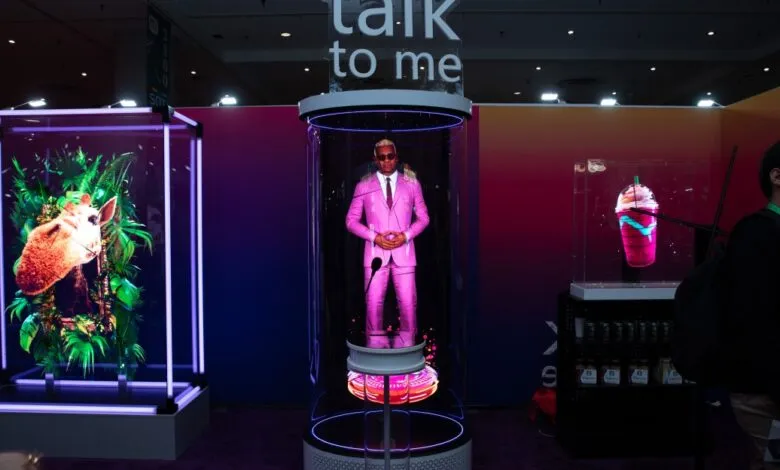
– “Mike” is a holographic AI brand ambassador at a retail trade show, designed to act as an icebreaker to lure customers into engaging with a brand.
– The dominant theme at the trade show was an AI-driven future for retail, with numerous companies promoting AI tools for customer analysis, ordering, and merchandising.
– AI is enabling hyper-personalized, in-store tracking that assigns shoppers IDs to monitor their movements and target ads, raising privacy concerns, especially in Western markets.
– In contrast to the AI focus, some companies like Equapack emphasize tangible, human-centered design for physical packaging, prioritizing reusability and customer experience over data extraction.
– The article questions whether many AI retail features, aimed at scale and data collection, actually improve the core product or customer experience, which simpler, tactile solutions might achieve.
Walking through the massive National Retail Federation trade show, the overwhelming sensation is one of digital intrusion. The future of shopping, as pitched by countless vendors, is a landscape saturated with artificial intelligence, often in forms that feel more like surveillance or gimmickry than genuine assistance. From holographic greeters to hyper-personalized in-store tracking, the focus is relentlessly on data extraction and automated engagement, raising the question of whether these innovations serve the customer or simply create new avenues for monetization.
One of the flashier exhibits featured “Mike,” a holographic man in a pink suit inside a clear tube, powered by ChatGPT. He fields questions with a slight delay, acting more as a branded icebreaker than a sophisticated concierge. Nearby, a gnome-like hologram recites rhymes, a deliberate choice by its creators to present a non-human character and perhaps soften anxieties about AI replacing jobs. These spectacles are entertaining, yet they underscore a shift toward digital intermediaries in spaces traditionally meant for human interaction.
Beyond the holograms, the promises were vast. Companies promoted “smart people counting,” “AI customer flow analysis,” and a new era of “merchandizing execution with AI.” The integration of AI into retail is accelerating at a breathtaking pace, moving from backend logistics to the very forefront of the customer experience. Pizza chain Papa Johns, for instance, demoed a chatbot that can not only recall your last order and apply coupons, but also suggest items based on a photo of your dining group, a feature of dubious necessity that exemplifies the drive to collect and utilize data at every turn.
This data-hungry approach extends to the physical store. A demonstration by Solum, a digital display company, showcased technology from startup SpaceVision. Cameras track shoppers, assigning them a demographic profile and monitoring their engagement with ads. The system can then trigger personalized promotions in real-time, like offering a beer deal to someone who looked at a chip advertisement. This creates a vast data dragnet of in-person shopping habits, translating the tracking precision of online retail into the physical world. A staffer acknowledged that while shoppers in South Korea and Japan have accepted such monitoring, those in Europe or the U.S. might be deeply uneasy.
Even the foundational practice of search engine optimization is evolving under AI’s influence, spawning a new lexicon of acronyms like AEO (Answer Engine Optimization) and GEO (Generative Engine Optimization). Firms now offer services to help brands monitor their visibility within AI chatbots like ChatGPT, a murky new frontier where the rules of discovery are largely unknown.
Amid this sea of screens and algorithms, one booth offered a stark contrast. Equapack, a packaging design company, presented a quiet space filled with tangible products: shopping bags, totes, and cooler bags for brands like Supreme and the US Open. There were no robots, holograms, or grand AI promises. Founder Eran Rothschild explained that their work starts with a physical problem a brand needs to solve, whether it’s insulation or aesthetic appeal.
“We’ll probably never use AI visualization because it’s not true to the product that we’re going to be delivering,” Rothschild noted. “We prefer making samples and making that tactility. No one’s going to purchase something that they can’t see.” His philosophy centers on the human at the end of the transaction, creating packaging that feels luxurious, is reusable, and enhances the perception of value. In a show dominated by abstract data and digital layers, Equapack’s offerings were a reminder of the physical and intentional artifacts that customers actually take home.
The relentless push for AI-driven scale often feels like added bulk, with little connection to improving the core product itself. While chatbots may someday streamline ordering, and dynamic shelves might offer targeted deals, these tools primarily serve the retailer’s bottom line by mining engagement. The humble, well-designed shopping bag, however, creates a lasting, tactile impression that no algorithm can replicate. In the race to define retail’s future, the most resonant innovations may still be those we can hold in our hands.
(Source: The Verge)