AMD Revives Ryzen AI & X3D CPUs for 2026 Laptops and Desktops
▼ Summary
– AMD’s Ryzen AI 400-series CPU announcements at CES are minor updates, not major new products.
– The new chips offer only slight improvements in CPU clock speeds, NPU performance, and supported RAM speeds over the Ryzen AI 300 series.
– Architecturally, the Ryzen AI 400 chips are identical to their predecessors, using the same Zen 5 cores, RDNA 3 GPU, and 4nm manufacturing process.
– This mirrors AMD’s past strategy of rebranding older chips with minimal upgrades, as seen with the Ryzen 8040-series.
– The practical takeaway is that consumers with Ryzen AI 300 systems are not missing significant performance gains.
The annual CES technology showcase often brings a wave of chip announcements, though their significance can vary widely. While some introductions feature genuinely new architectures, others serve primarily to refresh product lineups with minor updates. AMD’s latest Ryzen AI 400 and Ryzen 9000 X3D series announcements for 2026 hardware largely represent this second category, offering iterative improvements over their immediate predecessors rather than a fundamental redesign.
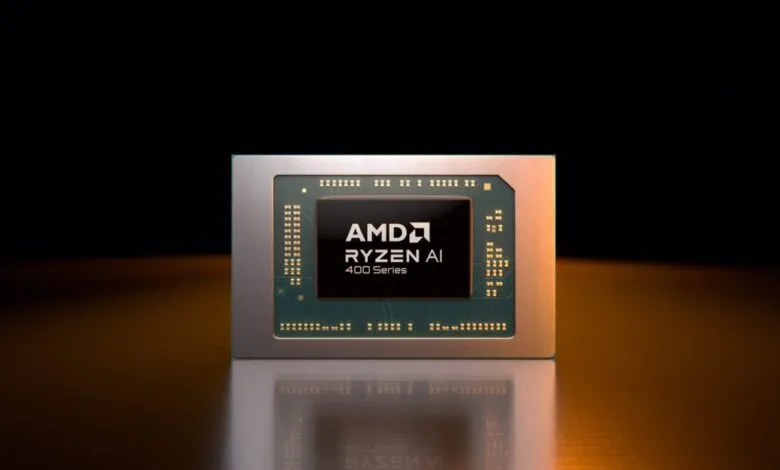
Focusing first on the mobile segment, the Ryzen AI 400 series stands as the official successor to the Ryzen AI 300 chips. The upgrades are best described as modest. For instance, the flagship Ryzen AI 9 HX 470 now reaches a peak boost clock of 5.2 GHz and supports LPDDR5x-8533 memory, a slight step up from the 5.1 GHz and LPDDR5x-8000 of the previous HX 370 model. Its integrated Neural Processing Unit (NPU) also sees a bump, now rated for 60 trillion operations per second (TOPS) compared to the prior 50 TOPS.
Beyond these incremental speed adjustments, the underlying architecture remains unchanged. These processors continue to utilize a hybrid core design blending high-performance Zen 5 cores with efficient Zen 5c cores. They also retain the same RDNA 3-based integrated graphics and are fabricated on TSMC’s 4 nm process. This strategy is not new for AMD; a similar refresh occurred with the transition from the Ryzen 7040 to the 8040-series laptop chips, where clock speeds received a minor uplift with little else altered. The practical takeaway is clear: consumers who find a discounted system with a Ryzen AI 300 chip are unlikely to miss out on meaningful performance by choosing it over a 400-series equivalent.
For desktop enthusiasts, AMD is reviving its popular 3D V-Cache technology with new Ryzen 9000 X3D processors slated for 2026. These chips are expected to build upon the standard Ryzen 9000 series, which itself is based on the Zen 5 architecture, by stacking a large pool of L3 cache directly on the processor die. This design is renowned for delivering substantial performance gains in latency-sensitive applications, particularly many video games. While specific models and cache sizes are yet to be detailed, the return of X3D signals AMD’s continued commitment to this performance niche for high-end desktop PCs.
In essence, these announcements serve to extend the lifecycle of AMD’s current architectures. The Ryzen AI 400 series provides a nominal refresh for the laptop market, while the promised Ryzen 9000 X3D chips aim to capture the premium desktop segment with a specialized feature. For most users, the performance delta between the new and immediately old chips will be minimal, making value and availability key purchasing factors.
(Source: Ars Technica)