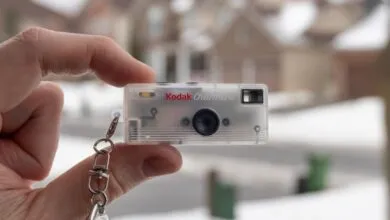
Big Lenses on a Tiny Camera: The Kodak Charmera Experiment

▼ Summary
– The Kodak Charmera, a retro-styled keychain camera sold in blind boxes, was a major holiday hit but has limited capabilities due to its small built-in lens.
– Camera modifier James Warner successfully modified a Charmera by replacing its original lens with a C-mount, which required careful disassembly and a custom spacer.
– The modification transforms the camera, allowing the use of plentiful and affordable C-mount lenses, though the small sensor creates a large crop factor.
– Warner states the modification is achievable for most people as it involves no electronics, with the main challenge being the careful removal of the glued-in original lens.
– Beyond the lens swap, Warner also optionally removed the camera’s IR filter, enabling infrared photography as demonstrated in some black-and-white images.
The Kodak Charmera keychain camera became an instant sensation, a retro-styled gadget that flew off shelves during the holiday season. Its initial charm, however, is somewhat limited by the basic plastic lens it comes with. This inspired camera modifier James Warner, known online as Snappiness, to perform a fascinating experiment: what happens when you equip this tiny toy with a serious, high-quality lens?
Warner secured a full set of the cameras shortly after their launch, just before they sold out completely. He recognized their immediate appeal, noting their cute design, surprising functionality, and position in the popular impulse-buy category. The trend toward retro-inspired products and the booming popularity of blind box packaging certainly contributed to its success, he observed.
Choosing the classic yellow model for his project, Warner set out to modify it. He was particularly drawn to this camera because, unlike other simple mods he’s done, the Charmera features a live view screen. This makes it the smallest camera with such a capability, allowing for manual focus when paired with a new lens, a feature that transforms its potential.
The modification process itself is accessible. Warner believes most determined DIY enthusiasts could successfully complete it, as it involves no complex electronics. The primary challenge is carefully removing the factory-glued lens from the sensor assembly without causing damage. With patience and a razor blade, this adhesive can be separated. The rest of the housing can be opened with a simple screwdriver.
Essential parts include a C-mount spacer ring to achieve the correct flange distance for new lenses. Warner 3D-printed his spacer, but creative alternatives using common hardware store items could work. The goal is to adjust the distance until the camera can achieve infinity focus with the new lens attached.
Once modified, the Charmera’s character changes entirely. Its small sensor creates a significant crop factor, meaning even a very wide lens behaves like a telephoto. Warner enjoyed using a 6mm f/1.4 lens, which provides a field of view similar to a standard 50mm lens. The world of affordable and plentiful C-mount lenses opens up, offering everything from vintage cinema glass to modern options, all adaptable to this pocket-sized body.
As an optional step, Warner also removed the camera’s internal infrared filter, which allows for unique black-and-white infrared photography, showcasing another layer of creative possibility. This project demonstrates how a little ingenuity can unlock hidden potential in even the most modest gadgets, blending vintage lens aesthetics with modern digital convenience.
(Source: PetaPixel)