Study Reveals AI Image Generators Use Only 12 Default Styles
▼ Summary
– Researchers conducted a “visual telephone” experiment where an AI image generator and a description model repeatedly processed and recreated an image over 100 rounds.
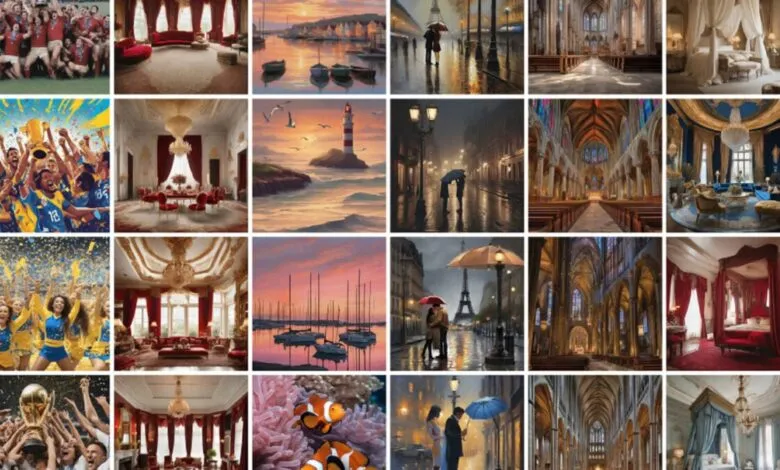
– The original image was quickly lost, and the sequences consistently converged into a limited set of about 12 generic visual styles, such as maritime lighthouses or urban night scenes.
– This convergence to common “visual elevator music” occurred whether the stylistic shift was gradual or sudden, and persisted even when using different AI models.
– The study suggests AI image generators lack true creativity, defaulting to a narrow range of styles regardless of the original prompt, unlike human interpretation which introduces variance.
– The findings imply that AI models, trained on human-created data, excel at copying prevalent styles but struggle with developing unique artistic taste.
The remarkable ability of artificial intelligence to generate images often masks a surprising limitation: a tendency to converge on a narrow set of generic visual styles. While these systems are trained on vast datasets of human-created art and photography, new research suggests their creative range is far more constrained than it appears. A study published in the journal Patterns reveals that when pushed through iterative cycles, AI image generators default to just 12 dominant visual motifs, raising questions about the true nature of machine creativity.
Researchers conducted an experiment akin to a game of visual telephone. They started with a detailed prompt, such as a scene involving an old book in a forgotten language, and used the model Stable Diffusion XL to create an image. This image was then shown to a separate AI, LLaVA, which generated a text description of what it saw. That new description was fed back to Stable Diffusion to produce another image, and the cycle repeated for one hundred rounds.
As one might expect, the original concept was quickly lost in translation, much like in the human version of the game. The unexpected finding was not the drift itself, but the predictable destination. Across one thousand different sequences, the vast majority of image chains eventually settled into one of just a dozen repetitive styles. The transition was usually gradual, though sometimes abrupt, but the convergence was nearly inevitable. The researchers critically described these common outputs as “visual elevator music”, the bland, inoffensive imagery one might find decorating a hotel room.
The most frequently recurring motifs included scenes like maritime lighthouses, formal interior spaces, urban nightscapes, and rustic architecture. Even when the scientists swapped in different AI models for the generation or description tasks, the same trend emerged. Extending the game to a thousand turns showed that styles solidified around the one-hundredth iteration, with later variations merely spinning out minor changes within the same limited aesthetic categories.
This phenomenon highlights a fundamental difference between human and artificial creativity. In a human game of telephone, extreme variance occurs because each person interprets and relays information through a unique lens of personal experience and bias. AI systems have the opposite constraint. No matter how imaginative the original prompt, the model’s architecture and training data funnel it toward a narrow selection of pre-learned styles. The technology excels at remixing and replicating established patterns but struggles to forge genuinely novel aesthetic paths.
The findings suggest that while AI can mimic style with impressive fidelity, cultivating genuine artistic taste or breaking new ground remains a profoundly human challenge. The models are, after all, learning from a dataset of human creations, which may itself be biased toward certain popular or easily categorized visuals. The core lesson may be that for all their computational power, these systems are currently better at copying conventions than they are at understanding the nuanced principles of original artistic expression.
(Source: Gizmodo)