How SpaceX’s Historic Rocket Landing Revolutionized Launches
▼ Summary
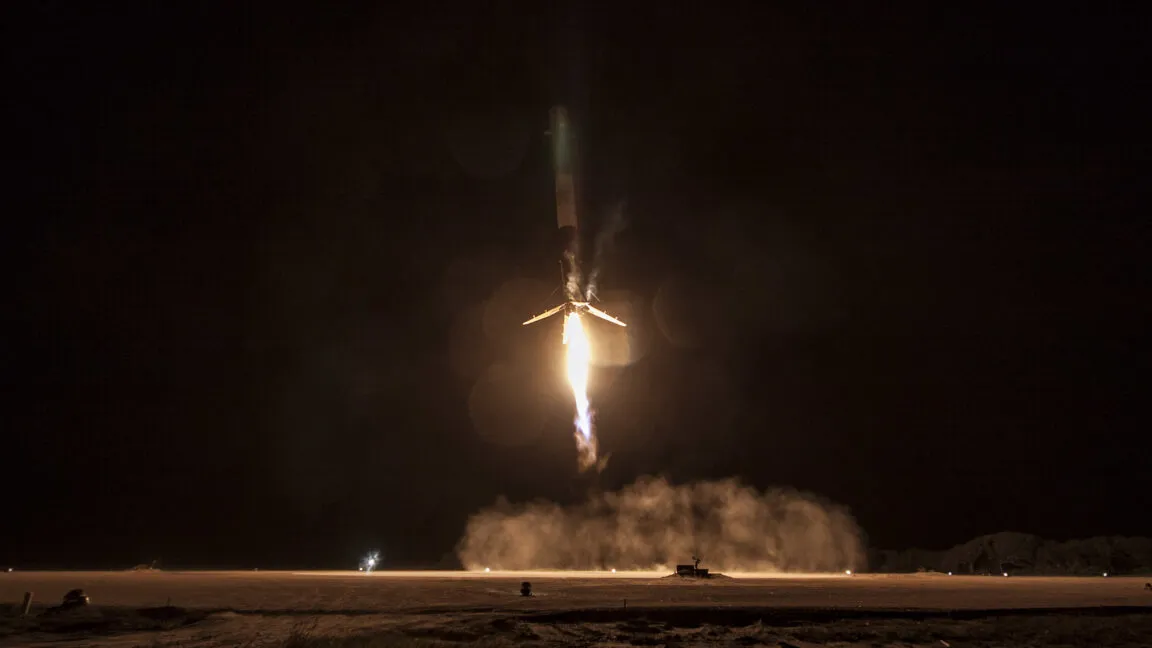
– SpaceX successfully landed the first stage of its Falcon 9 rocket for the first time on December 21, 2015, during the Orbcomm-2 mission.
– The 2024 book *Reentry* by Eric Berger provides the inside story of this landing, which Ars Technica is republishing for its tenth anniversary.
– The chapter begins with the June 2015 failure of the CRS-7 mission, where a Falcon 9 rocket disintegrated in flight, marking its first in-flight loss.
– After the breakup, engineer David Giger confirmed the Dragon spacecraft survived and was transmitting data, having separated from the rocket.
– Despite frantic efforts by controllers to command Dragon to deploy its parachutes, the spacecraft ultimately crashed into the Atlantic Ocean with its cargo.
The historic landing of a SpaceX Falcon 9 rocket in December 2015 fundamentally reshaped the economics and ambition of spaceflight, proving that orbital-class boosters could be recovered and reused. This breakthrough moment, however, was preceded by a dramatic and devastating failure just months earlier, a stark reminder of the immense challenges inherent in rocketry. The inside story of these pivotal events reveals a company under intense pressure, balancing grief with an unwavering drive to achieve what many considered impossible.
In June 2015, a Falcon 9 rocket disintegrating over the Atlantic Ocean marked the program’s first in-flight loss. The vehicle was carrying a Dragon spacecraft loaded with cargo for NASA’s International Space Station, a mission designated CRS-7. From the mission control center in Hawthorne, California, David Giger watched the catastrophic feed. As the senior manager for the entire Dragon program, he provided a leadership presence for a team of mostly younger engineers who had not experienced such a failure before. Many veterans of Dragon’s early, turbulent test flights had since moved to other roles or left SpaceX entirely.
Seconds after the breakup, Giger shouted into his headset, “Dragon is alive!” His experience with the three prior failures of the smaller Falcon 1 rocket had hardened him to setbacks. While his colleagues assumed the mission was completely lost, Giger noticed something critical: the Dragon capsule was still transmitting data. It had successfully separated from the disintegrating rocket and was now in a ballistic arc, flying alone roughly thirty miles above the ocean.
A desperate race against time ensued. The team’s only hope to salvage anything from the mission was to command the capsule to deploy its parachutes before it impacted the water. This was an unplanned contingency; SpaceX had not designed the system to send commands to Dragon while it was still attached to the Falcon 9 during ascent. In an emergency, however, ground controllers could communicate with the spacecraft using terrestrial antennas. Engineers in California worked frantically to configure this backup link and send the command to release the two small drogue parachutes, which stabilize the vehicle before the three main chutes open.
The command was successfully transmitted. Everyone waited. Nothing happened. Dragon continued its silent, deadly dive toward the Atlantic.
For nearly two minutes after the rocket’s destruction, the resilient spacecraft continued to stream data home. Then, less than a mile above the ocean’s surface and below the horizon from tracking stations, the signal vanished. The Dragon capsule and its four thousand pounds of precious cargo for the space station were gone, swallowed by the sea. The failure was a profound blow, but the data from Dragon’s final moments would inform crucial design changes. More importantly, the relentless focus on the next objective, landing a rocket, never wavered, setting the stage for the history-making success just six months later.
(Source: Ars Technica)